Bigger email lists don't automatically create bigger pipelines. In B2B outbound, a large spreadsheet can be a liability if the contacts are poorly matched, outdated, unauthenticated, or impossible for sales to act on. The practical question isn't how many records a provider can deliver. It's whether the provider can maintain a clean, relevant prospect database and help your messages reach the right inboxes.
That makes email list building services less like a data purchase and more like an operating system for outbound. The work includes ideal customer profiling, sourcing, enrichment, verification, authentication, segmentation, campaign feedback, and regular maintenance. Skip one of those layers and volume quickly becomes noise.
Why Most Email List Building Efforts Fail
The most common buying mistake is treating list building as a one-time procurement task. A provider sends a spreadsheet, the client uploads it into an outreach platform, and everyone expects the campaign to perform. That workflow ignores the conditions that determine whether a prospect ever sees the message.
In a 2026 benchmark, fully authenticated sending domains using SPF, DKIM, and DMARC reached an 89.1% inbox placement rate, while domains without full DMARC authentication reached 44.2%, a 45 percentage-point gap (Digital Applied's 2026 email marketing data). The point isn't that authentication rescues bad targeting. It's that good targeting can't compensate for weak infrastructure.
Practical rule: A contact record has no commercial value if your sending system can't reliably deliver to it.
List size is a weak success metric
Raw volume hides several problems:
- Poor fit: A contact may match an industry filter but lack buying authority, budget ownership, or a relevant business need.
- Stale records: People change jobs, companies change tools, and addresses stop working.
- Low signal density: A list built only from title and industry data gives a salesperson little reason to personalize the outreach.
- Operational waste: Sales teams spend time sorting irrelevant replies instead of handling qualified conversations.
The same 2026 source reported that 45% of email addresses become inactive within 12 months and that average annual list churn is 22.5% (Digital Applied's benchmark). A list can be accurate on delivery day and still degrade quickly. Professional providers therefore need a refresh process, not just an acquisition process.
Deliverability belongs inside the service
A competent engagement connects data decisions to sender reputation. That means checking whether the contact is appropriate for the campaign, verifying the address, removing risky records, monitoring bounce and complaint signals, and adjusting future sourcing based on campaign feedback.
For a practical technical reference, review these email deliverability best practices before evaluating a vendor. The strongest providers discuss authentication, segmentation, verification cadence, and reply handling in the same conversation. Providers that focus only on the number of contacts usually leave the most expensive work to the client.
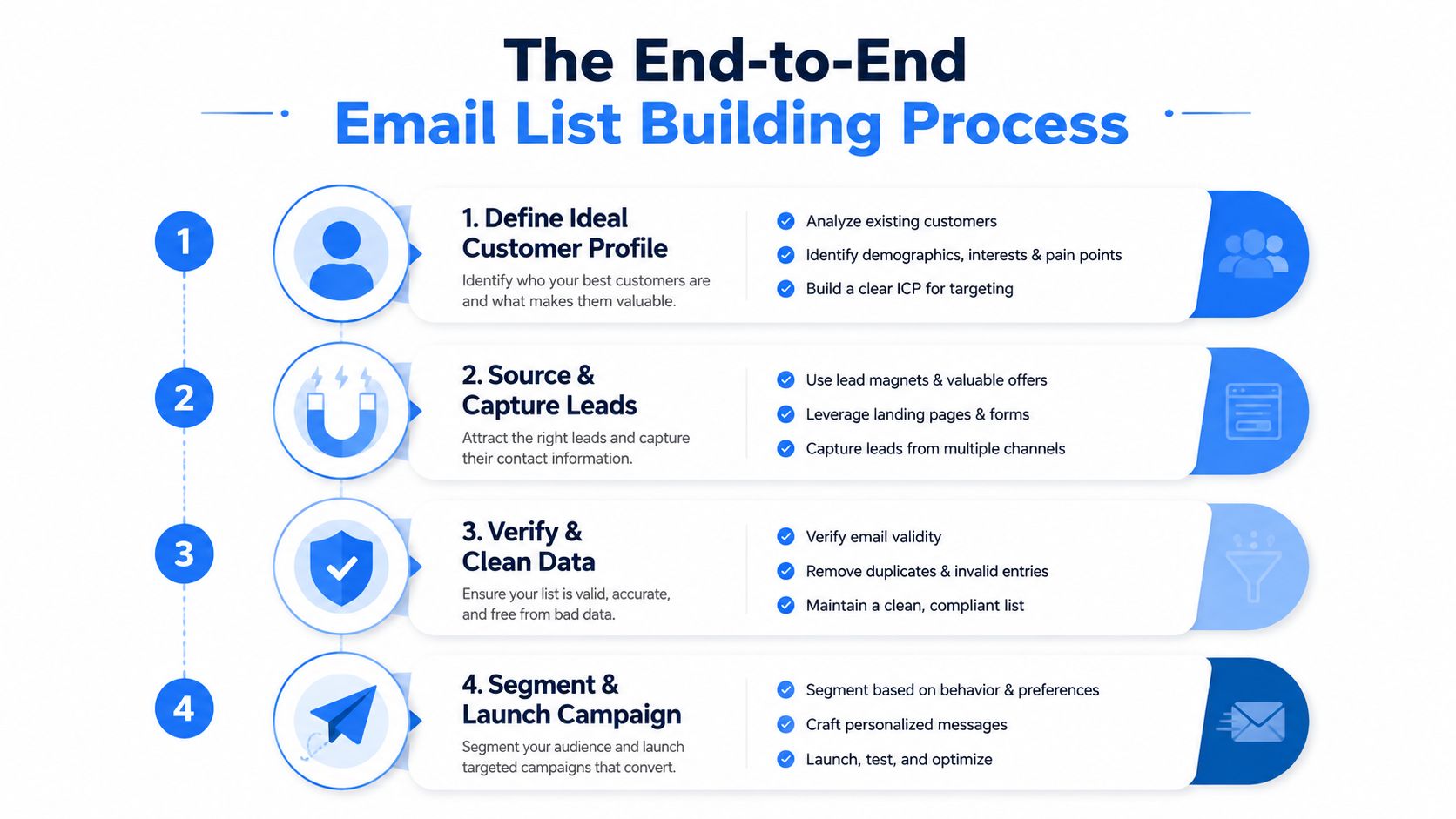
The End-to-End Email List Building Process
List size is a weak operating metric. A reliable workflow produces records that fit the buying motion, carry enough context for relevant outreach, and remain usable after launch. The provider should define the audience, evidence requirements, and maintenance rules before collecting addresses.
1. Define the ideal customer profile
The ICP should cover more than company size and sector. Specify geography, business model, role seniority, likely pain points, relevant technology, buying context, and exclusion rules.
A SaaS campaign might target companies using a particular tech stack and reach the person responsible for revenue operations. A manufacturer may need procurement, operations, engineering, or ownership contacts, depending on the product and buying committee. These distinctions shape the research sources, qualification rules, and message.
Set the qualified-record standard before research begins. A name and email address do not establish fit when the account misses the target criteria or the role has no connection to the proposed solution.
2. Source and capture leads
Each source provides different evidence. LinkedIn Sales Navigator helps identify roles, company relationships, and account characteristics. Google Maps can surface local operators and physical businesses that conventional B2B databases overlook. Targeted websites add context from service pages, technology pages, partner directories, and team pages. National business registries can supply formal company details in markets where those records are accessible.
Match the source to the buying motion. A local service provider may need geographic research, while a software vendor may need technology and organizational signals. One database applied to every campaign tends to flatten those differences and produce generic targeting.
3. Enrich and verify the records
Enrichment gives a record enough context for useful prioritization. Tools such as Clay, combined with custom scraping and manual review, can connect company attributes, roles, technologies, locations, and relevant business signals.
Verification is a filtering decision. The workflow should test address deliverability, identify role-based addresses and catch-all domains, remove duplicates and missing fields, and flag contacts that no longer match the ICP. Set a review status for uncertain records instead of passing every result directly to the sending platform.
4. Segment and launch
Segment the final database by variables that change the message, including tech stack, role, geography, company type, and competitive context. A finance leader and a technical evaluator may work at the same account, yet their priorities and objections differ.
Before launch, connect the list to the campaign objective, sending infrastructure, copy, reply routing, and suppression rules. Use engagement feedback to judge whether the message and audience are aligned. Teams assessing newsletter content and inbox performance can consult this survey embed deliverability guide, particularly when they need a clearer feedback loop.
Launch is a checkpoint, not the end of the operating cycle. Replies, bounces, unsubscribes, complaints, and sales feedback should update suppression rules, sourcing criteria, and segmentation. A provider that cannot explain this maintenance loop is delivering a file, not a working list-building system.
Technical and Legal Safeguards That Protect Your Domain
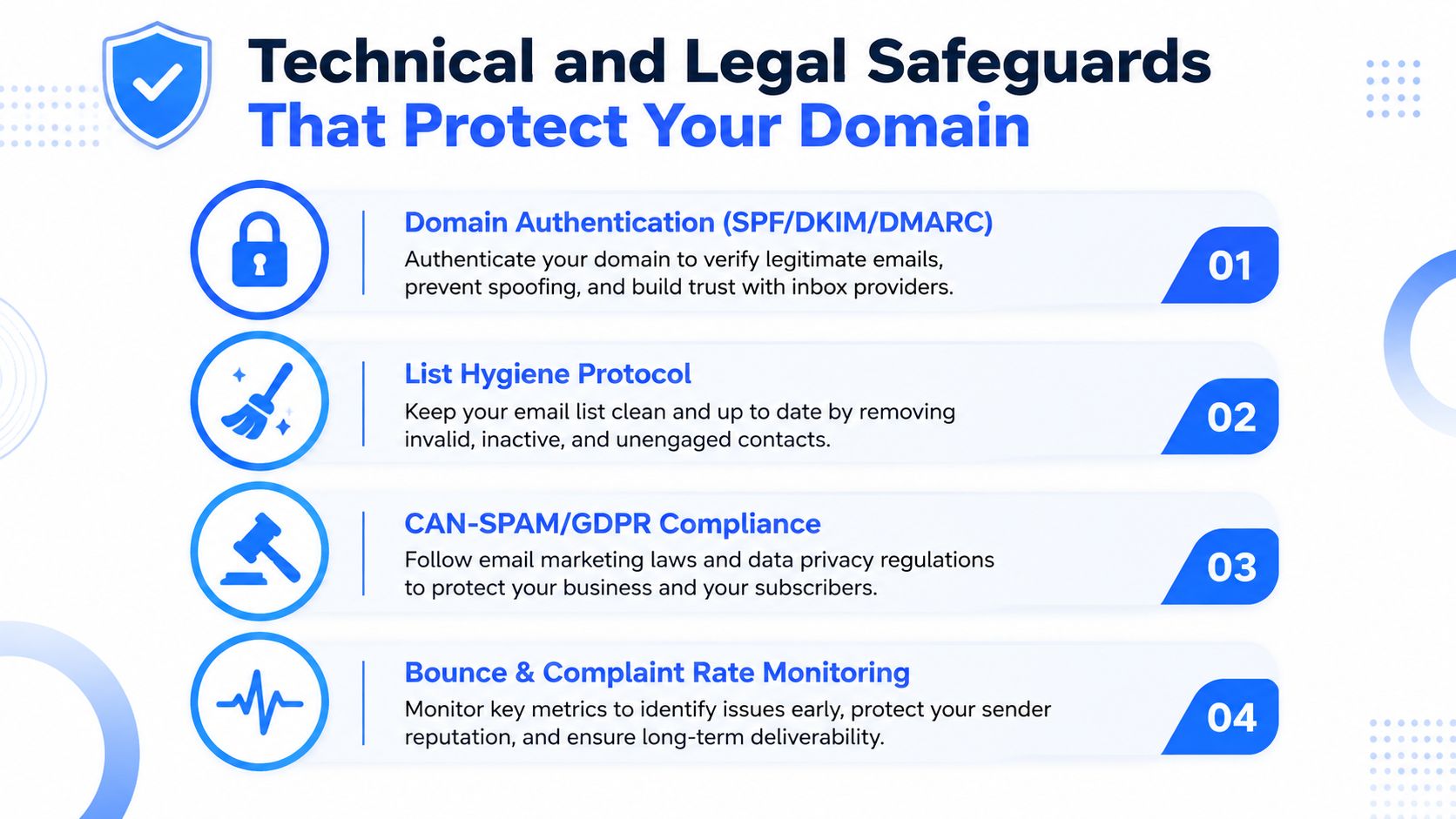
A large prospect database cannot compensate for weak sending infrastructure. Email list building services must protect both the contact data and the domain used to reach it. Clean records paired with poor authentication, weak suppression rules, or careless sending practices can still create operational risk.
Authentication and inbox infrastructure
SPF, DKIM, and DMARC provide the technical foundation for authenticated email. Receiving systems use them to assess whether messages are authorized and whether the sender's identity aligns with the domain. Fully authenticated domains generally perform better than domains without complete DMARC authentication, so configure these protocols before scaling campaigns.
Ask how the provider creates and manages inboxes, separates sending activity, monitors reputation, and handles warm-up. A gradual email domain warm-up process supports a controlled ramp. It does not replace relevant targeting, accurate data, or permission-aware outreach.
Hygiene thresholds and monitoring
Set stopping rules before sending. Deliverability guidance recommends keeping hard bounces below 2% and maintaining inbox placement around 95% or higher for stronger sending programs (Validity's State of Deliverability Report). Treat these figures as operating benchmarks, not guarantees. Results vary with audience quality, message relevance, infrastructure, and sending history.
Monitoring should cover:
- Hard bounces: Remove invalid addresses and investigate sudden increases before continuing a campaign.
- Spam complaints: Complaint rates above 0.3% can indicate targeting or list problems (ColdBox's cold email prospecting guidance).
- Catch-all contacts: Hold them for review until engagement and sender reputation justify continued use.
- Role-based addresses: Check generic inboxes because they may lack a clear individual owner.
- Suppression records: Exclude unsubscribes, prior complaints, and disqualified accounts from future sends.
Legal and regional controls
Technical delivery does not establish legal permission. The provider should explain how it handles applicable requirements under GDPR, CAN-SPAM, and other local rules. Confirm the lawful basis where relevant, clear identification, accurate sender information, unsubscribe handling, data minimization, and retention practices.
Localization affects data handling and campaign decisions, not only copy translation. EU outreach may require different controls from campaigns aimed at other markets. Clients should know where each record came from, why the contact fits the campaign, and how removal requests are recorded.
List hygiene continues after launch. Re-verify records on a defined schedule, with more frequent review for active, high-volume segments. The right cadence depends on usage, source quality, and observed decay. A provider that cannot explain who owns these checks, what triggers suppression, and how findings feed back into sourcing is delivering a file, not a maintained list-building system.
Pricing Models and What They Reveal About Quality
The pricing structure often tells you what the provider considers valuable. A cost-per-contact proposal rewards production. A retainer can support research, maintenance, and iteration. A performance model may align incentives with qualified outcomes, but only if the contract defines quality clearly.
| Pricing Model | How It Works | Best For | Key Risk |
|---|---|---|---|
| Per-lead | You pay for each delivered contact or qualified record. | Buyers with clear data requirements and internal campaign capacity. | The provider may prioritize volume over fit or freshness. |
| Monthly retainer | You pay for an ongoing research, enrichment, and campaign operation. | Teams that need continuous maintenance and optimization. | You may pay for activity without a clear connection to pipeline. |
| Performance-based | Fees depend on agreed outcomes such as qualified meetings or opportunities. | Buyers with a defined ICP, offer, and sales follow-up process. | Poor qualification rules can create disputes over attribution and quality. |
| Hybrid | A base fee covers infrastructure and operations, with an outcome-linked component. | Organizations that want accountability without transferring every variable to the provider. | The scope can become unclear if setup, data, and campaign fees aren't separated. |
A low per-lead price can look attractive until you account for enrichment, verification, infrastructure, inbox management, and sales review. If those tasks remain with your team, the quoted price isn't the total cost of the program.
Questions to ask about the quote
Request a clear answer to each of these:
- What is included: Does the fee cover research, enrichment, verification, segmentation, copy, campaign management, and reply handling?
- What stays current: How often are older segments reviewed, and what triggers re-verification?
- What counts as qualified: Is qualification based on company fit, role, stated interest, meeting acceptance, or another agreed condition?
- Who owns the infrastructure: Are domains, inboxes, accounts, and data exportable if the engagement ends?
- What happens when performance drops: Does the provider pause, clean, retarget, rewrite, or continue sending?
A credible proposal makes trade-offs visible. It won't promise that more contacts automatically produce more revenue. It will explain how targeting precision, operational effort, and campaign feedback affect the price.
Real Results Across SaaS, Ecommerce, and Manufacturing
Industry examples are useful only when they show the targeting logic behind the outcome. The verified material for this guide doesn't provide comparable, citable performance results for SaaS, ecommerce, or manufacturing campaigns, so responsible evaluation should focus on campaign design and measurement rather than invented case-study numbers.

SaaS requires account and role precision
A SaaS provider may start with accounts that use a relevant technology, operate in a defined market, or show a business condition connected to the offer. The list then separates economic buyers, technical evaluators, operational users, and potential champions.
The message should reflect the role. A revenue leader may care about forecasting or pipeline visibility. An operations contact may care about workflow and integration. A technical stakeholder may need evidence about implementation. Sending one generic sequence to all three wastes the signal created during research.
Ecommerce and fintech depend on merchant context
A platform selling to merchants may segment by store model, payment environment, product category, region, or operational complexity. Public business pages, maps, technology signals, and company websites can reveal useful context, but the provider should document how each signal supports inclusion.
A merchant list without a clear commercial reason for outreach is still a broad list. The better approach is to identify a specific trigger, connect it to the buyer's role, and suppress accounts that don't meet the campaign's qualification rules.
Manufacturing involves buying committees
Manufacturing outreach often requires more than finding a single executive. Procurement, engineering, operations, quality, and ownership can all influence a purchase. A strong database records the relationship between the company, the plant or facility, the relevant function, and the likely business problem.
The sales team should feed back which roles engage, which accounts are unsuitable, and which objections appear repeatedly. That feedback improves the next research cycle. The same underlying service can support all three industries, but the required data structure, qualification logic, and follow-up process are different.
Current outbound guidance also points toward smaller, better-targeted campaigns, using AI-assisted personalization, intent signals, account-based sequencing, and multichannel follow-up rather than relying on sheer sending volume (SalesHive's 2025 outbound strategies). That direction fits all three sectors, although the signals themselves must be industry-specific.
How to Vet an Email List Building Provider
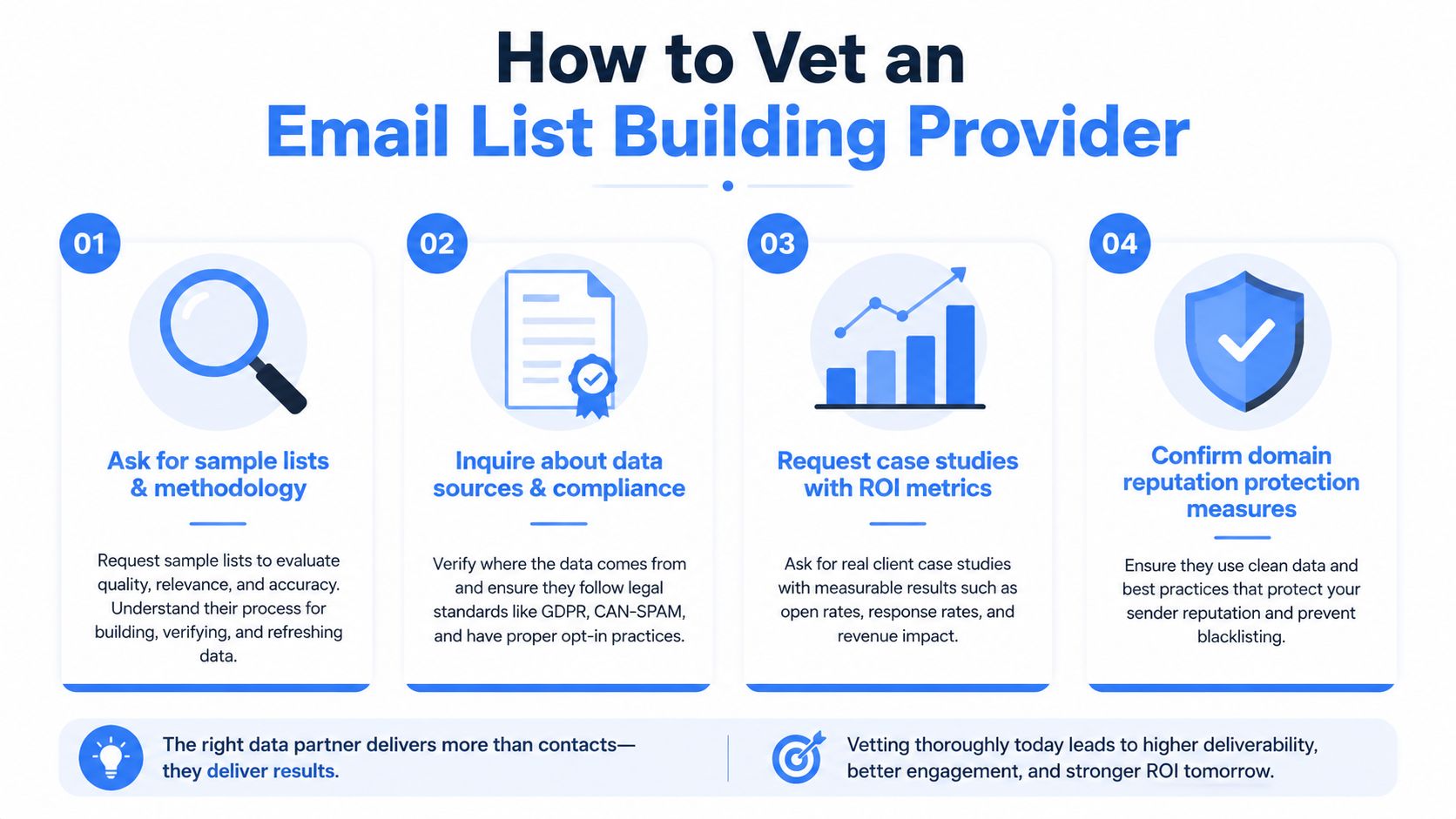
A serious operator should demonstrate methodology first. They should explain where records come from, how the ICP becomes a search method, which fields are enriched, and what happens after a campaign produces poor engagement. The provider's maintenance process matters as much as its initial research.
Ask for methodology, not just samples
A sample list shows formatting, but it cannot prove consistent quality. Ask the provider to annotate several records and explain why each account, role, and address passed its qualification process.
Ask these questions:
- Which sources are used: Can the provider distinguish LinkedIn Sales Navigator, Google Maps, targeted websites, registries, and third-party databases?
- How enrichment works: Does the team use Clay, custom scraping, manual research, or a combination?
- What gets excluded: Are duplicates, role-based addresses, catch-alls, former employees, and poor-fit accounts removed?
- How freshness is managed: What is the re-verification cadence for active and older segments?
Test infrastructure knowledge
Request a plain-language explanation of SPF, DKIM, DMARC, inbox creation, warm-up, bounce monitoring, and complaint monitoring. You do not need sensitive configuration details, but someone must own sender reputation and monitor the signals that affect delivery.
The provider should also explain how it handles unsubscribe requests, suppression lists, regional compliance, and data removal. Vague answers create operational risk for your domain and sales team.
Evaluate proof without accepting vanity metrics
Ask for case studies that define the ICP, channel mix, qualification standard, sales handoff, and measurement method. A high reply count means little if responses are irrelevant, while a large list can conceal poor fit. Look for evidence connecting research quality to pipeline contribution, rather than delivery activity alone.
Your customer-facing details also need clear ownership. Consistent sender identity reduces confusion during outreach, so teams may benefit from documented processes to manage team email signatures across sales and follow-up staff.
Confirm accountability
Before signing, clarify who reviews replies, books meetings, owns the data, and responds when a segment underperforms. Ask whether the provider pauses sending when bounce or complaint thresholds rise, then reworks the audience instead of sending more messages through the same problem.
Lead Printer combines infrastructure setup, prospect research, Clay-based enrichment, personalized messaging, multichannel outreach, qualification, and calendar handoff. Evaluate that integrated scope against your requirements, including its ongoing hygiene and deliverability controls, rather than comparing contact volume alone.
Integrating List Building Into Your Sales Workflow
A list becomes commercially useful only when its handoff into sales is explicit. Define qualification criteria, excluded accounts, reply routing, and the response time for positive interest before outreach begins. Assign ownership for list hygiene as well, because outdated titles, changed roles, and unresolved opt-outs can undermine an otherwise well-run campaign.
Store the reasoning behind each CRM record. Useful fields include target segment, source, role, account context, verification status, campaign, reply classification, and next action. Without that context, sales sees a name and address but loses the research that made the contact worth pursuing.
Build a closed feedback loop
Sales should classify replies in terms the research team can act on: positive interest, timing issue, wrong person, poor fit, unsubscribe, objection, referral, or no response. These categories show whether the weakness sits in the audience, offer, message, or follow-up.
The CRM and sales engagement platform should control suppression automatically. An unsubscribe, customer conversion, active opportunity, or disqualification must stop future outreach. Manual cleanup cannot reliably manage a database that changes every day.
Connect email with other touchpoints
Coordinate email with LinkedIn messages, account research, webinar invitations, or other permitted touchpoints when they fit the audience. Multichannel sequencing works when each interaction adds context that the prior touchpoint did not cover. Repeating identical copy across channels reduces relevance and can create an inconsistent buyer experience.
Copy still needs to turn research into a credible reason to respond. Teams building that layer can use this guide to understand what email copywriting involves, then test messages against reply categories instead of surface engagement alone.
Track qualified replies, accepted meetings, opportunities, pipeline contribution, disqualification reasons, bounce signals, and sales follow-up speed. Feed those outcomes back into sourcing, segmentation, list hygiene, and authentication decisions. Signal density and deliverability controls matter more than contact volume alone.
Lead Printer runs B2B outbound programs across email and LinkedIn, including authenticated infrastructure, prospect research, Clay-based enrichment, personalized sequences, qualification, and calendar handoff. Teams needing a maintained prospect database can visit Lead Printer to discuss an ICP, deliverability requirements, and sales workflow.