You're staring at two browser tabs, two annual plans, and a client pipeline that can't afford a bad infrastructure decision. Instantly looks easier to launch. Smartlead looks more configurable. Both promise warmup, mailbox rotation, sequencing, and scale, so the feature pages don't make the choice any clearer.
The practical answer is that Instantly versus Smartlead is an operating-model decision, not a checklist contest. Instantly favors shared-network simplicity and an integrated growth workflow. Smartlead favors deeper infrastructure control for operators managing many mailboxes, domains, clients, and sending patterns.
| Decision area | Instantly | Smartlead |
|---|---|---|
| Core operating model | Simpler scaling with built-in infrastructure | Agency-scale control and sending infrastructure |
| Best fit | Solo founders, small teams, lean outbound programs | Agencies, SDR teams, multi-client operators |
| Deliverability posture | Automated warmup and broader shared network | More granular mailbox, domain, and ESP controls |
| Prospecting model | Built-in lead database and integrated workflow | More data-light, stronger for external data pipelines |
| High-volume agency economics | Accessible at lower and moderate volume | Often stronger at larger sending volumes |
| Public review footprint | Larger, reflecting earlier market entry | Smaller, reflecting a later launch |
| Main trade-off | Less infrastructure-level control | More operational complexity |
The four questions that matter are straightforward: what deliverability control do you need, how complex are your sequences, how many client environments will you govern, and what will the complete monthly stack cost? A platform that works well for a small founder can become an administrative burden across a large agency book. The reverse is also true. A control-heavy system can waste time when a team only needs to launch clean campaigns quickly.
These are the working notes I'd give a new VP of outbound before approving recurring spend. The right choice depends less on which interface looks better and more on whether your team wants shared-network simplicity or deep infrastructure control.
The Outbound Platform Decision Every Agency Faces
The decision usually arrives after a client signs, not before. You need to connect sending accounts, import a list, build a sequence, assign responsibility, and explain to someone else why one platform deserves a permanent line in the budget. At that point, “which tool has more features?” is the wrong question.
The better question is, who will operate the system every day? A solo consultant may value a clean launch path, built-in prospecting, and fewer integrations. An agency operator may care more about account isolation, sender governance, diagnostics, permissions, and the ability to reproduce the same setup across client environments.
The same platform behaves differently at different volume
At a modest campaign size, the main cost is usually operator attention. A simple platform can win because it removes setup decisions. Your team connects accounts, loads prospects, writes a sequence, and monitors replies without building a separate infrastructure layer.
As sending expands, the cost shifts. You're no longer managing one campaign. You're managing mailbox health, domain segmentation, client reporting, suppression rules, failed connections, data quality, and billing allocation. A platform that hides complexity early may leave you with fewer controls when that complexity becomes operationally important.
Practical rule: Choose the system your team can govern under pressure, not the one that looks fastest during a trial.
The wrong choice compounds across client work in several ways:
- Workflow duplication: Every client needs a repeatable onboarding process, not a custom workaround.
- Reputation exposure: One poorly managed campaign can create problems for the sending environment around it.
- Reporting friction: Client-facing teams need clear ownership of leads, replies, and campaign status.
- Margin pressure: A low subscription price can become irrelevant once data, verification, support, and manual administration are added.
That's why the comparison needs to resolve four pivots. Deliverability tells you how much control the team needs. Automation shows whether campaigns can reflect the buyer journey. Multi-client scale determines whether the workspace remains manageable. True monthly cost reveals whether the platform still fits the agency's margin after the rest of the stack is included.
What Instantly and Smartlead Actually Are in 2026
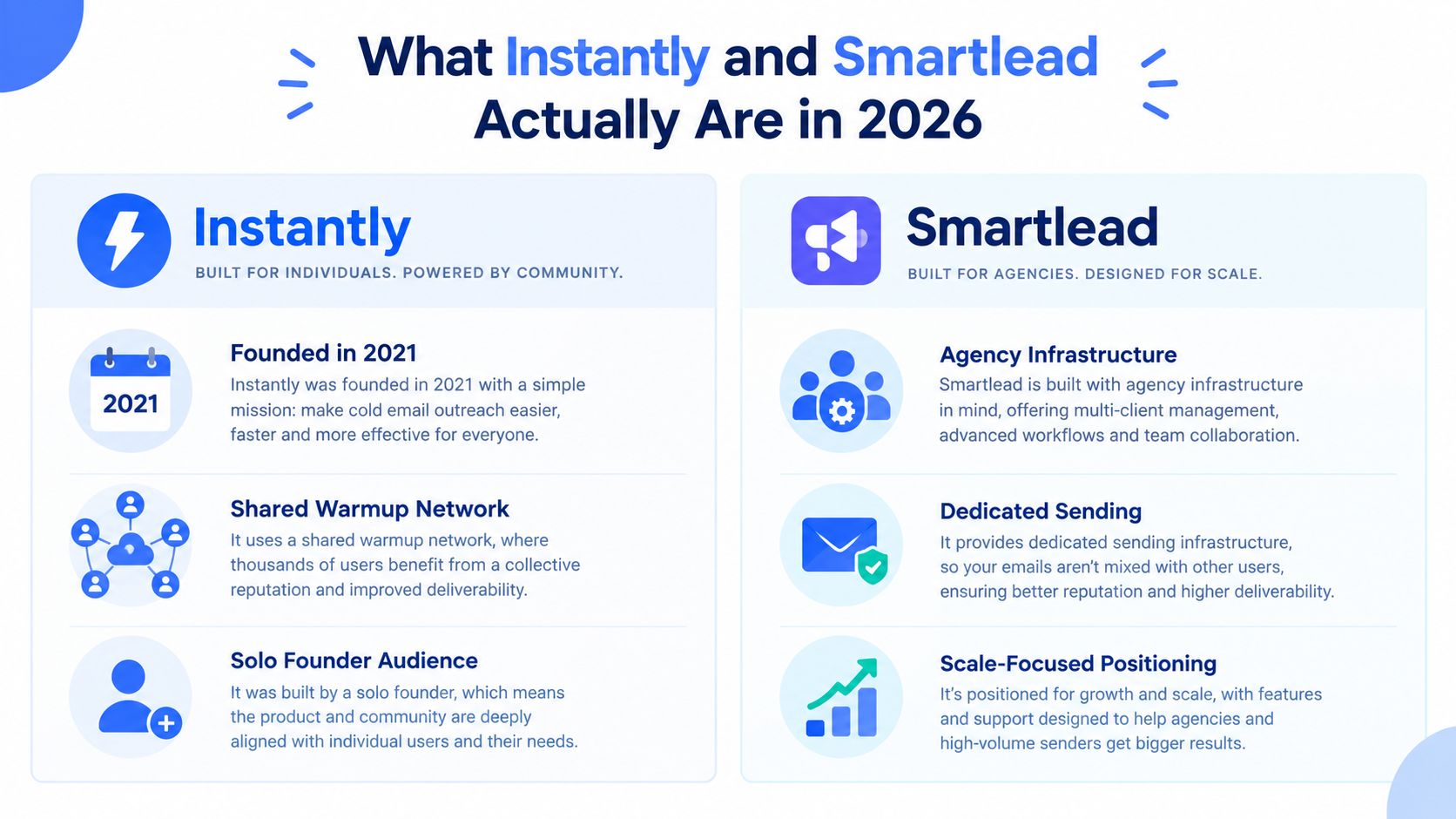
The fastest way to understand the difference is to ignore the feature grids and look at each company's strategic identity. Instantly entered the market earlier, with a founding year of 2020, while Smartlead is listed as founded in 2022, according to the G2 comparison of Instantly and Smartlead. That two-year gap helps explain why Instantly has accumulated a much larger public review footprint.
The same comparison reports roughly 4,830 reviews for Instantly versus about 357 for Smartlead, and lists G2 scores of 4.8 for Instantly and 4.6 for Smartlead. Those figures don't prove that one platform produces better campaigns. They do show that Instantly had more time to build public usage and review momentum before Smartlead reached the same comparison set.
Instantly sells a shorter path from data to outreach
Instantly is the better fit when the operator wants fewer moving parts. Its positioning centers on accessible campaign creation, built-in infrastructure, lead discovery, and reply handling inside a broader growth workflow. That makes it attractive to founders, coaches, small sales teams, and agencies that standardize relatively straightforward outbound motions.
The trade-off is control. Instantly's value comes from abstraction. The system handles more decisions for you, which is useful when speed matters, but less useful when every client requires different mailbox rules, sending patterns, and diagnostics.
Smartlead sells control over the sending layer
Smartlead is built around the needs of outbound operators who treat mailboxes, domains, ESP matching, and account-level monitoring as core infrastructure. Its identity is closer to a sending control plane than an all-in-one prospecting suite.
That distinction matters for agencies. You may already have data flowing from enrichment tools, spreadsheets, CRM systems, or custom workflows. In that environment, Smartlead's appeal is not that it eliminates the stack. It gives the operator more control over how the sending layer behaves inside the stack.
The divergence is clear. Instantly simplifies the route to launch. Smartlead exposes more of the machinery needed to govern scale.
Deliverability and Inbox Placement Compared
An agency with clean lists, authenticated domains, and disciplined volume can get either platform into workable inbox-placement territory. The operating decision comes later: do you want a shared-network experience with fewer infrastructure choices, or tighter control over mailboxes, domains, and provider matching?
A third-party benchmark covering more than 8 million emails and over 200 campaigns recorded 94% inbox placement, a 1.2% bounce rate, and a 12.3% reply rate for Instantly, compared with 89% inbox placement, a 2.1% bounce rate, and a 10.1% reply rate for Smartlead. It also reports an industry average of 76% inbox placement in the Instantly versus Smartlead deliverability benchmark.
That dataset favors Instantly, especially on bounce behavior. A separate controlled fresh-domain warmup test reported 87% placement for Smartlead and 84% for Instantly, according to this independent Smartlead and Instantly deliverability comparison. Treat both results as test conditions, not permanent guarantees.
| Mechanic | Instantly | Smartlead |
|---|---|---|
| Warmup model | Larger shared warmup network and automated setup | More granular warmup and account-level controls |
| ESP handling | Simpler operator experience | Stronger emphasis on ESP matching |
| Domain governance | Easier to standardize | Better suited to isolation and diagnostics |
| Scaling posture | Automation-led | Infrastructure-led |
| Main risk | Less control when the operation becomes complex | More setup and governance work |
Fundamentals still decide the outcome
SPF, DKIM, DMARC, list hygiene, sensible warmup, domain reputation, and disciplined sending matter more than a brand comparison. The tactics in this email lead generation guide address the list-quality side of that equation. Risky addresses, ignored bounce signals, or careless volume will undermine either platform.
Review the mechanics behind your email deliverability rate before treating a dashboard percentage as proof of superiority. Identify whether the problem comes from authentication, the list, copy, mailbox behavior, or sending volume.
Smartlead wins when an agency needs per-mailbox diagnostics, domain isolation, and provider-specific controls. Instantly wins when the team wants automated warmup and a larger shared network without assigning an operator to every infrastructure decision.
The platform can create better conditions. It can't rescue poor targeting, weak authentication, or an unverified list.
For operations below roughly 50,000 emails per day, shared-network simplicity usually keeps execution cleaner. Beyond that point, infrastructure control can justify Smartlead's added governance work, particularly when separate clients require distinct domains, mailbox rules, and diagnostics. The cost crossover is operational, not just a subscription comparison.
The benchmark conflict does not make the tools interchangeable. The deliverability ceiling is set by the operator first. Choose Instantly for simplicity and speed. Choose Smartlead for control over a growing sending infrastructure. Neither platform can manufacture inbox placement from weak fundamentals.
Automation, Sequencing, and Personalization Mechanics
The campaign editor matters after the list is ready. A basic follow-up sequence either stays manageable or turns into a branching system that needs constant supervision.
Instantly's strength is speed. Its visual sequence builder makes standard email campaigns quick to assemble, and its newer campaign logic brings conditional steps and testing closer to the editor. Spintax can operate at the email and sentence level, while its AI reply agent helps classify and draft responses in the same workspace.
Instantly favors fast execution
For a small team running repeatable campaigns, Instantly's workflow is easier to teach. A campaign manager can load leads, build a sequence, add personalization, test variations, and monitor replies without moving between several operational surfaces.
That simplicity is useful for common B2B motions. It becomes less comfortable when the sequence needs deep routing based on multiple behaviors, distinct sender rules, or a carefully controlled mix of channels. Strong copy still matters more than an elaborate editor, which is why a practical resource on what email copywriting involves belongs in the operating process, not just the creative process.
Smartlead takes the opposite approach. It supports email sequencing alongside LinkedIn task steps and manual call tasks, with reply detection that can pause a sequence when a person responds. Its master inbox gives operators a central place to review conversations across sending accounts.
| Capability | Instantly | Smartlead |
|---|---|---|
| Standard email launch | Faster and simpler | More configurable |
| Conditional branching | Available inside campaign workflows | Stronger fit for complex routing |
| Multichannel tasks | More email-centered | Email, LinkedIn tasks, and manual call tasks |
| Reply handling | AI-assisted classification and drafting | Centralized inbox and reply-based controls |
| Personalization | Variables, AI assistance, spintax | Deeper field and workflow flexibility |
| Operator profile | Campaign manager | Technical outbound operator |
Control creates responsibility
Smartlead is the better choice when the sequence must reflect a complex sales motion. You can build more deliberate routing around replies, sender groups, and channel tasks, but the operator needs to validate merge fields, attachments, images, HTML signatures, and sending constraints carefully.
Neither editor can compensate for careless personalization. A missing field, broken fallback, oversized attachment, or aggressive HTML signature can damage trust and placement. For standard sequences, Instantly wins on launch speed. For complex B2B motions that mix channels and require branching depth, Smartlead gives the operator more room to work.
List Handling, Data, and the Prospecting Stack Cost
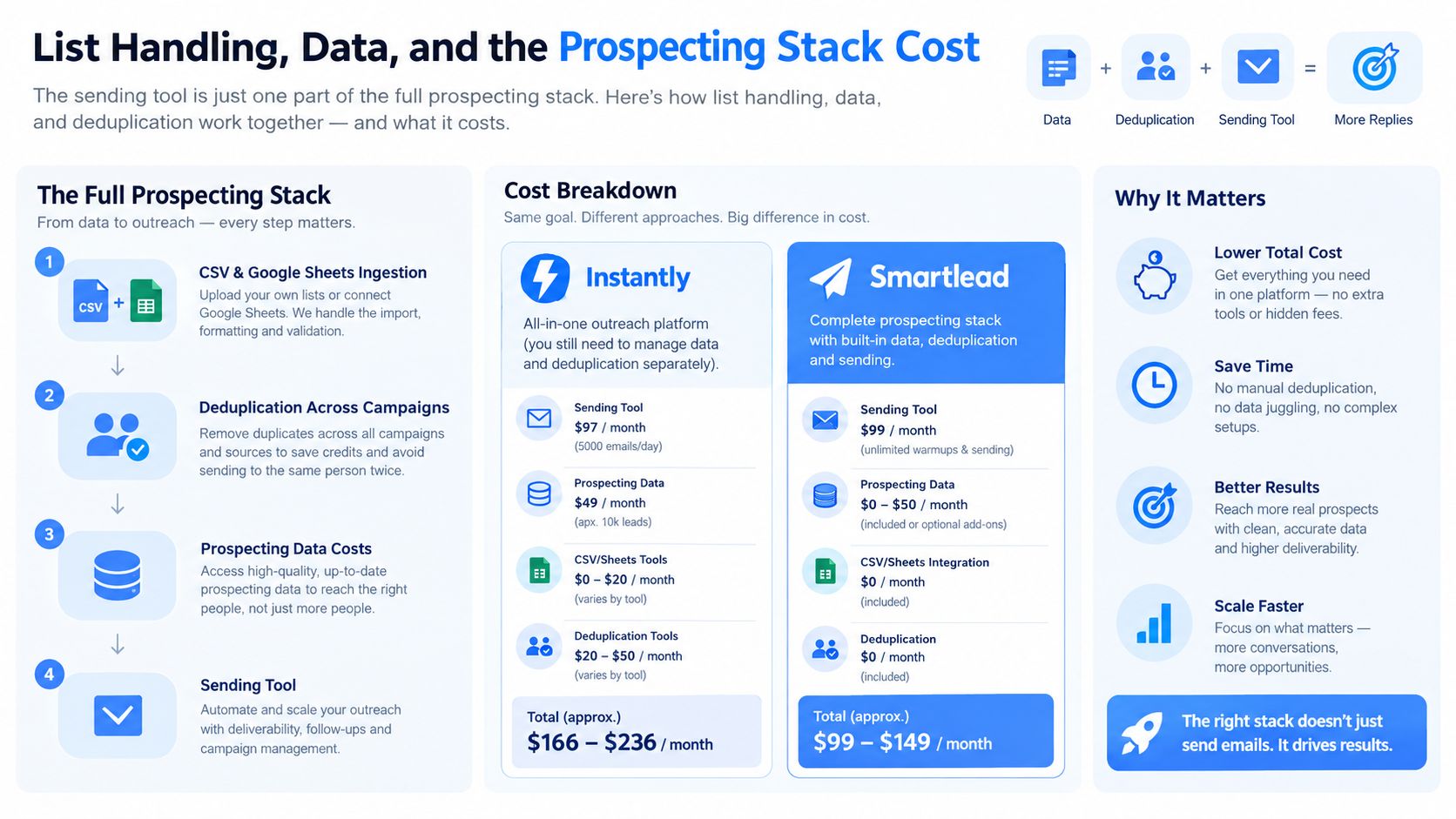
Your sending platform is only one part of the prospecting stack. The honest budget includes data discovery, enrichment, verification, storage, suppression, campaign management, and the human time required to keep records clean.
Both platforms can ingest common sources such as CSV files and Google Sheets, then use campaign-level filters and suppression logic to prevent obvious duplication or unwanted follow-up. The practical difference is strategic. Instantly brings prospecting closer to the sending workflow through a built-in B2B database and native credits. Smartlead is more comfortable as the execution layer for data supplied by external systems.
Three stack patterns appear repeatedly
A freelancer may use a free scraper, a spreadsheet, and Instantly's included data access. That setup is attractive because it reduces the number of subscriptions and keeps list building close to campaign launch.
A small agency may pair Smartlead with Clay and Apollo. That creates stronger enrichment and segmentation possibilities, but it also introduces more data movement, field mapping, verification decisions, and vendor administration.
A mid-market agency may run Smartlead with several data providers, custom enrichment, and API-driven workflows. The system can be powerful, but the hidden costs become visible quickly:
- Enrichment usage: API calls can rise as fields are added or refreshed.
- Verification charges: A large imported list may need separate validation before sending.
- Duplicate handling: Poor suppression creates wasted credits and damaged outreach.
- Overage exposure: Lead or database credits can sit outside the headline sending subscription.
- Operations time: Someone must monitor failed enrichment, missing fields, and stale records.
Teams comparing tools should also review broader lead generation insights before choosing a data workflow. The key question is whether you want the platform to supply more of the prospecting process or whether your agency already has a reliable research and enrichment layer.
This video provides another practical reference point for thinking about the prospecting workflow:
My recommendation is simple. Choose Instantly when integrated data access reduces operational drag. Choose Smartlead when your agency already owns the data pipeline and needs the sending platform to behave predictably inside it.
Scaling for Multi-Client Agency Operations
The first client is easy. The tenth exposes your process. By the time an agency manages a broad book of business, the important questions are no longer about campaign creation. They're about permissions, isolation, onboarding speed, reporting, billing ownership, and what happens when one client breaks a sending rule.
Instantly's account-based structure suits agencies that want a more approachable workspace. Sub-accounts, team access, permissions, client-facing reporting, and white-label presentation can support a standardized service model. The operator experience stays relatively direct, which helps when account managers need to inspect campaigns without becoming deliverability specialists.
Smartlead is more operator-centric. Its unified master inbox, client separation, white-label console options, and account-level sending controls are better suited to an agency that manages many inboxes as infrastructure rather than treating each campaign as an isolated project.
A repeatable client onboarding sequence
Use the same onboarding checklist regardless of platform:
- Confirm the sending plan. Define the client's audience, domains, mailbox ownership, suppression rules, and approval responsibilities.
- Connect the sending environment. Add domains and mailboxes, then verify that authentication records have propagated before sending.
- Start warmup gradually. Keep the ramp controlled and monitor mailbox behavior instead of assuming the tool has made the account safe.
- Run a small validation campaign. Test merge fields, unsubscribe handling, reply routing, links, signatures, and scheduling.
- Launch the first production segment. Keep the initial campaign narrow enough to identify list or copy problems before expanding.
- Assign monitoring ownership. Someone must check bounces, replies, disconnected accounts, and client approvals every working day.
For agencies building this process as a service, the distinction between a cold email marketing agency and a software reseller is operational discipline. The platform supports the work, but the agency owns the quality standard.
Where the operating models strain
Instantly can become less comfortable when one client's sending behavior creates limits that require manual intervention across an otherwise simple workspace. Smartlead can create the opposite problem, because deeper controls require more governance and more training.
At more than 50,000 emails per day, the platform decision becomes an infrastructure decision. Smartlead's agency positioning and control surfaces are usually the stronger fit when mailbox isolation, account diagnostics, and high-volume governance are central. Instantly can still work when the agency values integrated tooling and has a tight, standardized domain pool, but its simplicity becomes less valuable if operators need controls the interface doesn't expose.
Pricing Models and the True Cost Crossover
The sticker price only answers the easiest version of the question. Published 2026 comparisons place Smartlead's Pro plan at about $94 per month for roughly 150,000 emails, while Instantly's Hypergrowth plan is about $97 per month for roughly 100,000 to 125,000 emails, according to this 2026 Smartlead versus Instantly pricing comparison.
A separate comparison lists Instantly's Growth plan at $30 per month for 1,000 active contacts and 5,000 emails, while Smartlead's Growth plan is listed at $79 per month for 2,000 active leads. Those differences show why raw subscription price can point in different directions depending on whether you're buying contact capacity, sending volume, infrastructure, or agency controls.
| Volume band | Instantly monthly cost | Smartlead monthly cost | Crossover note |
|---|---|---|---|
| Modest outbound | Often more accessible when integrated data reduces stack size | Can offer an economical sending entry point | Compare included contacts, credits, and warmup needs |
| Moderate agency volume | Hypergrowth-style capacity may fit standard campaigns | Pro-level capacity adds stronger agency controls | Raw price can converge while operating models diverge |
| 50,000+ emails per day | Higher-tier infrastructure and possible add-ons become important | Agency or custom economics can become more favorable | Smartlead is often the stronger scale case |
| Custom agency operation | Budget for data, verification, domains, support, and labor | Same external costs, with more room for infrastructure governance | Platform price is only one line in total ownership |
The cost crossover doesn't happen at one universal account count. It depends on mailbox volume, client isolation, database credits, enrichment, support, and how much manual work the platform creates. A cheaper plan can lose its advantage when the team has to buy separate prospecting tools or spend hours correcting data and campaign issues.
The most useful published signal is that Smartlead's agency economics are reported to undercut Instantly at 50,000 emails per day and above, while Instantly's Light Speed plan is described as supporting 500,000 or more emails with SISR and dedicated IP options, as summarized in this Instantly versus Smartlead pricing analysis. That isn't a universal invoice for every agency. It's a warning to model the sending pattern before signing an annual plan.
At smaller volume, Instantly's integrated workflow can keep total stack cost lower. At larger volume, Smartlead's infrastructure controls can produce better economics even if the interface demands more operational expertise.
Which Platform to Choose for Your Use Case
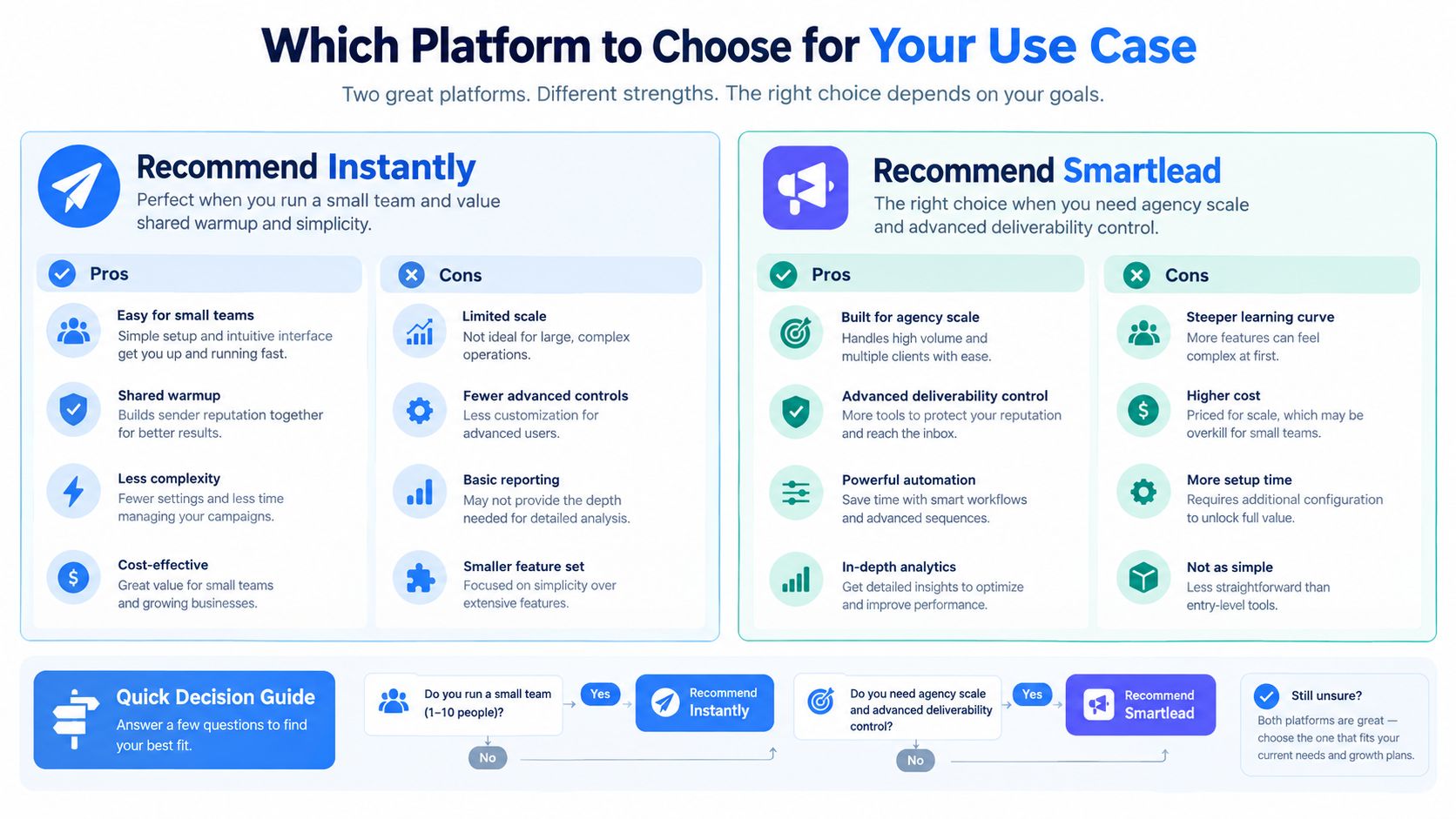
There isn't one winner because the tools solve different operating problems. Instantly is the better choice when your priority is speed, integrated prospecting, automated warmup, and a smaller number of operational decisions. Smartlead is the better choice when your priority is mailbox governance, client isolation, diagnostics, and sending infrastructure that can be shaped around a complex agency model.
Use Instantly when simplicity is the constraint
Choose Instantly if you're a solo founder, coach, small sales team, or lean agency that wants to move from prospect data to campaign without assembling a large technical stack. It's especially appropriate when campaigns follow a repeatable email-first structure, your domain pool is tight, and the team values shared warmup infrastructure over granular sender controls.
Instantly is also a reasonable choice when built-in lead access and AI-assisted reply handling reduce the number of tools your team must operate. The platform's earlier launch and larger review footprint, described above, also make it easier for buyers who want a mature public usage base.
Use Smartlead when governance is the constraint
Choose Smartlead for a dedicated outbound agency, an SDR-heavy team, or an operator managing many client environments. It's the stronger fit when ESP matching, domain isolation, mailbox diagnostics, master inbox management, and API-driven workflows are essential rather than optional.
At more than 50,000 emails per day, I'd start with Smartlead unless the agency has a strong reason to prioritize Instantly's integrated growth suite. The higher the sending volume and the more clients you serve, the more valuable control becomes.
| Situation | Recommendation | Reason |
|---|---|---|
| Solo founder launching standard campaigns | Instantly | Less setup and fewer moving parts |
| Small in-house sales team | Instantly | Faster adoption and integrated workflow |
| Lead generation agency with many client accounts | Smartlead | Stronger infrastructure governance |
| Technical outbound operation with external data pipelines | Smartlead | Better fit for API-led execution |
| Mixed client portfolio with different needs | Both, selectively | Match the platform to each operating model |
| Agency above 50,000 emails per day | Smartlead first | Scale economics and control become central |
If you're evaluating an external partner alongside the software, an agency offering marketing automation services can help separate platform selection from campaign execution. That distinction matters because the best sending tool still needs accurate data, credible messaging, authentication, monitoring, and human reply handling.
My agency verdict is direct: pick Instantly when shared-network simplicity saves your team time, and pick Smartlead when infrastructure control protects your margin and client operations. Don't choose based on the longest feature list. Choose based on who will own the system when volume, client count, and deliverability problems arrive together.
Lead Printer builds and runs data-driven email and multichannel campaigns, including infrastructure setup, prospect research, personalized sequences, campaign optimization, and lead qualification across US, UK, and EU markets. Visit Lead Printer if you want an operator-managed outbound system designed around the same trade-off discussed here, reliable sending infrastructure without losing control of targeting, messaging, or qualified opportunities.