You're probably looking at two tabs, two sales quotes, and a pipeline that still isn't full. One vendor looks bigger. The other looks cleaner for Europe. The key question isn't which logo is stronger, it's which database turns into accepted opportunities without burning your team on bad records, dead dials, and wasted sends.
| Criterion | ZoomInfo | Cognism | Implication for outbound campaigns |
|---|---|---|---|
| Market posture | Public-company scale with a longer operating history and a larger disclosed data universe | Later-founded, private growth company with an international-first identity | Choose based on the market you sell into, not on vanity size |
| Reported scale | More than 500 million contact profiles, 100 million company profiles, 135 million verified phone numbers, and over 200 million verified business emails ZoomInfo about page | Revenue and customer base grew quickly, with an estimated 6,400 customers in 2024 ZoomInfo about page | Bigger doesn't help if the records in your target region don't actually work |
| Fit for geography | Strongest in North America, with broad global positioning | Commonly positioned around Europe and phone verification | Geography should drive the shortlist, not brand familiarity |
| Buying model | Quote-based annual contracts | Quote-based annual contracts | You're negotiating total cost, not comparing sticker prices |
| Usability question | How many records are usable after verification, filtering, and list cleanup? | How many records are usable after verification, filtering, and list cleanup? | The winning platform is the one that lowers cost per meeting, not cost per seat |
Two Platforms, Two Different Outbound Problems
A US SaaS team usually asks a bad first question. They want to know which platform has “more data.” A UK agency pushing into Germany and the Nordics makes the same mistake from the other side, only with a European accent. In both cases, the purchase looks like a database decision, but the true job is far more specific. You need records that match the market, survive verification, and still turn into replies after enrichment and sequencing.

The lazy framing is “ZoomInfo for scale, Cognism for Europe.” That's too thin to guide procurement. A team selling North American enterprise software cares about direct dials, org depth, and how well the data fits sales motions already built around CRM workflows. An agency selling into the UK, Germany, or the Nordics cares more about whether the data survives a local-language, multi-market outbound sequence without blowing up reply quality.
Practical rule: Don't buy a contact database until you know which failure hurts more, missed coverage or unusable records.
The rest of the decision comes down to four questions. How accurate is the data in your exact geography? What does the total cost per qualified meeting look like after verification, seats, and campaign labor? How does the platform handle compliance and outreach constraints in your markets? Does it fit the stack you already run, or will it create another handoff problem?
If you can answer those four questions for your own ICP, the choice gets much simpler. If you can't, you're still shopping by brand.
Company Background and Reported Scale
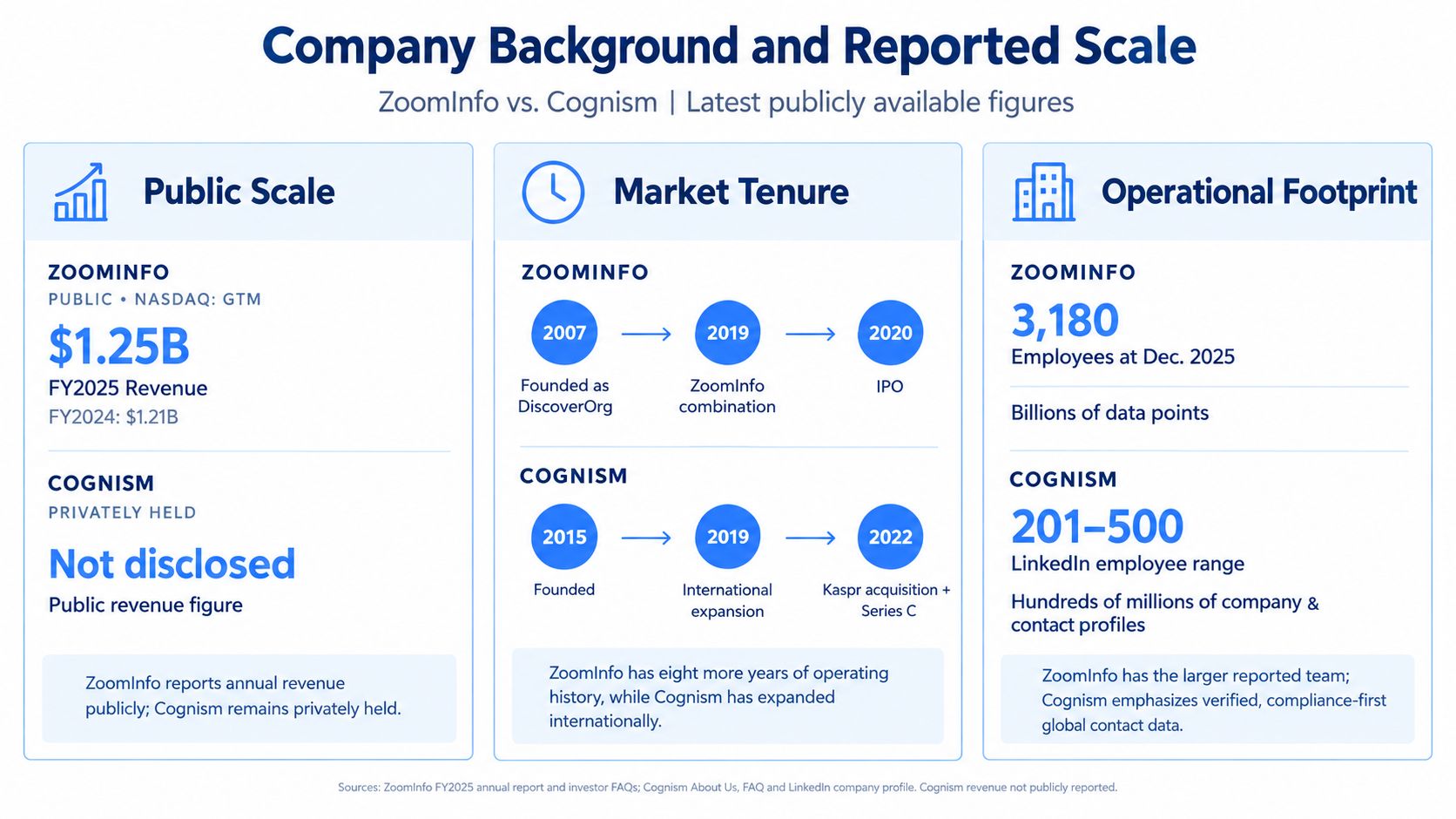
If you are choosing between ZoomInfo and Cognism, start with how each company was built. ZoomInfo began in 2007 as DiscoverOrg, was acquired in the Zoom Information transaction in February 2019, took the ZoomInfo name in September 2019, and went public on Nasdaq in June 2020. Its 2020 listing was described as the largest software IPO in a decade, which signals the scale and maturity buyers were dealing with at that point ZoomInfo fact sheet.
What that maturity means in practice
By the time of its IPO, ZoomInfo said it had about 16,000 customers, around 215,000 paid users, and 109% net annual retention for 2019 ZoomInfo fact sheet. It also reported annualized second-quarter 2020 GAAP revenue of $444 million, including $111 million in quarterly revenue and 62% year-over-year growth ZoomInfo fact sheet. For buyers, that points to a platform built for enterprise procurement, with a long history of adding capability through acquisitions, including RainKing in 2017, NeverBounce in 2018, Zoom Information in 2019, and Komiko in 2019 ZoomInfo fact sheet.
Cognism took a different path. The company says it was founded in 2015, though some corporate registries list 2016, and it scaled as a private, venture-backed business. It raised £2.8 million in February 2019 after reporting 23% monthly revenue growth in 2018, then raised $10 million in Series B funding in July 2019, bringing total funding at that point to more than $16.5 million. That funding path shows a younger company pushing hard into international sales intelligence, not a public-market giant built around broad enterprise coverage.
Why headline scale can fool buyers
ZoomInfo's company materials describe more than 500 million contact profiles, 100 million company profiles, 135 million verified phone numbers, and over 200 million verified business emails ZoomInfo about page. Cognism has reported revenue growth from roughly $2 million in 2018 to $7 million in 2019, $16.1 million in 2020, $19.2 million in 2021, and $25 million in 2022, with later estimates putting 2024 revenue at $83 million and customer count at about 6,400. Those figures are self-reported, and the two companies do not define “customer,” “contact,” or “verified” the same way ZoomInfo about page.
That is why database size is the wrong shortcut. A bigger universe still fails if the records do not match your geography, persona, and channel. The number that matters is the one that survives verification and turns into accepted opportunities.
Side-by-Side Criteria Comparison
The buying decision is not a feature checklist. It is whether the platform gets your team from list build to accepted opportunity with less waste. I care more about operational fit than vendor polish, because cost per meeting is what the pipeline math comes back to.
If you are comparing adjacent categories too, use this compare marketing intelligence tools view before you lock a vendor into your stack. Procurement often bundles data, intent, enrichment, and outreach, so the wrong shortlist can drag the whole motion off course.
| Criterion | ZoomInfo | Cognism | Implication for outbound campaigns |
|---|---|---|---|
| Data scale | Larger disclosed data universe, deeper North American footprint | Smaller disclosed base, stronger European positioning | Scale helps search breadth, but not automatically list quality |
| Customer profile | More mature public-company footprint | Growth-stage private company with international focus | Bigger enterprise maturity can mean better process, not necessarily better fit |
| Coverage emphasis | Broad North America, Europe, and APAC positioning | European data and phone verification positioning | Geography should determine which platform you start with |
| Contract style | Annual, quote-based, seat and credit dependent | Annual, quote-based, typically packaged with seat floors | Negotiation matters, because list price is rarely the cost you end up paying |
| Working model | Stronger for teams that want data tied to broader workflow | Stronger for teams that want verified data and compliance-led selling | Match the tool to how your team executes |
| CRM fit | Better for teams that live inside a heavier sales stack | Better for teams that prioritize clean contact extraction | The more handoffs you create, the more meetings you lose |
| Procurement story | Enterprise scale and platform breadth | Compliance and European dialing confidence | Your buyer will care more about the risk story than the feature story |
What this means for campaigns: if your team exports lists, enriches them in Clay, and then runs multichannel sequences, the platform that creates fewer dead records wins, even if its dashboard looks less impressive.
Pricing still gets oversold in vendor decks. Buyer-reported estimates place a typical ZoomInfo contract around $33,500 annually, while Cognism packages for five seats are reported around $22,500 to $37,500 depending on tier AiSDR comparison. Those numbers help with budgeting, but they do not tell you which tool will produce cleaner records or fewer wasted sends. If ZoomInfo's contract structure does not fit your motion, review the case for ZoomInfo alternatives before you sign.
The practical call is straightforward. Use ZoomInfo when your territory, stack, and SDR motion are built around North America at scale. Use Cognism when your campaign is European, your buyers care more about phone verification and compliance, and you want a tighter record set over a broader one. Do not let a rep sell you a global story if your team only needs three countries and two personas.
Geography, Industry, and Persona-Level Accuracy
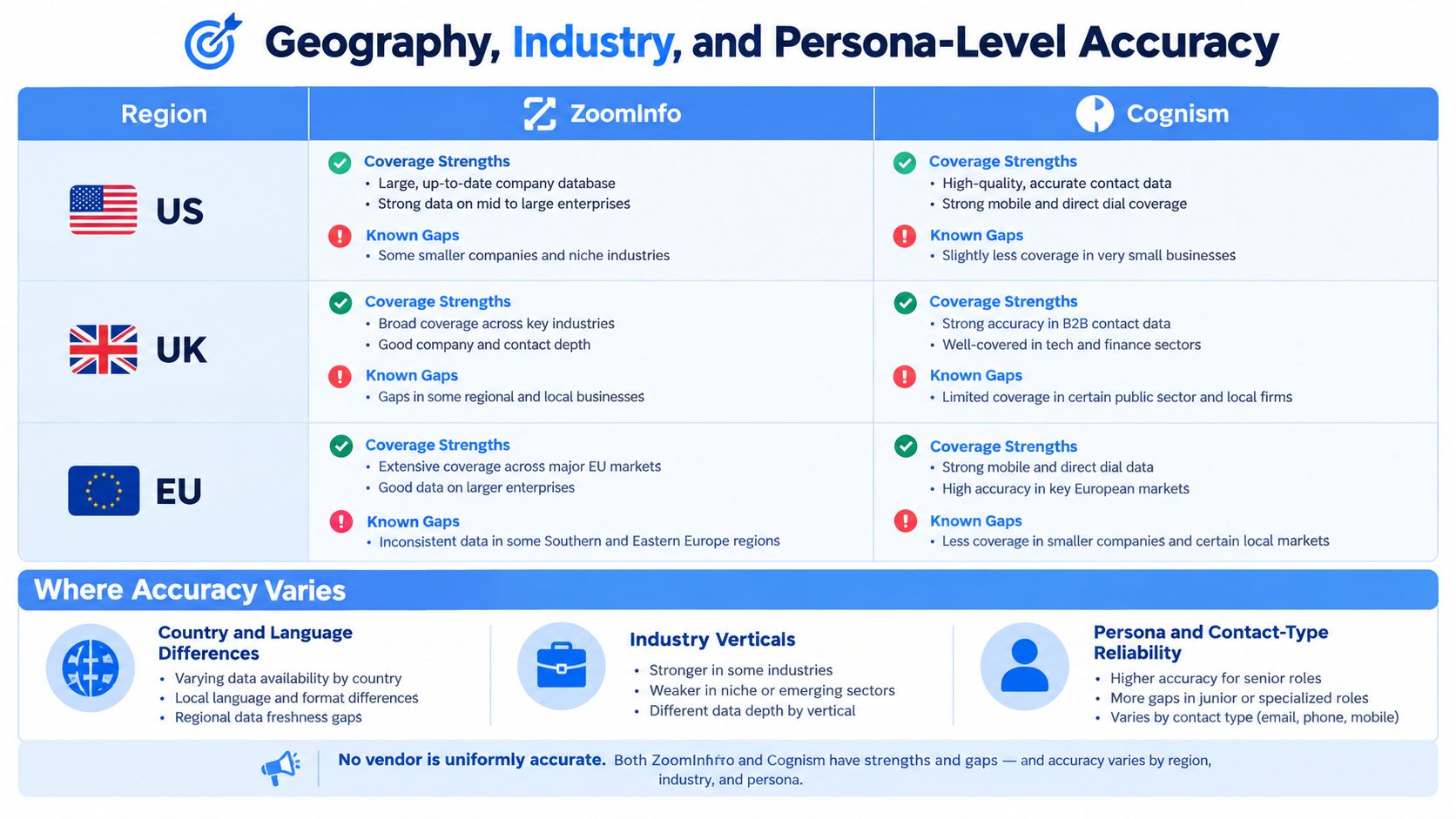
A big database does not help if the record quality breaks in the countries and roles you sell into. That is the core ZoomInfo vs Cognism test. ZoomInfo promotes 500M+ verified profiles and broad North America, Europe, and APAC coverage, while Cognism is positioned around European data and phone verification. In practice, performance shifts by market, and review patterns on third-party platforms back that up ZoomInfo comparison page.
Where the fit usually breaks
For US accounts, ZoomInfo usually makes more sense because North American contact depth is its historic strength. For UK and broader European campaigns, Cognism's pitch is tighter because its value proposition centers on European phone verification and compliance. That does not make the decision automatic. It means your first assumption should change with the buyer's geography.
Industry shifts the outcome as well. A German manufacturer, a UK SaaS company, and a US ecommerce payments team do not fail in the same way. One may have enough company records but thin direct-dial coverage. Another may have usable emails but poor seniority matching. A third may look clean in a demo and then fall apart once you filter down to the actual buying committee.
G2 reviewers in DACH markets often report weaker mobile-dial coverage than reviewers in the UK, which matches what many campaign samples show. The point is simple. Geography affects usability, and usability affects meetings.
How to test accuracy without fooling yourself
A one-market demo proves very little. Pull a matched sample from both vendors, split it by country and persona, and score the records on freshness, role accuracy, usable business email, direct dial presence, bounce rate, and qualified meeting rate. Keep the sample tied to the same companies and the same buying roles, or you are just comparing list-building tricks.
Use this scorecard:
- Country fit: Does the record match the market you sell into, not just the region label?
- Persona match: Is the contact at the seniority and function you need?
- Channel usability: Can you reach the person by email, phone, or both?
- Freshness: Is the employer current, or already stale?
- Business outcome: Did the record help produce a reply or meeting?
Rule of thumb: if your team cannot separate US, UK, and EU results, you do not have a vendor comparison yet, you have a vanity exercise.
The winner is the platform that produces more usable records for your exact ICP. In one market, ZoomInfo may win on depth. In another, Cognism may win on dialability. That is why cost per accepted opportunity matters more than list size or sticker price. A cheaper contract that fills your sequence with dead records costs more by the time the SDR team burns through bad data and misses meetings.
How to Run Your Own Head-to-Head Test
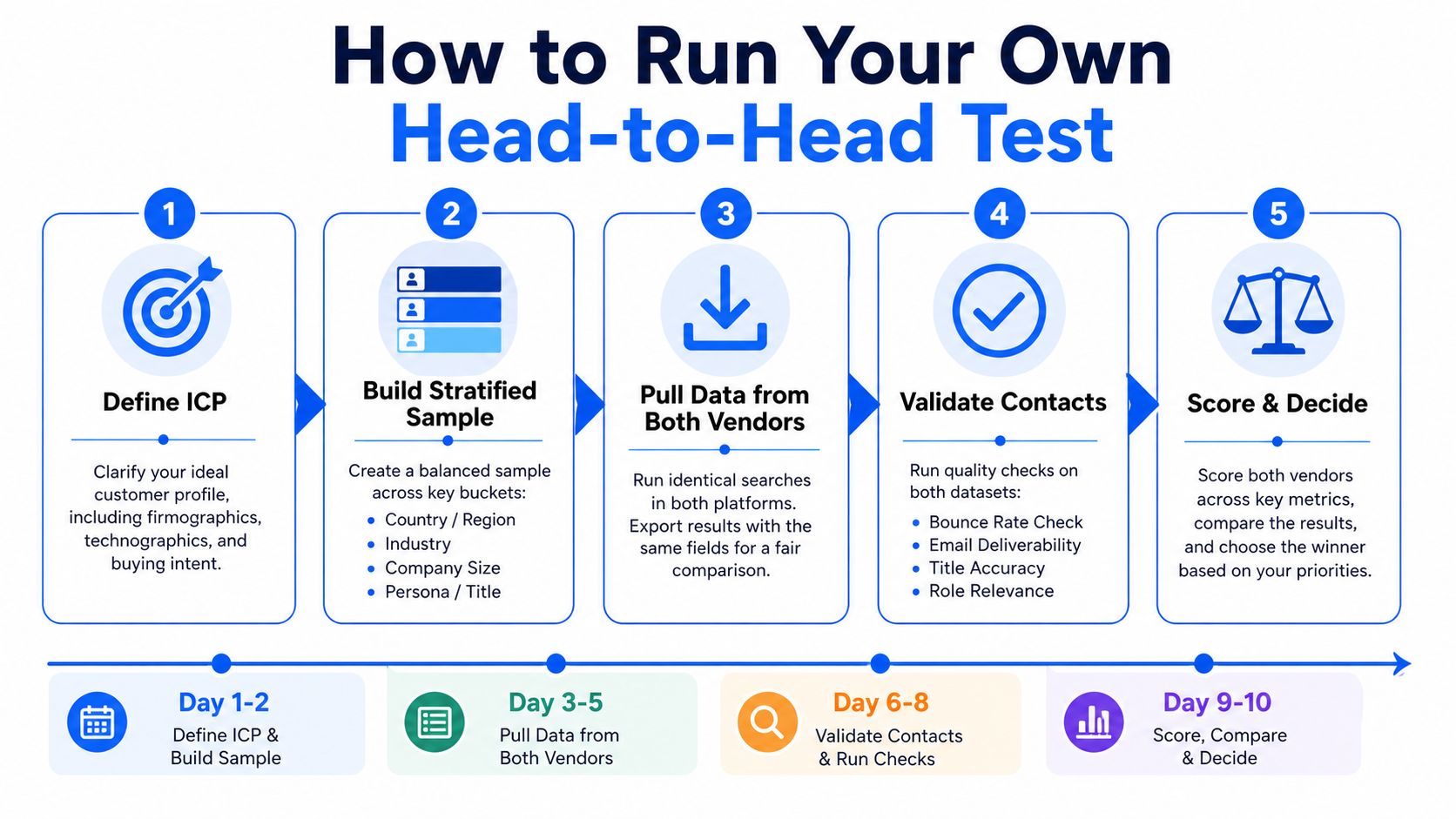
A one-week test beats a three-hour demo every time. Start by defining one ICP clearly, then lock the variables so the vendors can't hide behind broad coverage claims. If you sell into UK SaaS finance leaders, don't test random marketing contacts in London and call it a result. Build a stratified sample that reflects your actual pipeline.
Run the test in five moves
- Define the ICP. Write down country, persona, industry, company size, and buying trigger. If the brief isn't specific, the data won't be either.
- Build a stratified sample. Split targets by geography and role so you can compare UK, EU, and US performance separately.
- Pull matched records from both vendors. Use the same companies and the same personas wherever possible, so you're testing data quality instead of list-building creativity.
- Validate contacts. Check bounce risk, title match, and whether the person still works there.
- Score and decide. Pick the winner by usable records and pipeline impact, not by the vendor that exported the biggest file fastest.
The metrics matter more than the tooling. Measure freshness, role accuracy, bounce rate, and reply rate separately. If one platform wins on contact coverage and the other wins on email validity, don't force a false binary. Use the better contact source for the fields it does best, then enrich and verify in a second layer.
Practical rule: when the list source and the verification layer disagree, trust the record that still survives after the second pass.
That's where Clay or a similar enrichment layer earns its keep. Pull the best records from each platform, enrich them, and keep only the contacts that pass validation. In some campaigns, that means ZoomInfo supplies the broader discovery layer while another source tightens email validity. In others, Cognism gives you better European coverage and a second tool handles cleanup and sequencing. The point is to build a working system, not defend a vendor.
If you're not running a test like this before renewal, you're guessing with a subscription budget.
Real Buyer Scenarios and What Each Team Should Pick
A US SaaS team selling into enterprise North America should start with ZoomInfo. That buyer usually needs seniority depth, direct dials, and a list source that can keep pace with outbound without constant rebuilding. If the records still go stale, fix the verification process first. Changing vendors rarely solves a weak workflow.
A UK agency running campaigns into Germany and the Nordics should start with Cognism. The true test is whether the contacts support phone-led outreach, local-market messaging, and a deliverability-safe process that avoids wasted sequence volume on bad data. In that setup, more usable European decision-makers beat a bigger-looking database every time.
For an EU manufacturer or ecommerce brand selling cross-border, the right choice follows the buyer geography. If the motion is mainly US-facing, ZoomInfo is the cleaner fit. If the motion sits in the UK or continental Europe, Cognism is the more practical starting point. Mixed-market campaigns often justify a blended stack, because one vendor rarely wins every segment.
A useful purchasing rule applies across all three scenarios. Agencies should judge the system by accepted-opportunity math, not sticker price. In-house teams should care more about integration depth, governance, and repeatability. If you need a bridge between raw data and live execution, Lead Printer's Cognism alternatives page is a useful reference for how agencies separate data sources from managed execution.
The hidden cost sits in usable-record rate. For a UK agency pushing 5,000 records a month into DACH, a small lift in valid, role-matched contacts can outweigh the difference between two contracts once you factor in scrubbing, verification, and wasted sends. That is the part price sheets hide. A cheaper contract that feeds more bad records is the expensive option once campaigns hit the inbox and the phone.
If the team is agency-led, choose the platform that produces the most accepted opportunities per hour of operator time. If the team is in-house, choose the platform that fits the CRM, approval process, and reporting model with the least friction. On European-heavy work, that usually points to Cognism. On North American enterprise work, it usually points to ZoomInfo.
A Decision Framework for Agencies and In-House Teams
Agencies should default to the platform that gives them the cleanest accepted-opportunity math, not the deepest product tour. In-house teams should favor the platform that fits their CRM, governance, and reporting model. That means agencies often care more about deliverability, enrichment, and multichannel handoff, while internal teams care more about integration and control.
If your stack already depends on warm inboxes and verified sending domains, it helps to review best email warmup tools before you decide whether data quality or sending infrastructure is the bigger bottleneck. A bad database can hurt your campaign. A bad sending setup can kill it outright.
Use this quick filter:
- Choose ZoomInfo if your ICP is mainly North America and you need deeper enterprise coverage.
- Choose Cognism if your ICP is primarily UK or EU and phone verification is central to your outreach.
- Reject both if you need highly custom lists, niche sourcing, or a build process that mixes registries, scraping, and enrichment better than any packaged data vendor.
- Build your own stack if your campaigns live or die on exact-fit records and you already have the ops maturity to manage Clay, verification, and sending infrastructure.
Lead Printer's lead generation software sits closer to the execution side of that decision than the software side. It's for teams that care about building and running campaigns, not just renting a database.
My verdict is blunt. ZoomInfo wins for US-heavy enterprise outbound. Cognism wins for Europe-led motion with compliance and phone verification at the center. If you're buying for an agency or a mixed-market team, stop comparing database size and start comparing accepted opportunity cost. That's the metric that pays for itself.
If you want someone to run the list work, enrichment, localization, deliverability, and outreach instead of just selling you access to records, talk to Lead Printer. We build outbound campaigns for the US, UK, and EU, then turn the data into qualified leads your sales team can work.