A growth lead opens the CRM on Monday morning and finds plenty of activity, but almost nothing that sales can use. The team blames the subject line, rewrites the opener, and asks a freelancer for more personalization. Meanwhile, domains lack proper authentication, contact records contain stale addresses, and nobody has defined what makes a meeting worth taking.
That's the operational reality of lead generation for marketing agencies in 2026. The agencies that build dependable pipeline treat outreach as an infrastructure and data problem first, then a messaging problem. Cold email remains foundational, but benchmark performance usually sits in the low single digits. One 2026 benchmark reports an average B2B reply rate of 3.43%, while another large study reports 5.8% across 16.5 million emails, with top-performing campaigns exceeding 10% (cold email benchmark data). The difference between a campaign that creates conversations and one that burns budget usually begins before the first send.
Why Most Agency Pipelines Stall Before the First Send
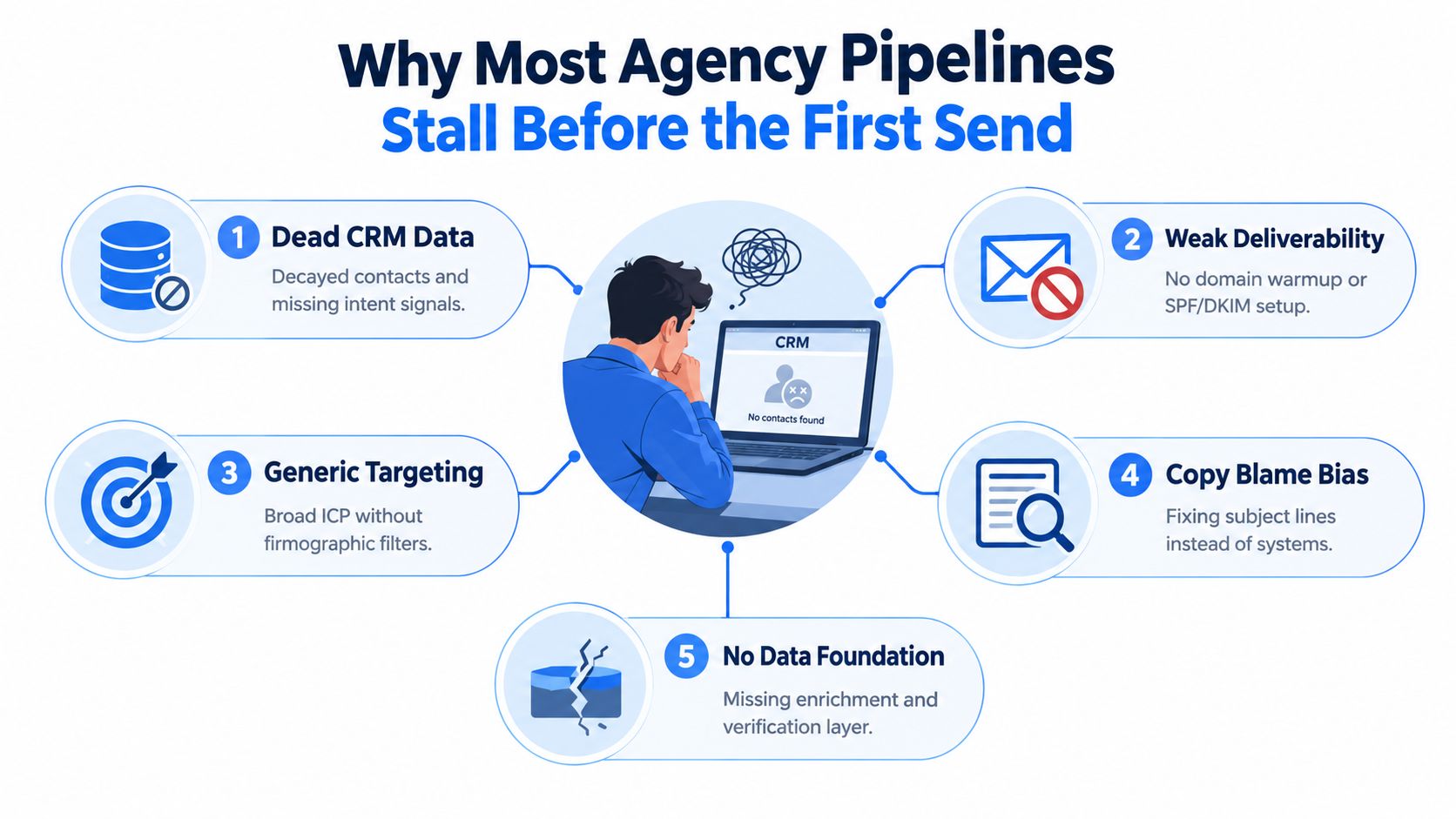
The dead CRM is rarely the root cause. It's the visible symptom of four failures underneath it: an unclear ideal customer profile, unverified contact data, unmanaged sending infrastructure, and no shared qualification standard.
An agency may say it serves “B2B companies that need growth,” then build a list containing startups, local retailers, enterprise procurement teams, and companies with no plausible budget for its offer. A job title filter won't fix that problem. The agency needs a defined market, a service-to-pain connection, and a reason that the target account might act now.
Practical rule: If a researcher can't explain why an account belongs on the list, the account isn't ready for outreach.
The second failure is data quality. Duplicate contacts, generic inboxes, outdated roles, missing company information, and unverified email addresses create bad decisions before copy enters the process. Lead scoring becomes unreliable, personalization becomes awkward, and a sequencer turns incomplete records into a high-volume mistake.
The third failure is infrastructure. Agencies often buy a new domain, create inboxes, and start sending as though deliverability were a troubleshooting task. It isn't. SPF, DKIM, and DMARC alignment, separate sending domains, mailbox configuration, reply-to protection, and gradual warming belong in the launch plan.
The fourth failure is qualification. If “positive reply” means any response, an agency can celebrate conversations that have no fit, authority, need, or timing. The CRM then fills with activity while strategists waste calendar space on prospects who were never viable.
Deliverability belongs in the setup layer
A sensible domain plan separates campaign traffic from the agency's primary corporate domain. That separation reduces the risk that outbound activity affects the domain used for the website, client communication, and internal mail. Whether an agency uses aged or fresh domains, the decision should follow its risk tolerance, compliance standards, and ability to monitor reputation. PBR and MAPS approaches can be evaluated as infrastructure choices, but neither replaces authentication, list hygiene, or responsible sending behavior.
Configure SPF, DKIM, and DMARC before launch, then verify alignment rather than assuming that a DNS record alone solves the problem. Industry guidance recommends maintaining inbox placement at 85% or higher and keeping spam complaints below Google's 0.1% limit (B2B cold email infrastructure guidance). Dedicated inboxes provide clearer ownership and reputation control than a shared pool, although they require more administration.
Warm new inboxes gradually. A practical ramp can move from 5 sends per inbox per day to 50, increasing only when placement and complaint signals remain healthy. Tools such as Instantly, Lemwarm, and Warmbox can support the process, but automation doesn't excuse monitoring. Use seed-list placement tests and require at least 80% inbox placement before a production launch. Agencies should also monitor Google Postmaster, avoid image-heavy HTML templates and suspicious formatting, and use a reply-to arrangement that protects the primary domain.
For a detailed implementation walkthrough, use this guide to warm up an email domain. Agencies selling advisory work can also strengthen trust through clearer authority and niche positioning for consultants, especially when a specialist founder's reputation supports the outbound offer.
The copy-first trap
Hiring one SDR and a freelance writer before building list logic is backwards. The SDR can't qualify accounts that aren't defined, and the writer can't personalize records that lack meaningful signals. The result is polished copy delivered to the wrong people through inboxes that weren't prepared to receive it.
Treat pipeline as a system with explicit ownership. One person owns data rules, another monitors sending health, sales defines qualification, and the campaign operator connects those decisions inside the CRM. Once that foundation works, copy becomes an optimization lever instead of a distraction.
Building Targeted Lists From Real Buyer Signals
Job titles identify people. Buying signals identify situations. A marketing agency should start with accounts that could plausibly purchase its service, then find the people who can approve, influence, or sponsor that purchase.
Begin in LinkedIn Sales Navigator. Combine seniority and function with company headcount, revenue range, geography, industry, and visible growth indicators. A performance agency might target marketing leaders at companies hiring demand-generation staff. A content agency might look for firms launching a product, entering a new market, or expanding a category team. Boolean logic helps narrow titles, but the trigger gives the message a reason to exist.
Build the list in layers:
- Account layer: Record the industry, business model, geography, size, technology stack, and relevant growth event.
- Contact layer: Add the economic buyer, operational owner, and a plausible internal champion.
- Signal layer: Capture hiring activity, product launches, funding announcements, service changes, or evidence of a current marketing gap.
- Verification layer: Check role accuracy, email validity, company status, duplication, and compliance before sequencing.
Apollo and ZoomInfo can provide starting data. Clay-style waterfall enrichment can fill gaps by moving through multiple sources rather than accepting the first incomplete record. Public registries, company websites, LinkedIn, and targeted scraping are useful when the data point is specific and verifiable. Scrape when a signal is public and changes quickly. Buy data when coverage, licensing, and workflow speed matter more than bespoke research.
Use NeverBounce or ZeroBounce to verify addresses, then group accounts into tiers. A researcher should be able to pull a focused account set quickly because the rules are explicit, not because the researcher is guessing. A flat CSV is not a strategy. Every row should contain the industry, role, trigger, offer angle, and sequence path that downstream systems can use.
Agencies trying to make signal-based prospecting more relevant can review Exerta's discussion of how to reduce ad fatigue with intent data. For hands-on execution, email list building services can support research, enrichment, and segmentation workflows.
Reply Rate Benchmarks and What They Actually Tell You
Reply rate is useful only when the list and outcome are defined. A broad campaign can produce activity that looks healthy while generating few viable opportunities. A smaller, tightly segmented campaign can produce fewer total replies and more sales value.
The benchmark baseline is modest. Broad cold outreach commonly sits around the 3% to 6% reply-rate range, while under 3% often points to targeting or deliverability trouble. Strong segmentation can reach 6% to 8%, and intent-driven campaigns can exceed 8% according to practical outreach benchmarks (cold outreach reply-rate benchmark).
The table below uses the planning ranges supplied for different list types. Treat them as operating hypotheses, not promises. The verified benchmark data supports the broader reply-rate ranges, but it doesn't establish universal positive-reply or meeting figures for each list category.
| List Type | Reply Rate | Positive Reply | Meetings / 1k Sends |
|---|---|---|---|
| Broad scraped lists | Qualitatively low | Usually limited | Depends on qualification |
| Tagged Sales Navigator segments | 3%–7% | More relevant | Depends on offer and handoff |
| Enriched intent lists | 5%–12% | Stronger buying context | Depends on timing and fit |
| Hand-curated account lists | 8%–15% | Highest relevance potential | Depends on qualification |
A reply isn't automatically positive intent. “Send details,” “not now,” and a polite objection may be useful signals, but they aren't the same as a prospect confirming a problem and accepting a next step. Agencies should track meetings per 100 sends, then connect that number to held meetings, opportunities, and revenue.
A 4% reply rate from a tightly defined vertical can outperform a 9% rate from a loose list if the first group contains buyers with a shared pain and a realistic service fit. Teams that want to improve copy can use this guide to write cold emails that get replies, but they should diagnose list quality and inbox placement before rewriting every sentence. A focused cold email lead generation program should report qualified outcomes, not just response volume.
Sequences, Personalization, and A/B Tests That Produce Signal
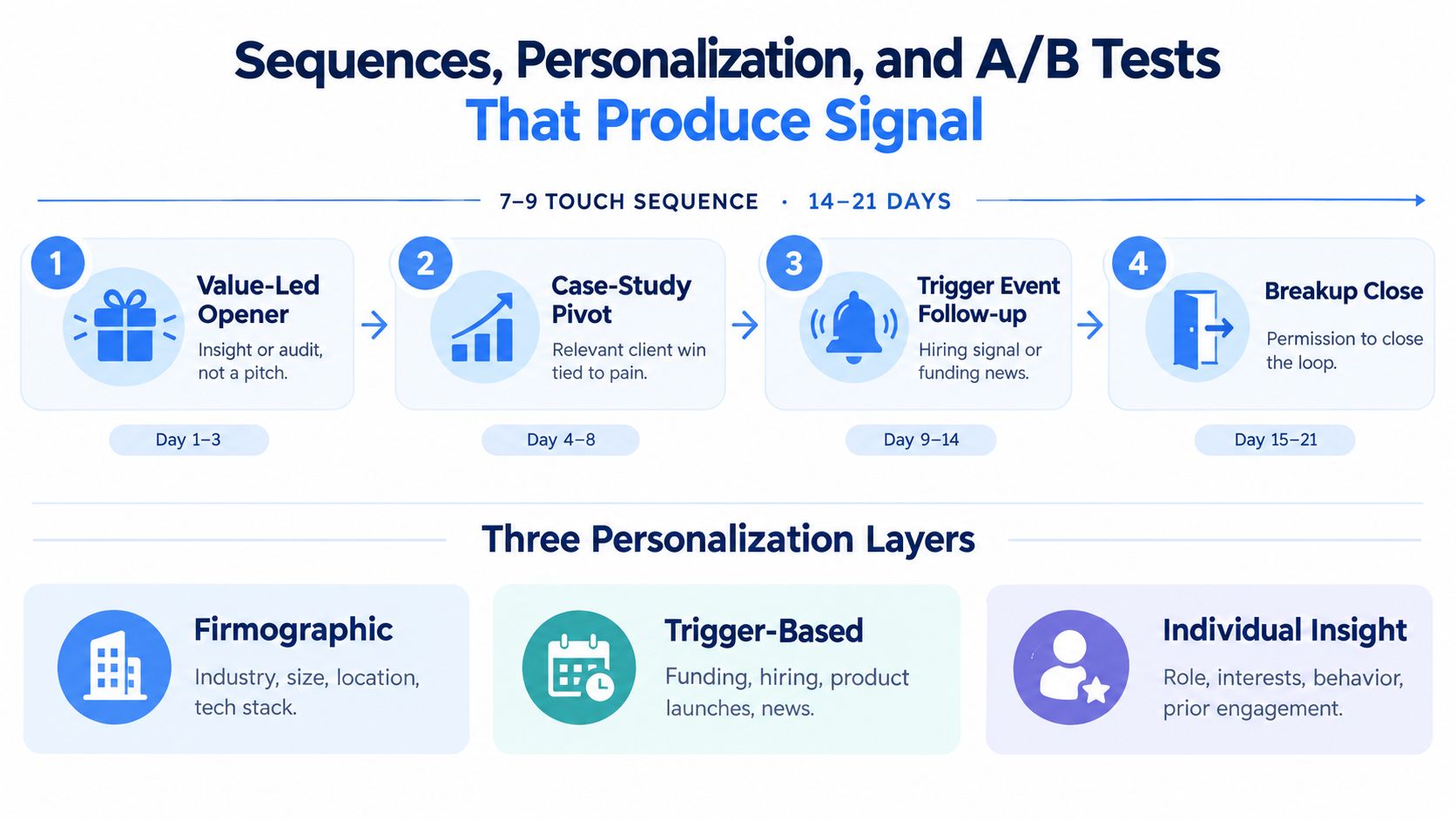
A good sequence gives the prospect several credible reasons to respond without repeating the same pitch. A defensible structure uses 7 to 9 touches over 14 to 21 days, combining a value-led opener, a relevant proof point, a trigger-based follow-up, and a respectful close.
Start with an observation or useful asset, not a service catalog. The second touch can connect a relevant client result to the prospect's operating context. A later message can reference a hiring event, product launch, funding news, or another public trigger. The final message should make it easy to decline or defer without creating unnecessary pressure.
Personalization needs three layers
Company-level relevance explains why the account is a fit. Use its vertical, technology stack, hiring pattern, market, or operating model.
Role-level relevance explains why the recipient should care. A CMO, demand-generation director, and founder may share a business goal but carry different responsibilities, reporting lines, and decision authority.
Trigger-level relevance explains why the message is timely. A recent hire, product launch, funding event, or service expansion gives the outreach a concrete starting point.
The mistake is confusing a custom sentence with personalization. “I saw your website” adds little. A useful opener connects a verified fact to a likely business problem and a narrow offer.
Testing rule: Change one meaningful variable at a time, and decide the evaluation rule before the campaign starts.
Test subject lines, openers, calls to action, or cadence separately. Keep the audience, offer, sender, and sending conditions stable enough that the result has an interpretable cause. Stop based on a pre-agreed confidence standard rather than a compelling anecdote from a handful of replies. Don't test five variables in one launch, and don't treat open rate as proof of commercial intent. Subject-line tests often produce noise when deliverability, list quality, or sample size changes at the same time.
Use this video as a practical visual companion to the sequence and personalization model:
Multichannel Orchestration Beyond the Inbox
Email can carry the core message, but prospects often recognize an agency through several channels before they agree to speak. LinkedIn, webinars, paid retargeting, and SMS can reinforce a relevant point. They can also make an agency look careless when every channel sends a separate pitch.
A coordinated pattern might look like this:
- Day 1: View the prospect's LinkedIn profile and prepare the email.
- Day 2: Send the first email with a specific account insight.
- Day 3: Activate retargeting only for appropriate engaged accounts.
- Day 5: Send a follow-up that adds evidence or a practical resource.
- Day 7: Comment thoughtfully or send a restrained LinkedIn message.
- Day 9: Invite the prospect to a relevant webinar or share a useful asset.
- Day 14: Close the loop by email.
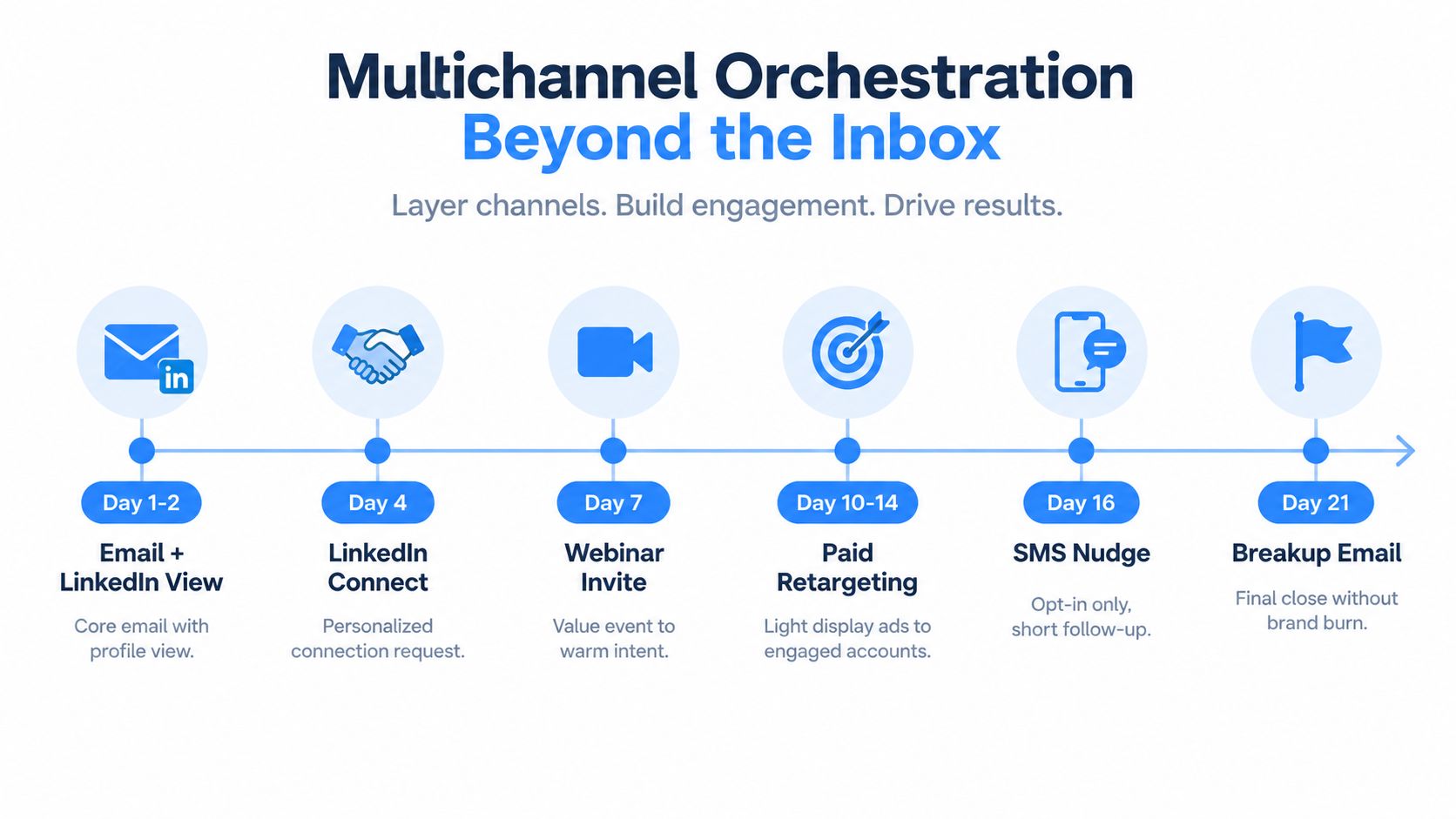
The exact timing should reflect channel permissions, account sensitivity, and the prospect's behavior. One person shouldn't receive an email, LinkedIn DM, ad, and SMS message within the same short window. Set a channel cap per prospect, suppress people who reply, and stop paid audiences when the account exits the sequence.
LinkedIn activity deserves special care. A founder's profile is a brand asset, not an automation sandbox. Route research and low-risk activity through a safe-touch tool or virtual assistant layer, while keeping connection requests and direct conversations human. SMS should be opt-in only and reserved for a legitimate follow-up context, not used as a workaround for weak email performance.
The best multichannel programs don't maximize touches. They make each touch answer a different question: Is this relevant? Is there evidence? Is the timing right? What is the easiest next step?
Qualification and the Calendar Handoff
An agency isn't paid for emails sent. It gets paid for qualified opportunities that move toward a commercial conversation. That makes qualification and calendar handling part of the product, not administrative work after the campaign.
A practical BANT-lite framework for marketing services asks four questions:
- Fit: Does the company match the agency's industry, size, service scope, and budget band?
- Authority: Can the contact approve or materially influence a 3 to 6 month engagement?
- Need: Is there an active pipeline, acquisition, positioning, or execution problem connected to the offer?
- Timing: Does the prospect have a decision window within the current quarter or a clearly defined future period?
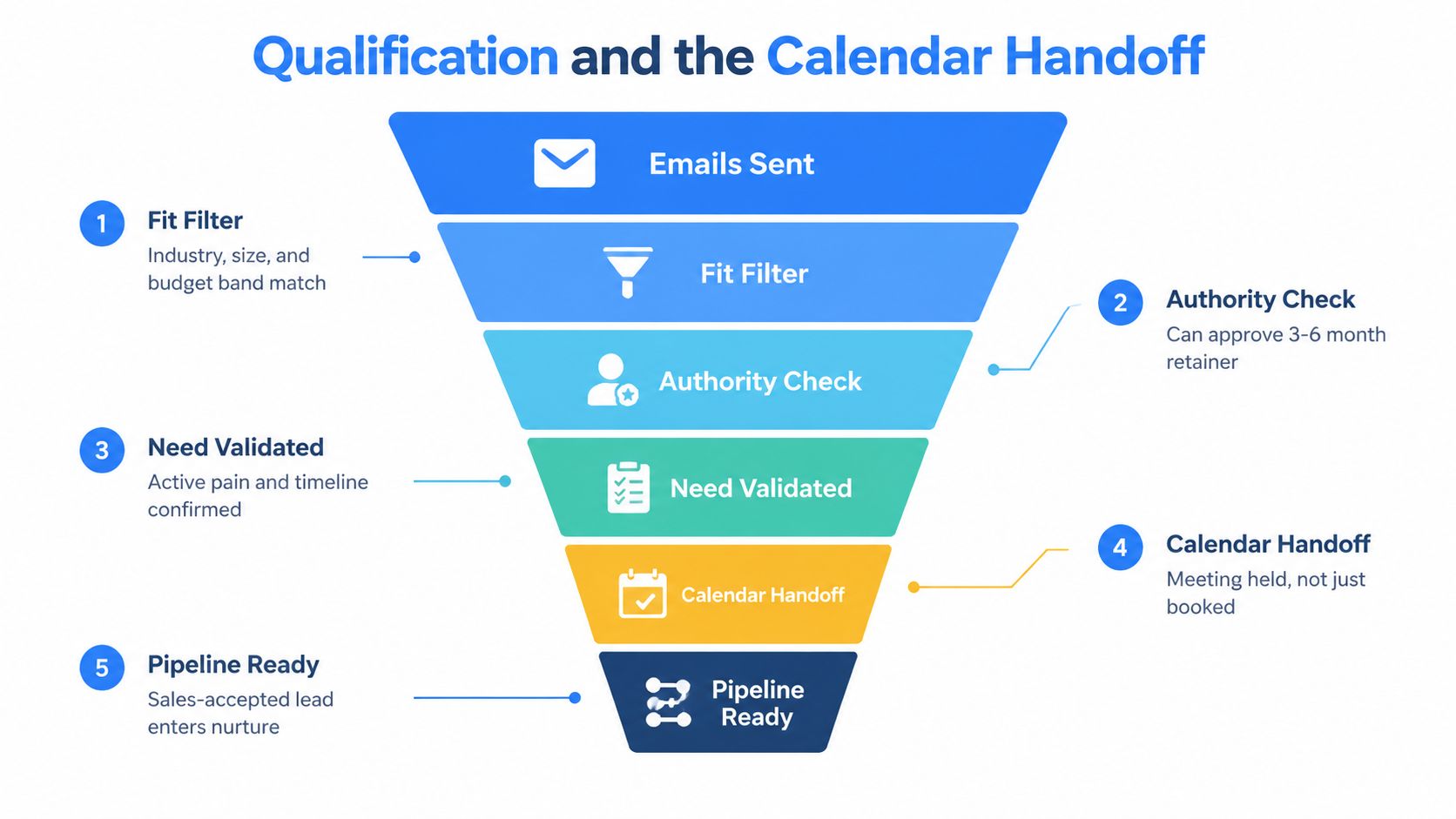
Encode those rules into reply tags and CRM stages. “Positive,” “needs qualification,” “nurture,” “disqualified,” and “booked” should mean the same thing to the SDR, strategist, and founder. Calendar routing should use round-robin assignment between qualified strategists, not whichever person notices the inbox first.
The handoff needs context. Auto-populate a pre-call brief with the account's enrichment data, trigger, reply summary, stated pain, service fit, and open questions. A 24-hour show-rate SLA gives the team a clear standard for reminders, confirmation, and rescheduling. The meeting is not complete merely because a prospect selected a time.
Disqualification protects the system. Send a polite closeout, place viable but untimely accounts into nurture, and define re-engagement windows at 90 and 180 days. Don't keep emailing someone who has clearly declined. A clean exit protects sender reputation and leaves the relationship intact.
Reporting, Optimization, and Scaling to 300 Leads a Month
Reporting should answer one question: which operating choices create pipeline? Open and reply data help diagnose a campaign, but agency leadership should connect them to qualified meetings, held meetings, opportunities, closed business, and cost per qualified meeting.
Run three dashboards:
- Deliverability health: Inbox placement, spam complaints, authentication status, domain reputation, bounce patterns, and mailbox behavior.
- Engagement and conversion: Opens, replies, positive replies, meetings booked, meetings held, opportunities, and disqualifications.
- Revenue contribution: Pipeline created, closed-won revenue, campaign cost, and cost per qualified meeting.
Review the system weekly. Prune unengaged domains and unhealthy inboxes, refresh enrichment sources, inspect failed segments, and rotate creative when the audience has seen the same angle repeatedly. Re-score segments monthly as triggers change. Don't increase volume to compensate for a weak offer or deteriorating placement.
The scaling path should add operational capacity in sequence:
| Monthly Leads | Channels | Team | Target CPL | Target SQLs |
|---|---|---|---|---|
| 50 | Email with tightly focused targeting | Founder or senior operator | Set from actual campaign cost | Defined by held-meeting quality |
| 100 | Email plus LinkedIn or webinar invitations | Add channel ownership | Reviewed against qualified pipeline | Increase only with stable qualification |
| 300 | Dedicated inbox pool, email, LinkedIn, retargeting | Add junior SDR coverage and management | Controlled through infrastructure and list efficiency | Scaled only when show and acceptance rates hold |
These tiers are operating stages, not guaranteed benchmarks. The verified research shows why economics matter: one 2026 source cites an average B2B cost per lead of $198, compared with about $53 for cold email and $31 for SEO, while marketing automation is reported to generate up to 451% more qualified leads (lead generation statistics and channel economics). Those figures don't replace an agency's own attribution model, but they clarify why teams combine outbound, inbound, automation, and disciplined qualification.
At the first tier, improve ICP precision and reply quality. At the second, add a channel only after email operations are stable. At the third, separate list research, infrastructure, campaign management, qualification, and calendar ownership. A dedicated inbox pool and junior SDR coverage can increase capacity, but only if senior staff continue to review segment quality and pipeline acceptance. Lead Printer is one example of a provider that combines infrastructure setup, prospect research, enrichment, personalized email, LinkedIn orchestration, qualification, and reporting for B2B outbound programs.
The agencies that scale without letting acquisition costs drift don't just send more. They protect inboxes, refresh data, keep qualification strict, and assign human ownership to every stage from account selection through held meeting.
If your agency needs a cleaner pipeline foundation, Lead Printer can build and run the data, email infrastructure, personalization, multichannel outreach, qualification, and calendar handoff behind your outbound program. Visit Lead Printer to discuss a campaign built around qualified opportunities rather than raw send volume.