A cold email campaign can average just 3.43% in replies, while top performers exceed 10%, according to Instantly's 2026 cold email benchmark report. That gap isn't explained by sending more messages. It comes from better data, tighter segmentation, stronger deliverability, and outreach built around signals that tell you why a prospect might care now.
The most effective lead generation campaigns don't treat email, LinkedIn, paid media, events, and sales development as separate activities. They connect those channels around one audience, one commercial problem, and one measurable pipeline outcome. When the system works, technical infrastructure protects reach, personalization improves relevance, and sequencing gives buyers several sensible opportunities to respond.
What Lead Generation Campaigns Are in 2026
Signal-based outreach can produce reply rates of 15% to 25%, compared with around 1% to 3% for campaigns without personalization, according to Autobound's 2026 cold email guide. Basic personalization falls around 5% to 9%, while advanced personalization reaches 9% to 15%. Results still depend on the market, list quality, offer, and execution. The practical lesson is clear: relevance creates more opportunities than raw volume.
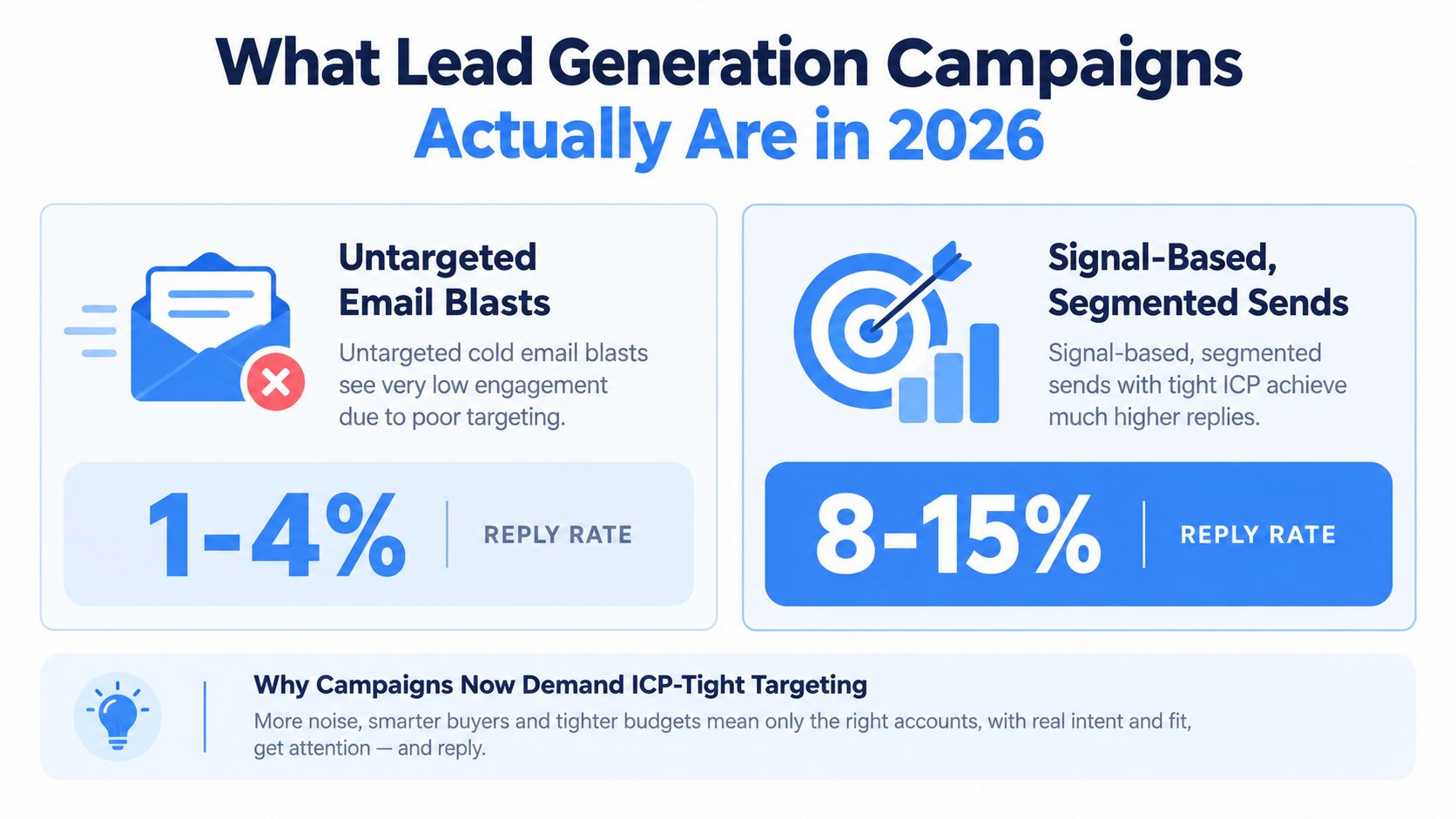
A lead generation campaign is a coordinated motion that turns a defined prospect universe into a measurable commercial outcome. It may combine cold email, LinkedIn outreach, phone calls, webinars, paid search, retargeting, partner distribution, and sales follow-up. The email sequence is only one operating part. Deliverability, audience selection, message design, timing, and sales handoff must work as one system.
That structure matters because buying decisions rarely sit with one contact. Research summarized by Sopro's lead generation statistics reports that 84% of purchase decisions involve more than one person, with an average of 4.05 decision-makers. A campaign aimed at one person through one channel can miss the wider group that evaluates, approves, and implements the purchase.
From batch sending to coordinated outreach
Legacy outbound starts with a list and a template. Modern outbound starts with a market hypothesis. Define the ideal customer profile, group accounts by fit and buying context, enrich the records, and build a message around a verifiable business condition.
A RevOps campaign might target companies hiring sales operations staff, adopting a new CRM, or expanding their go-to-market team. Email can introduce the problem, LinkedIn can build familiarity, a webinar can educate several stakeholders, and a sales call can address operational detail. Each touch needs a distinct job. Repeating the same pitch across channels wastes attention.
Operator rule: Don't add another channel until you know which failure you're trying to fix. More activity won't repair bad data or poor inbox placement.
Diagnose the system in order. Confirm that messages reach inboxes, then check whether the right prospects respond, then measure whether responses become qualified meetings and pipeline. Open rates provide limited context, but they are a weak basis for diagnosing a cold outbound program. Fix the earliest broken stage before changing the offer or adding more activity.
Core Channels and How to Combine Them
Each B2B channel addresses a different acquisition constraint. Email provides control over audience, timing, copy, and follow-up, while sender reputation determines whether prospects see the message. LinkedIn supplies visible identity and social context, but requires manual work and careful account management. Webinars and virtual events give several stakeholders a reason to engage, though they need a credible topic and promotion. Paid search and social can create attention quickly, but targeting limits and media costs make efficiency harder to control.
| Channel | Typical Cost per Lead | Sender Control | Best-Fit Use Case |
|---|---|---|---|
| Cold email | Low relative cost, dependent on infrastructure and data quality | High over list, message, and cadence | Precise account-based prospecting |
| LinkedIn outreach | Moderate operational cost because of manual effort | Moderate, with platform limits | Building familiarity and social proof |
| Webinars and virtual events | Higher preparation cost | High over topic and audience experience | Educating mid-funnel buyers and involving groups |
| Paid social or search | Variable and often difficult to control at scale | Moderate over targeting and creative | Capturing demand and creating awareness |
Email usually supplies scalable reach. LinkedIn strengthens recognition and credibility rather than replacing email. A prospect who receives a relevant inbox message and later recognizes the sender on LinkedIn experiences a connected campaign. The sequence should share one thesis, while each channel performs a specific job. Repeating identical copy across channels wastes attention.
Phone outreach fits accounts with high potential value, a strong buying trigger, or buyers who are difficult to reach digitally. Sales teams should use practical guidance to train sales teams on cold calling, including preparation, call openings, objection handling, and handoff rules.
Match channels to buyer stage
Use outbound email to start a relevant conversation. Use content, events, and retargeting while prospects assess the problem. Use sales development for qualification, stakeholder mapping, and agreement on the next step. A webinar attendee has context that an untouched account does not, so follow-up should reference the event topic and propose a specific operational discussion.
Paid media can keep the category visible while outbound creates direct conversations. Both programs need compatible positioning, audience definitions, and calls to action. Otherwise, paid impressions reinforce one message while outbound asks for a different action.
Treat the campaign as one operating system: deliverability controls whether reach exists, sequence design determines whether attention develops, and signal-based personalization makes the conversation relevant. If results stall, check those dependencies in order before adding another channel. Review cross-channel lead generation for an operating model that connects email, LinkedIn, content, and follow-up within one campaign.
How to Plan and Build a B2B Campaign Step by Step
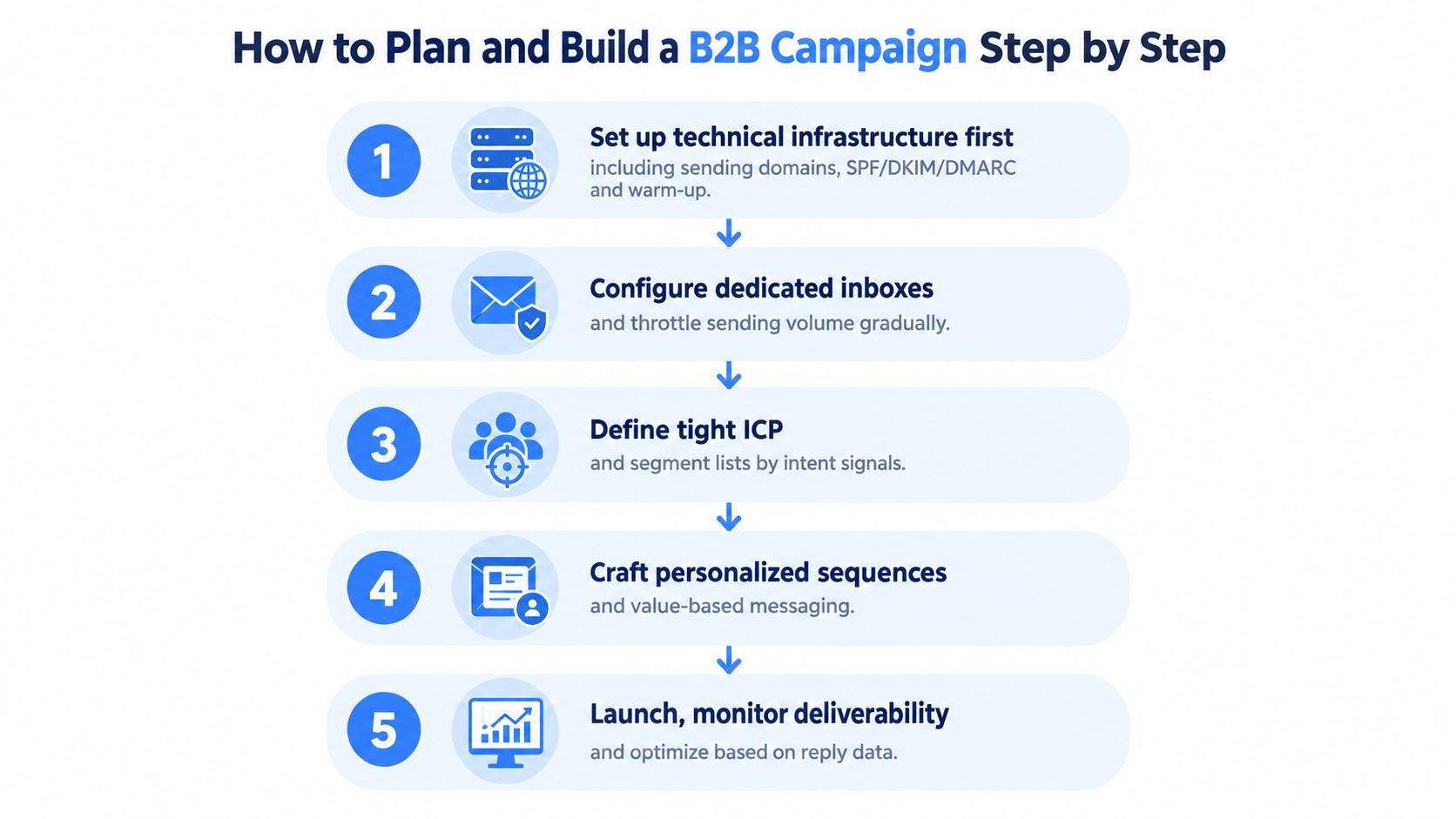
A campaign works best when built in dependency order. Start with the revenue hypothesis, define the audience, prepare the data, then write the message. Copy cannot compensate for poor targeting, weak records, or infrastructure that sends qualified prospects to spam.
Build the foundation before the message
Set up sending domains, authenticated mailboxes, warm-up, bounce controls, and reply routing first. Separate campaign traffic from the company's primary domain where appropriate, and assign daily monitoring to a named owner. Keep the infrastructure stable before adding a large audience or complex sequence.
Define the ICP around a specific commercial problem. A SaaS company selling to RevOps leaders might separate fast-growing software companies from mature enterprises, then rank accounts by technology stack, hiring activity, team structure, and operational complexity. A RevOps leader implementing a new CRM faces different pressure from one reducing tool sprawl.
Enrich every record with firmographic, technographic, role, geographic, and trigger data. A job title and email address are not enough. The message needs a defensible reason for contact.
Write and sequence around one useful idea
Connect the offer to the trigger. If a prospect is hiring operations staff, address reporting and process ownership as the team scales. If the company is consolidating tools, focus on visibility and workflow consistency. A generic product description gives the buyer little reason to reply.
Build the sequence across channels, with each touch adding context instead of repeating the opener. Test the audience and offer together, not only subject lines. Hold out a controlled group when possible, so genuine improvement is easier to separate from normal variation.
Before launch, verify throttling, bounce monitoring, automated suppression, reply ownership, qualification rules, and calendar routing. For teams using Appointment Setters, define the context those setters receive and the criteria they use to qualify a response. Poor handoff can erase gains from strong targeting and messaging.
A structured outbound lead generation process should connect infrastructure, research, messaging, launch, and handoff. Treating them as separate vendor tasks creates gaps between deliverability, sequence behavior, personalization signals, and sales follow-up.
A short visual walkthrough helps teams align on the mechanics before launch:
The KPIs That Predict Pipeline
Inbox placement comes first. Pintel's email deliverability benchmarks place healthy placement at 85% or higher, with strong programs at 88% to 92% or higher. The same guidance sets spam complaints below 0.1% and identifies at least 3 meetings per 1,000 sends as a target for top-performing programs.
This order prevents bad diagnosis. If messages miss the inbox, a weak reply rate says little about the copy. Healthy placement with few replies points to list fit, trigger quality, positioning, or offer relevance. Healthy replies with few meetings shifts attention to qualification and sales follow-up.
| KPI | Healthy Range | What a Bad Number Reveals |
|---|---|---|
| Inbox placement | 85%+ healthy, 88% to 92%+ strong, according to Pintel's benchmark guidance | Authentication, reputation, bounce, or sending-volume problems |
| Reply rate | 3.43% overall average, with top performers exceeding 10%, according to Instantly's 2026 report | Weak targeting, poor relevance, or an unconvincing offer |
| Meetings per 1,000 sends | 3+ for top performance, according to Pintel's benchmark guidance | Qualification, call-to-action, or follow-up friction |
| Spam complaints | Below 0.1%, according to Pintel's benchmark guidance | Irrelevant targeting, excessive pressure, or poor list hygiene |
Open rates belong lower on the dashboard. Apple Mail Privacy Protection, automated security scans, and seed-list behavior make opens a noisy attention signal. Track delivery, replies, positive replies, qualified meetings, opportunity creation, and pipeline contribution instead. These metrics connect channel performance to the sales calendar.
Turn metrics into decisions
Calculate cost per qualified meeting by dividing campaign and operational spend by meetings that meet your qualification standard. Track pipeline velocity by comparing qualified opportunities with send volume and time to sales acceptance. Consistent definitions matter more than elaborate formulas. If marketing counts every response while sales counts only viable buying conversations, the dashboard produces disputes instead of decisions.
Use this diagnostic sequence:
- Delivery problem: Audit domains, authentication, bounce handling, complaints, and volume.
- Audience problem: Review firmographic fit, role seniority, account status, and trigger freshness.
- Message problem: Test the problem statement, proof, offer, and call to action.
- Conversion problem: Review qualification, response speed, meeting availability, and sales ownership.
For activity across LinkedIn and outbound channels, LinkedIn analytics tools add useful engagement context, but they do not replace pipeline measures. Define a shared lead qualification standard before comparing channels. That lets teams identify which constraint to fix first, rather than changing deliverability, messaging, and follow-up at the same time.
Real B2B Campaign Examples and What Drove the Results
Campaign results become useful only when their operating conditions are visible. Audience definition, channel coordination, timing, offer, sequence length, and qualification rules all affect the outcome. Copying the visible tactic without those details usually produces a weaker campaign.
Lead Printer's supplied operational materials include 687 warm leads for ÖÖD House, 237 qualified leads and €40k in revenue for B2B Growth, and 7 new clients plus 106 sales opportunities for ESTO. These are company-reported examples, not universal benchmarks. They also come from different campaign conditions, so the useful comparison is the mechanism behind each result.
| Campaign Type | Starting Conditions | Sequence Design | Result and Key Lever |
|---|---|---|---|
| Cold email for a niche ICP | A focused market with a need for controlled reach | Email-led outreach with segmentation and follow-up | ÖÖD House reported 687 warm leads. The campaign used a narrow audience and a qualification step that separated active interest from simple engagement |
| Multichannel outreach for business buyers | A B2B offer requiring role and account context | Email combined with LinkedIn touches and personalized messaging based on role and trigger | B2B Growth reported 237 qualified leads and €40k in revenue. Qualification required a relevant business need before commercial follow-up |
| Outreach supported by event or market context | A target market needing education before a direct sales conversation | Content or event context followed by targeted outbound | ESTO reported 7 new clients and 106 sales opportunities. The sequence used the event context as the opening trigger before sales outreach |
The examples point to different operating choices. A niche market may reward localization, a focused list, and strict fit checks. A complex B2B sale may require several stakeholders, coordinated email and LinkedIn touches, and a clear handoff to sales. A cold audience may engage more readily after an educational event gives the conversation a shared reference point.
The sequence should also match the signal. A role change, account expansion, event attendance, or stated business problem can justify personalization. Without a current trigger, adding more copy or more channels usually increases activity without improving sales conversations.
Pattern-match before you copy
Ask four questions before adopting another company's sequence:
- Does the audience share the same buying trigger?
- Does the offer solve a problem the buyer recognizes now?
- Can the sales team handle the response volume and qualification standard?
- Is the channel mix appropriate for the market and buyer role?
If any answer is no, changing subject lines will not rescue the campaign. Diagnose the constraint first. Deliverability determines whether the message arrives, sequence design determines whether interest develops, and signal-based personalization determines whether the outreach feels relevant. The transferable lesson is the operating condition, not the headline result.
Why Most Campaigns Stall and How to Break Through
More touches do not create intent by themselves. They create more chances to be ignored, reported, or remembered for the wrong reason. A longer sequence earns its place only when each step adds a new reason to respond. Repeating the same pitch increases fatigue.
A deliverability ceiling appears first. Once a sending domain loses reputation, adding volume worsens the constraint. B2B teams often answer fewer replies by contacting more people, even though undelivered messages have already made the reply rate misleading. The campaign may still show activity while fewer prospects see the offer.
List decay creates a second ceiling. Roles change, companies reorganize, and priorities shift. A contact that matched the ICP during research may not own the problem when outreach arrives. Refresh enrichment and buying triggers before adding another generic follow-up. A stale list can make good copy look ineffective.
Channel stacking creates a separate failure mode. Email, LinkedIn, ads, and phone outreach often sit with different teams, each measuring its own output. Prospects then receive overlapping messages without shared context. Internally, the campaign looks busy. Externally, it feels careless.
The strongest programs treat these channels as one operating system. A trigger can start an email sequence, inform a LinkedIn touch, and shape the sales call. Each channel should add context, not repeat the same request. Signal-based personalization matters because it gives every touch a reason to exist.
Stalling campaigns also waste sales capacity. Replies may rise while poor-fit prospects reach account executives, creating more qualification work and weakening trust between marketing and sales. Qualified pipeline remains more useful than activity totals.
Use the troubleshooting checklist for the order of operations. This section's point is narrower: protect the delivery ceiling, keep the list current, and coordinate channel touches before increasing sequence volume. Scaling a broken system only makes its failure more visible.
Troubleshooting, Localization, and Scaling Checklist
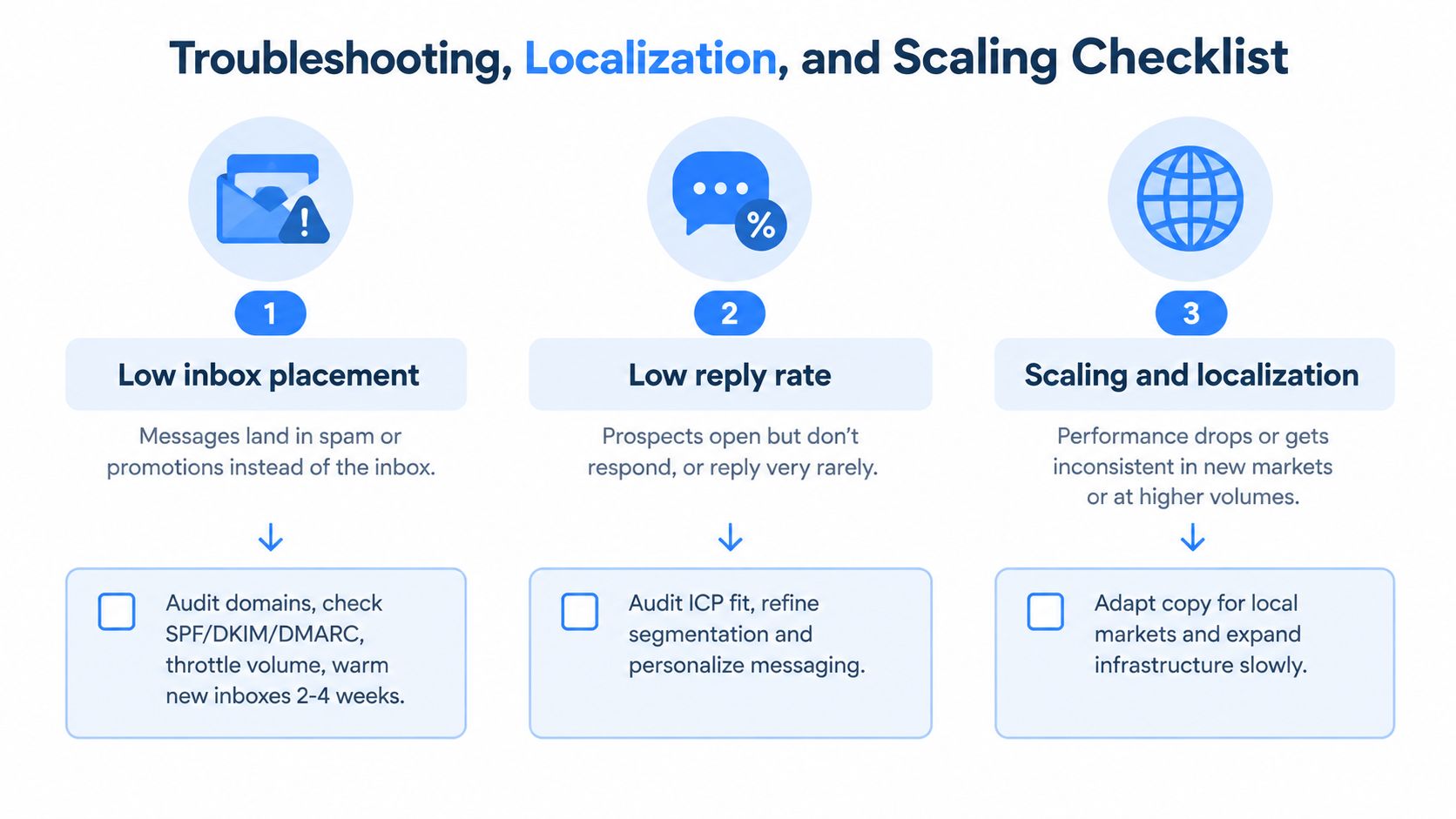
Troubleshooting starts with the symptom, not the tactic you planned to try next. If inbox placement has collapsed, inspect delivery infrastructure before rewriting the sequence. If replies are weak while delivery remains healthy, examine list quality and relevance before adding domains or sending more volume.
Start with the symptom
Low inbox placement calls for an infrastructure audit. Confirm SPF, DKIM, and DMARC alignment, review bounce and complaint signals, inspect inbox health, and compare sending pace with the capacity of each inbox. Throttle volume when delivery worsens, warm new inboxes gradually, and pause segments generating harmful signals. Use the healthy inbox placement thresholds defined earlier as operating context. First verify that messages reach recipients, then work on reply-rate improvements.
Low reply rate points to targeting, data, or message relevance after delivery is stable. Recheck the ICP, remove stale records, and enrich contacts with a current role, initiative, or other buying signal. Rewrite the opener around one specific reason for contacting that account. Test subject lines and message structures in controlled groups, while separating a copy adjustment from a broader targeting problem.
Low meeting conversion usually appears after the reply. Review whether the SDR response matches the promise made in the email, tighten qualification, and make the next step easy without pushing every prospect directly to a calendar. A prospect asking for information may need a useful answer before a meeting request.
Localize before entering a new market
Localization includes language, regional terminology, working hours, local proof, legal requirements, and commercial conventions. For EU outreach, review consent, legitimate-interest reasoning, suppression, and data handling with appropriate legal counsel. CAN-SPAM requirements also apply to US campaigns.
Set send windows by local time zone and adapt examples to the prospect's market, not only its spelling. Confirm that pricing, payment currency, meeting format, and sales ownership fit the region before launch. A translated sequence with the wrong offer, handoff, or business context still feels generic.
Scale without burning the system
Scale through controlled infrastructure and clearer segmentation. Separate sending by persona when the buying trigger or message differs. Rotate message blocks when fatigue appears, monitor bounces and complaints, and cap activity per inbox according to what the infrastructure can safely sustain. Add channels only when they share campaign context, so email, LinkedIn, advertising, and sales calls reinforce the same signal instead of repeating disconnected requests.
A practical scaling checklist includes:
- Protect reputation: Pause segments that create delivery or complaint problems.
- Separate audiences: Keep personas, regions, and offers distinct enough to diagnose.
- Route replies quickly: Assign ownership before the campaign starts.
- Review quality weekly: Sample positive, negative, and non-responsive accounts.
- Scale by evidence: Expand only after delivery, relevance, and qualification remain stable.
Lead Printer provides outsourced B2B outbound execution covering prospect research, data enrichment, email and LinkedIn campaigns, qualification, calendar handoff, and reporting. Teams that need an operator to connect those pieces can visit Lead Printer to discuss their target market, offer, and pipeline goal.