Your sales team has a clear offer, a capable website, and a CRM full of contacts, yet the calendar still has gaps. Prospects recognize your company but don't reply to cold emails, paid campaigns produce clicks without enough qualified conversations, and executives are difficult to reach through generic outreach.
That situation is why LinkedIn marketing services have moved beyond routine posting. The strongest programs connect professional targeting, useful content, paid distribution, LinkedIn messages, email follow-up, and revenue reporting into one pipeline system. LinkedIn has evolved from a professional networking site launched in 2003 into the largest B2B-focused social platform in the world. A source projects 1.3 billion members by 2026, while another reports 424 million monthly active users in Q1 2026 (Thunderbit's LinkedIn B2B marketing research).
Introduction Why LinkedIn Marketing Services Matter Now
A B2B buying process can start long before a form submission. A finance leader may see a founder's post, notice a colleague engaging with it, encounter a relevant LinkedIn advertisement, accept a connection request, and respond to an email later. If those touchpoints sit in separate campaigns, your team sees scattered activity instead of one developing buying conversation.
LinkedIn gives marketers a clearer starting point because professional identity is visible. Buyers often show their role, company, industry, seniority, location, and career context. That information helps teams select accounts and shape messages with more precision than broad interest targeting. Research cited in Thunderbit's 2026 statistics roundup reports that 87% of B2B marketers use LinkedIn, while 53% of B2B professionals rank it as the most important social platform for business marketing.
The practical shift: Ask how LinkedIn can help the right buyers recognize, trust, and respond to your company across the revenue journey.
LinkedIn marketing services support an acquisition system rather than an isolated posting schedule. The system can connect profile positioning, company-page management, thought leadership, paid advertising, account research, connection workflows, direct messages, email follow-up, lead qualification, and attribution.
Each part has a different job. Content builds recognition, advertising reaches selected accounts, outbound messages create direct conversations, and email gives sales a channel for continued follow-up. CRM and attribution data then show whether those interactions produce qualified meetings, opportunities, and revenue.
The goal is not more LinkedIn activity. It is a traceable path from a named account and relevant message to a business outcome. This guide explains how those pieces fit together and how to assess the providers that manage them.
Understanding What LinkedIn Marketing Services Really Include
A software buyer sees a thoughtful post, visits an executive profile, clicks an account-specific ad, and later replies to a direct message. If those steps are managed separately, the journey becomes difficult to understand. LinkedIn marketing services connect them into a pipeline that can continue through email, sales qualification, and revenue attribution.
LinkedIn works like a professional directory combined with a media and outreach channel. Members are identified through their role, company size, industry, and geography, giving B2B teams a clearer basis for account selection than broad interest targeting. The platform's scale is one reason it supports account-based programs. The broader context is covered in Thunderbit's LinkedIn B2B marketing statistics.
The service package behind the posts
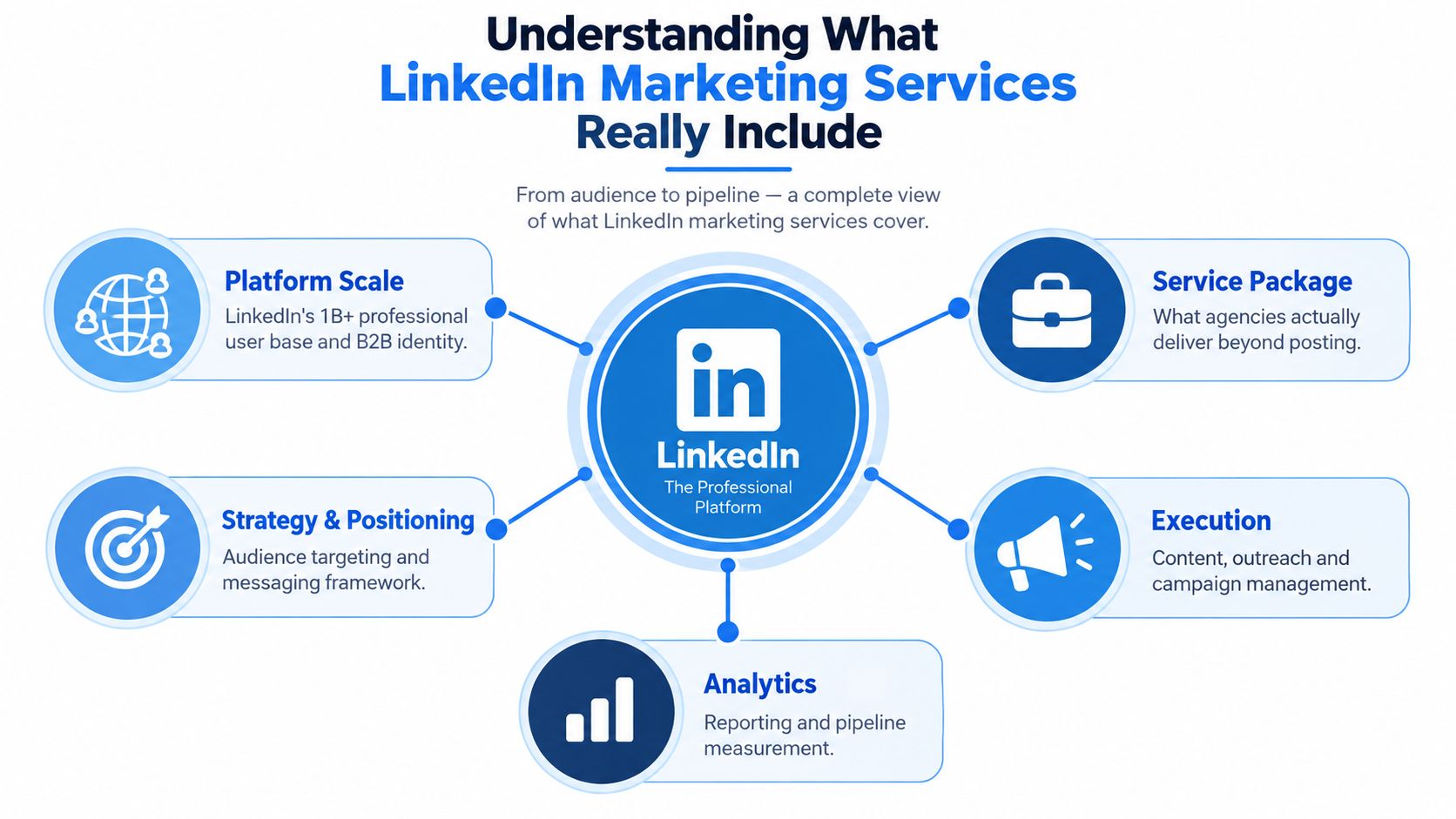
A managed program usually combines five connected activities:
- Platform strategy: Defining ideal customer profiles, account segments, buying triggers, and the role of each channel.
- Positioning: Refining executive profiles, company pages, offers, and messages so buyers quickly understand the problem being addressed.
- Execution: Producing organic content, managing sponsored campaigns, sending approved outreach, and coordinating follow-up.
- Data operations: Building account lists, enriching contact records, and maintaining audience quality.
- Measurement: Connecting impressions, clicks, form fills, conversations, meetings, opportunities, and revenue in one reporting model.
The operating work extends beyond a content calendar. Internal teams must maintain audience data, write for different buyer roles, configure advertising, coordinate with sales, and preserve the handoff into the CRM. An agency can provide that operating layer while subject-matter experts supply insight and approve the message.
Video can support trust when an expert has a useful process, explanation, or customer problem to address. Teams seeking a practical production starting point can try this free LinkedIn video maker for marketers, then adapt the result to the brand's voice and audience instead of publishing generic clips.
The scope determines the provider's value. A vendor that only schedules posts manages content. A provider that connects targeting, content, ads, outbound DMs, email follow-up, qualification, and attribution manages a pipeline system. Each activity should support the next, with CRM data showing whether attention becomes a qualified conversation, opportunity, or revenue.
Core Pillars of Effective LinkedIn Marketing Services
A company can publish regularly, run ads, and send messages without creating a working pipeline. Effective LinkedIn marketing services connect these activities in sequence, from a buyer's first impression to a qualified conversation and revenue attribution. Evaluate a provider across five pillars, because each one removes a different constraint.
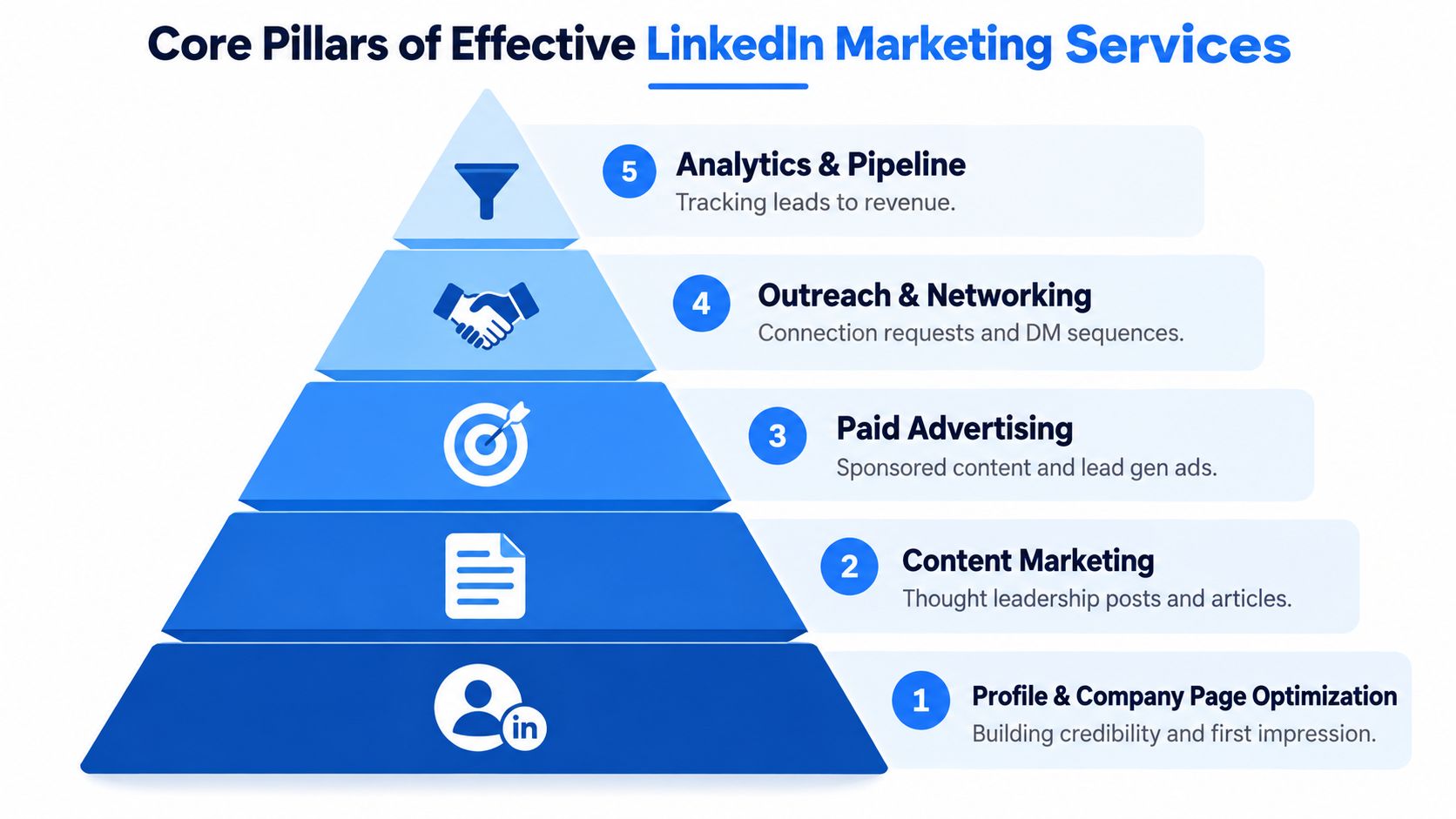
1. Profile and company page optimization
Your profile often becomes the first conversion surface after a prospect sees a post, advertisement, or message. It should explain who you help, which business problem you address, and what a sensible next step looks like. The company page should reinforce that position through clear services, useful resources, proof, and consistent visual identity.
A common error is treating the profile as an internal biography. Responsibilities may be accurate, yet they do not answer the buyer's question: “Is this relevant to my situation?” Strong optimization makes relevance clear without turning every sentence into a sales pitch. It also gives later content and outreach a credible destination.
2. Content and thought leadership
Organic content creates familiarity before a direct conversation starts. Useful formats include practical education, expert interpretation, customer problems, operating lessons, and evidence that the team understands the buyer's environment. Each post should support a broader message, so paid campaigns and outbound conversations reinforce rather than contradict it.
Trust needs deliberate attention. LinkedIn's 2025 B2B Marketing Benchmark reports that 94% of marketers see trust as critical, 55% already partner with creators or subject-matter experts, and 78% use video ([LinkedIn's B2B marketing reports and benchmarks](https://www.linkedin.com/pulse/ultimate-list-b2b-digital-marketing-reports-b lkpc)). The same source says teams combining video and influence are 2.2 times more likely to be trusted and 1.8 times more likely to be well known. Native documents also reached a 7.0% engagement rate, while video engagement declined 36% year over year. Publishing more video alone will not solve a weak trust proposition.
Editorial test: If a post could have been written by any competitor, it isn't yet thought leadership.
3. Paid LinkedIn advertising
Paid campaigns place useful content and offers in front of selected accounts and roles. They can promote expert material, capture demand with Lead Gen Forms, retarget engaged visitors, or support account-based campaigns that require repeated exposure.
Targeting changes the cost of attention. Broad B2B audiences generally cost less than narrow enterprise or account-level audiences, while smaller audiences can raise auction prices. The detailed CPM benchmarks belong in the measurement section, so this pillar should focus on decision quality. An agency should explain the audience definition, the reason for its size, the offer shown to each segment, and how campaign results connect to later conversations.
4. Outreach and networking
Direct messages convert recognition into a possible conversation. Effective programs segment contacts, personalize the reason for reaching out, avoid premature pitches, and define when a sales representative takes over. The message should follow the content or advertising context, giving the recipient a clear reason to respond.
Governance protects that trust. Teams should agree on connection criteria, message approval, frequency, opt-out handling, and CRM logging. High volumes of irrelevant messages can weaken relationships faster than an underperforming post.
Scheduling supports the content system by keeping useful material consistent. These Taja AI scheduling tips offer practical workflow guidance. Teams connecting content with prospecting can also use this LinkedIn lead generation framework to relate audience activity to contact acquisition.
5. Analytics and pipeline attribution
Reporting should follow the buyer through the pipeline. Track audience quality, engagement, form submissions, replies, meetings, opportunities, influenced pipeline, and closed revenue where the CRM supports those connections.
Follower growth and impressions describe visibility. A service provider should also show which audiences, messages, formats, and offers help sales progress accounts. That attribution layer turns LinkedIn from a collection of tactics into an operating system for content, advertising, outbound conversations, and revenue measurement.
How LinkedIn Integrates With Email and Multichannel Outbound
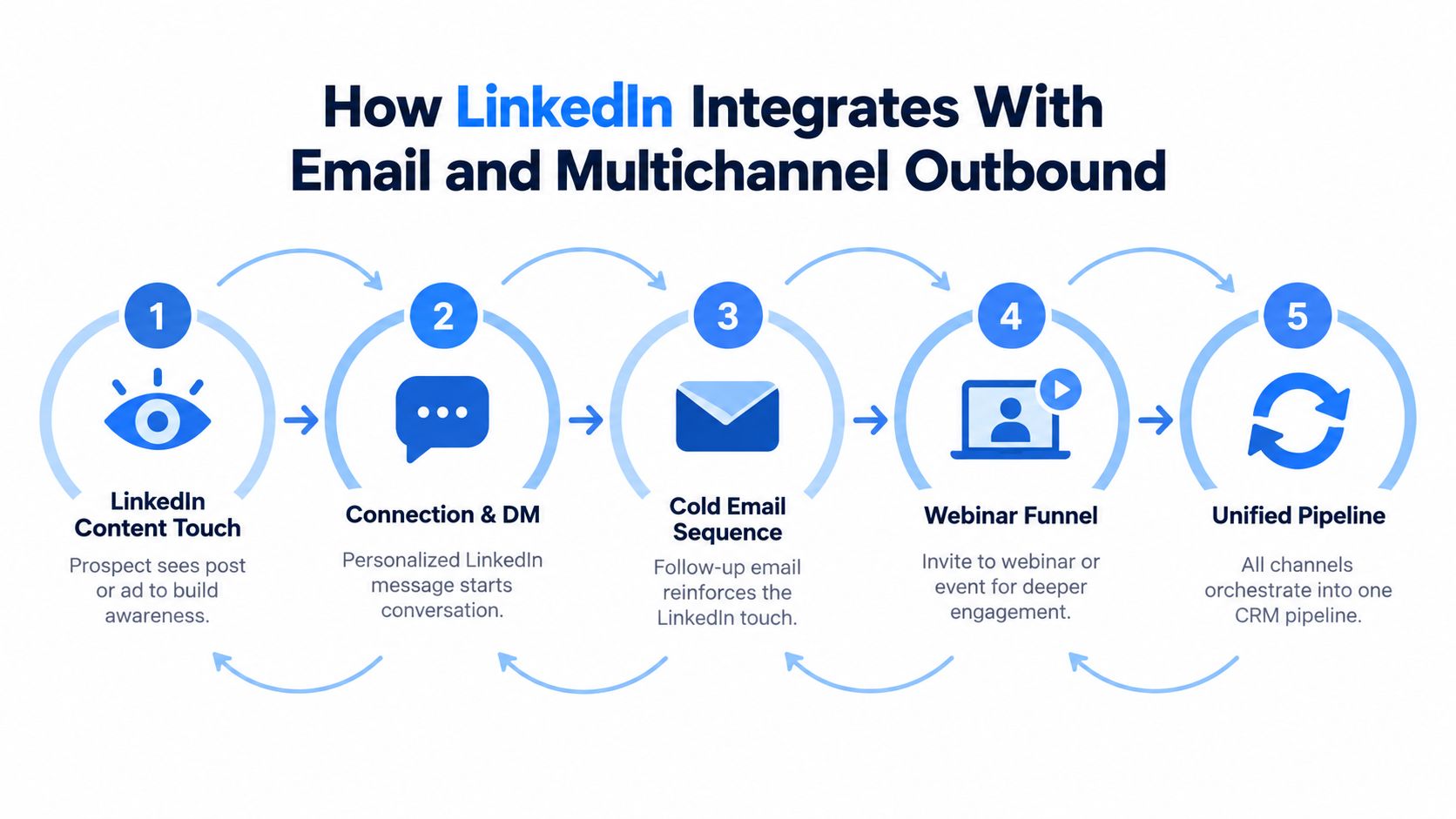
LinkedIn and email work best as coordinated touches, not competing campaigns. LinkedIn creates familiarity and context, while email gives the prospect a direct, searchable path to respond. A unified sequence lets each channel do the job it handles well.
Start with account intelligence
The workflow begins with a defined ideal customer profile. Teams identify target companies, relevant departments, decision-makers, influencers, geography, and useful triggers. LinkedIn Sales Navigator can support account research, while enrichment tools such as Clay can help organize firmographic and role information for segmentation.
The next step is message design. A marketing team might create one angle for a revenue leader, another for an operations leader, and a third for a technical evaluator. The message should reflect the prospect's business context, not merely insert a first name into a generic template.
Coordinate the touches
A mature sequence might look like this:
- Content or advertising exposure: The prospect sees an educational post, expert video, document, or account-focused advertisement.
- Connection and direct message: A relevant LinkedIn interaction opens a low-friction conversation.
- Email reinforcement: A concise email adds detail, a useful resource, or a clear reason to continue.
- Event or webinar invitation: A webinar gives interested buyers a deeper learning experience without forcing an immediate sales call.
- CRM handoff: Replies, engagement, qualification notes, and meeting outcomes move into one pipeline record.
The order can change by audience. A prospect who already engaged with a high-intent resource may receive an email first, while a cold account may need organic familiarity before outreach. The point is orchestration, not a rigid script.
Protect the handoff
Localization matters across US, UK, and EU markets. Tone, vocabulary, business norms, and consent expectations can differ, so one English-language sequence shouldn't automatically be copied across every region. Teams should also define ownership, so a positive reply doesn't sit in an agency inbox while the prospect waits.
The cross-channel lead generation process illustrates the operating principle: research, personalized messaging, campaign testing, qualification, and calendar handoff should sit inside one workflow. Siloed campaigns create duplicate messages and incomplete reporting. Integrated campaigns give sales a clearer account history.
Measuring Success With KPIs Benchmarks and ROI
A LinkedIn report should connect three questions: did the campaign reach the intended audience, did those people take meaningful action, and did that action influence pipeline or revenue?
Start with delivery metrics such as CPM, CPC, reach, and frequency. They indicate whether targeting and creative are working, but they do not establish business value. The next layer covers Lead Gen Form completions, message replies, email replies, meetings, and qualification. The final layer tracks opportunities, pipeline contribution, closed revenue, and return on advertising spend.
Native Lead Gen Forms reduce friction because LinkedIn pre-fills profile data. Independent 2026 benchmark roundups report Lead Gen Form conversion at roughly 6.1% to 13%, compared with approximately 2% to 5% for sponsored-content-to-landing-page flows (Traxy's 2026 LinkedIn lead-generation benchmarks). The tradeoff affects pipeline quality: easier submission can increase volume, while self-typed fields may capture more qualification detail.
Planning ranges
| Funnel Stage | Core Metric | Typical Benchmark Range |
|---|---|---|
| Paid reach | CPM for broad B2B audiences | $33 to $85 |
| Paid reach | CPM for narrower enterprise segments | $85 to $150 |
| Paid reach | CPM for ultra-narrow account targeting | $140 to $300 |
| Lead capture | Native Lead Gen Form conversion | 6.1% to 13% |
| Lead capture | Sponsored content to landing page conversion | 2% to 5% |
The ranges come from the cited LinkedIn advertising benchmark source and Lead Gen Form benchmark source. Use broad targeting when the offer needs reach and the sales team can qualify demand. Choose narrower segments when account fit matters more than volume. Ultra-narrow targeting suits named-account programs where each opportunity has higher strategic value, but it requires careful frequency and budget control. Audience, offer, creative, response time, and qualification rules will change the outcome.
Attribute the long journey
B2B buyers can interact with organic content, ads, outbound DMs, and email before entering an opportunity. Dreamdata's 2026 benchmark reports 121% ROAS for LinkedIn in 2025, compared with 113% in 2024, and says LinkedIn represented 41% of total B2B paid media budgets (Dreamdata's benchmark research via LinkedIn). The same source describes an average B2B journey lasting 272 days, with 81% occurring before pipeline creation.
A last-click model can therefore undervalue the content and advertising that made an account familiar with the brand. Connect campaign parameters, CRM activity logs, account-level engagement, opportunity stages, and multi-touch or influenced-pipeline views. Teams building a broader measurement framework can consult SourceLoop marketing measurement guidance.
Measurement rule: Every report should separate attention, response, qualified meetings, pipeline, and revenue. These outcomes require different decisions.
How to Choose the Right LinkedIn Marketing Agency
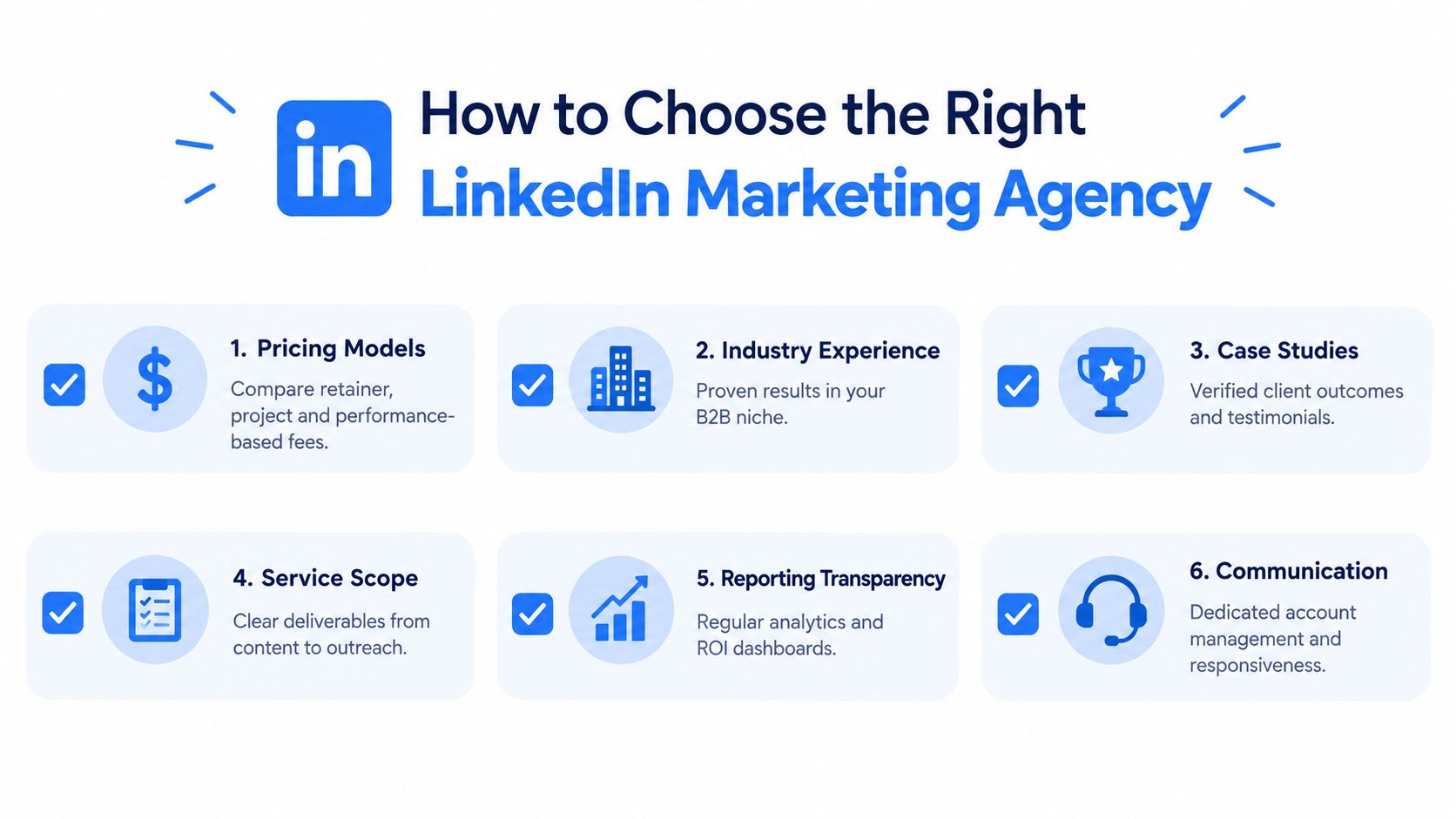
Choose an agency based on the operating problem you need solved, not on the number of posts it promises. A content-heavy provider may fit a company with strong sales infrastructure and weak authority. A demand-generation partner may be more suitable when the gap is account research, outbound execution, qualification, and CRM handoff.
Compare the commercial model
Retainers offer predictable access to strategy and execution. Project fees can suit a profile rewrite, positioning exercise, campaign build, or one-time audit. Performance-based arrangements align payment with defined outcomes, but you should examine how the agency defines a qualified lead and which factors remain under your team's control. Hybrid models combine a recurring operating fee with an outcome component.
Ask for a written scope that names deliverables, approval responsibilities, data ownership, reporting cadence, response-time expectations, and cancellation terms. Avoid proposals that promise “more leads” without defining audience, qualification, channel, and handoff.
Vet the operating details
Use discovery calls to ask:
- Targeting: How will you identify accounts and decision-makers?
- Data quality: Which sources and enrichment processes support the list?
- Personalization: How will messages reflect role, industry, geography, and business context?
- Infrastructure: Who manages sending safeguards, permissions, and inbox monitoring?
- Localization: Can the team adapt language and approach for US, UK, and EU audiences?
- Attribution: How will LinkedIn activity connect to meetings, opportunities, and revenue?
- Communication: Who owns the account, and how quickly will your team receive campaign insights?
A serious provider should also explain failure modes. If the audience is too narrow, the cost curve may rise. If the offer is unclear, better copy won't repair conversion. If sales doesn't follow up, channel performance can look weak even when buyer intent is real.
For companies comparing broader outbound support, a B2B lead generation agency can be evaluated alongside specialist LinkedIn firms. Lead Printer, for example, describes services spanning prospect research, personalized email, LinkedIn DMs, campaign optimization, qualification, and calendar handoff. Treat any provider's guarantees as contractual claims to inspect carefully, not as a substitute for fit, process, and measurement.
Real Results and Next Steps for Your LinkedIn Strategy
A SaaS company may use executive content to make a technical problem easier to understand, then retarget engaged accounts with a focused offer. An ecommerce or payments provider may combine merchant-focused list building with LinkedIn messages and email. A professional services firm may use partner-led content to create credibility before inviting selected prospects to a webinar. A manufacturer may target procurement, operations, and engineering roles with different messages instead of treating the account as one audience.
Those examples share a pattern. Content creates recognition, advertising extends selected messages, outbound starts direct conversations, email provides persistence, and CRM reporting shows whether the account is progressing. No single activity deserves credit for the entire result.
Start with an audit of your executive profiles, company page, target-account definition, active campaigns, message quality, CRM fields, and sales handoff. Choose one integration to test, such as connecting LinkedIn engagement to an email sequence or adding account-level reporting to paid campaigns. Then compare providers by the quality of their data, safeguards, personalization, localization, qualification process, and revenue reporting.
The right LinkedIn marketing services partner won't just publish more frequently. It will help your team turn professional audience data and useful expertise into a controlled, measurable path to qualified pipeline.
Lead Printer builds and runs data-driven email and multichannel campaigns that combine prospect research, personalized messaging, LinkedIn-assisted outreach, qualification, and calendar handoff. Visit Lead Printer to discuss how an integrated LinkedIn and outbound system could support your B2B pipeline.