In 2021, B2B customers regularly used ten or more channels to interact with suppliers, up from five in 2016, according to McKinsey research summarized by Belkins. For a marketing lead at a mid-sized company, that shift isn't an abstract trend. It looks like a partner asking for a co-branded campaign, sales requesting a prospect list, a LinkedIn post waiting for approval, an event approaching, and an outbound email sequence that still needs localization.
The problem isn't a shortage of channels. It's the lack of a practical operating system connecting them. B2B channel marketing works when partners, email, LinkedIn, content, events, and sales follow-up pass the buyer from one useful interaction to the next without losing context.
This playbook focuses on execution. It covers partner models, strategy design, outbound integration, localization for the US, UK, and EU, and measurement that gives channel activity a credible connection to pipeline.
Introduction
A buyer might discover a vendor through a partner, validate the category through search, see a leadership post on LinkedIn, attend an event, reply to an email, and then bring a sales colleague into the conversation. Each interaction changes the next one. A generic message sent after a partner introduction feels careless, while a relevant follow-up that reflects the buyer's industry and region feels coordinated.
That coordination is difficult when one person owns channel planning, partner communication, outbound execution, and reporting. The marketing lead may have a shared folder full of vendor assets, but no time to rewrite them for each market. A reseller may want to promote the offer but lack the staff to build a landing page, segment a list, or manage follow-up. Sales may see the resulting leads without knowing which partner or campaign created the original interest.
The practical test: every channel should make the next interaction more relevant, not merely add another touch.
The strongest programs connect vendor-side enablement with hands-on execution. They give partners usable campaigns, turn partner relationships into targeted prospecting, and make sure email and LinkedIn activity supports events and introductions rather than competing with them. They also measure contribution across the journey instead of rewarding whichever channel happens to record the final click.
The sections ahead show how to build that system without treating every partner, market, or channel as identical.
What B2B Channel Marketing Actually Means
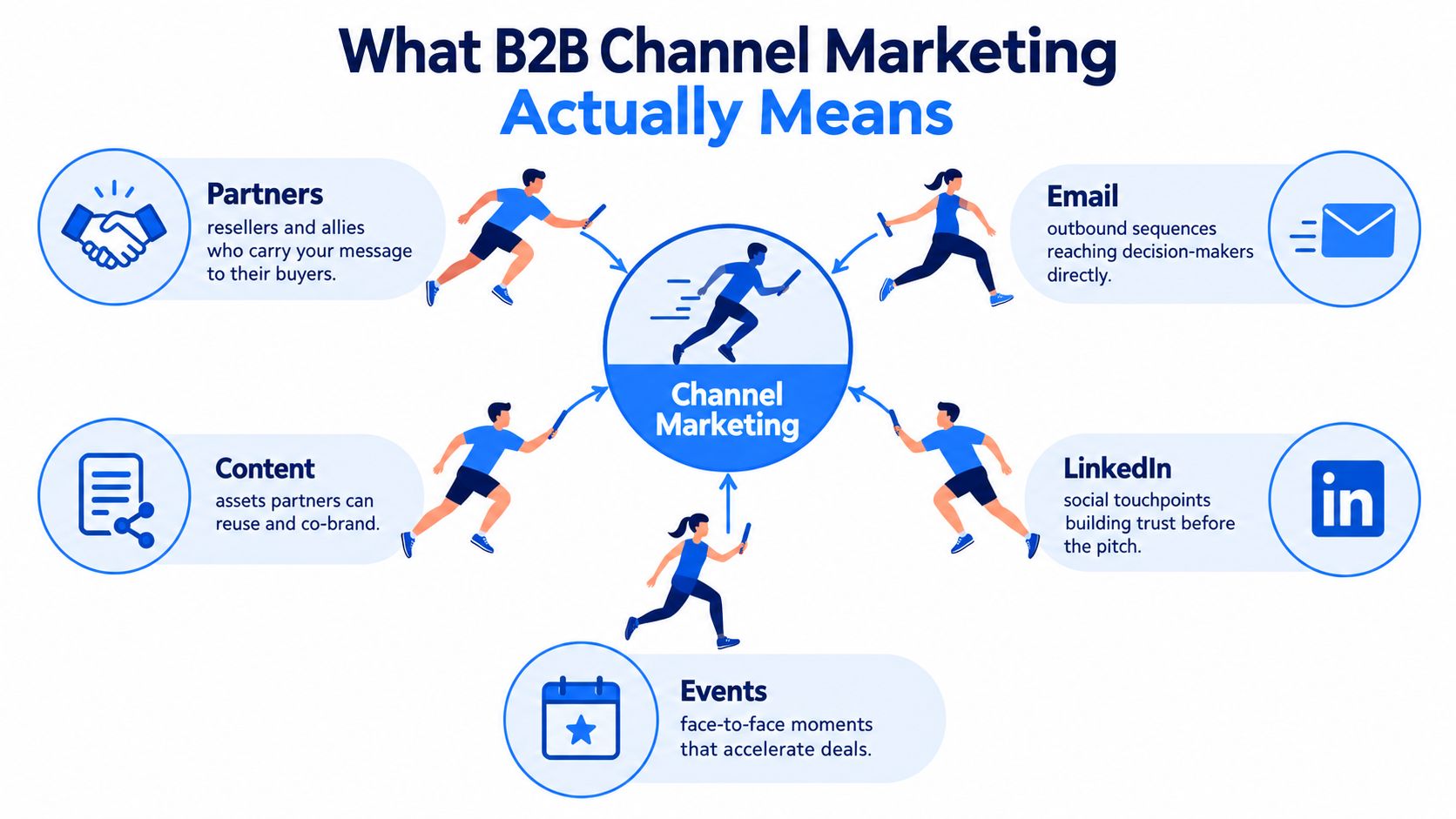
A solo salesperson can carry a conversation from first contact to close. Channel marketing is different. It works more like a relay team, where partners, email, LinkedIn, events, content, and sales each carry the baton for part of the buying journey. The handoff matters as much as the individual runner.
A reseller may introduce the solution to an existing account. A partner-branded email can make the first message credible. LinkedIn can provide a softer follow-up before a direct conversation. An event can create the trust needed for a complex discussion. Content gives every participant something useful to share. If the message changes at every handoff, the buyer has to reconstruct the story. If the handoffs are clean, the journey feels intentional.
Direct and indirect motion
Direct selling means your own team finds, engages, and converts the account. Indirect channel motion adds another organization that contributes access, trust, expertise, distribution, implementation, or commercial reach. The partner may source the opportunity, influence it, transact it, or support delivery.
Channel marketing sits between several functions:
- Partner marketing gives external organizations campaigns, content, training, and co-marketing support.
- Sales enablement equips sellers with messages, proof points, objection handling, and follow-up material.
- Demand generation creates awareness, engagement, and pipeline among target accounts.
- Channel operations connects partner activity to registration, routing, attribution, and reporting.
A program fails when these functions operate separately. A vendor can recruit excellent partners but give them assets that are too generic to use. A demand team can generate responses but fail to identify the partner that influenced the account. A sales team can receive a meeting without knowing whether the prospect came through a referral, an event, or a coordinated outbound sequence.
A useful introduction to the wider partner-marketing ecosystem is Affiliate Landscape's explanation of partner marketing, particularly for teams comparing referral and affiliate motions.
Reusable definition: B2B channel marketing is the coordinated use of partners and customer-facing channels to create, influence, and convert business demand.
The definition is intentionally operational. It includes the partner relationship, the message delivered through each channel, the handoff between teams, and the evidence that activity produced commercial progress.
Channel Types and Partner Models Compared
Not every partner deserves the same commercial design. A distributor can extend physical availability across a market, while an agency may create demand and deliver implementation. An affiliate can generate trackable introductions, but usually won't provide the account-level guidance of a strategic alliance.
The choice comes down to four questions: who already has access to the buyer, how much control you need, how much enablement you can provide, and where delivery responsibility sits.
B2B Partner Models at a Glance
| Partner Model | Best Fit | Vendor Control | Effort Level |
|---|---|---|---|
| Reseller | SaaS, equipment, and repeatable solutions sold through an established commercial team | Medium | High |
| Distributor | Manufacturing and products needing regional reach, logistics, or inventory support | Low to medium | High |
| Affiliate | Offers with clear digital conversion paths and trackable referrals | Medium | Low to medium |
| Referral partner | Professional services and relationship-led sales | Medium | Medium |
| Technology alliance | Complementary software, integrations, and shared customer problems | Medium to high | High |
| Agency | Services, implementation, managed delivery, and specialist expertise | Medium | Medium to high |
Resellers suit vendors that need another sales organization to present, sell, and sometimes support the offer. You gain reach and local credibility, but you give up some control over positioning and customer experience. Resellers need more than a product deck. They need qualification guidance, competitive context, pricing rules, campaign-ready copy, and a clear handoff process.
Distributors are useful when availability, logistics, or regional coverage matters. They can open markets that a vendor can't serve efficiently alone, but the vendor often has less visibility into the end buyer. Data sharing and downstream demand creation therefore become central parts of the agreement.
Affiliates and referral partners are lighter-weight options. Affiliates usually work through trackable links or codes, while referral partners rely more heavily on introductions and relationship trust. Both can be effective, but neither should be treated as a substitute for enablement when the product requires education.
Technology alliances and agencies create deeper collaboration. An integration partner can make your solution more valuable, while an agency can combine your offer with strategy, implementation, or ongoing service. These models demand joint planning because both parties are shaping the buyer's business case.
Partner revenue is already material for many companies. Partner Insight's channel benchmarks report that channels contribute about 20% of revenue on average, rising to roughly 30% for companies above $250M ARR. The same source cites a projection that 75% of global B2B transactions were expected to flow through channel partners by 2025. The implication isn't that every company should build a huge ecosystem. It is that indirect motion deserves commercial discipline, not leftover budget.
Start with two or three models that match your route to market. A SaaS vendor might combine referral partners with technology alliances. A manufacturer might begin with distributors and specialist resellers. A services firm may prioritize agencies and referral relationships. Adding every possible model at once creates recruitment volume without activation quality.
Building a Channel Marketing Strategy That Holds Up
A channel strategy should answer a commercial question before it answers a communications question. Start with the revenue contribution you expect from the channel, then decide which partners and motions can plausibly create it.
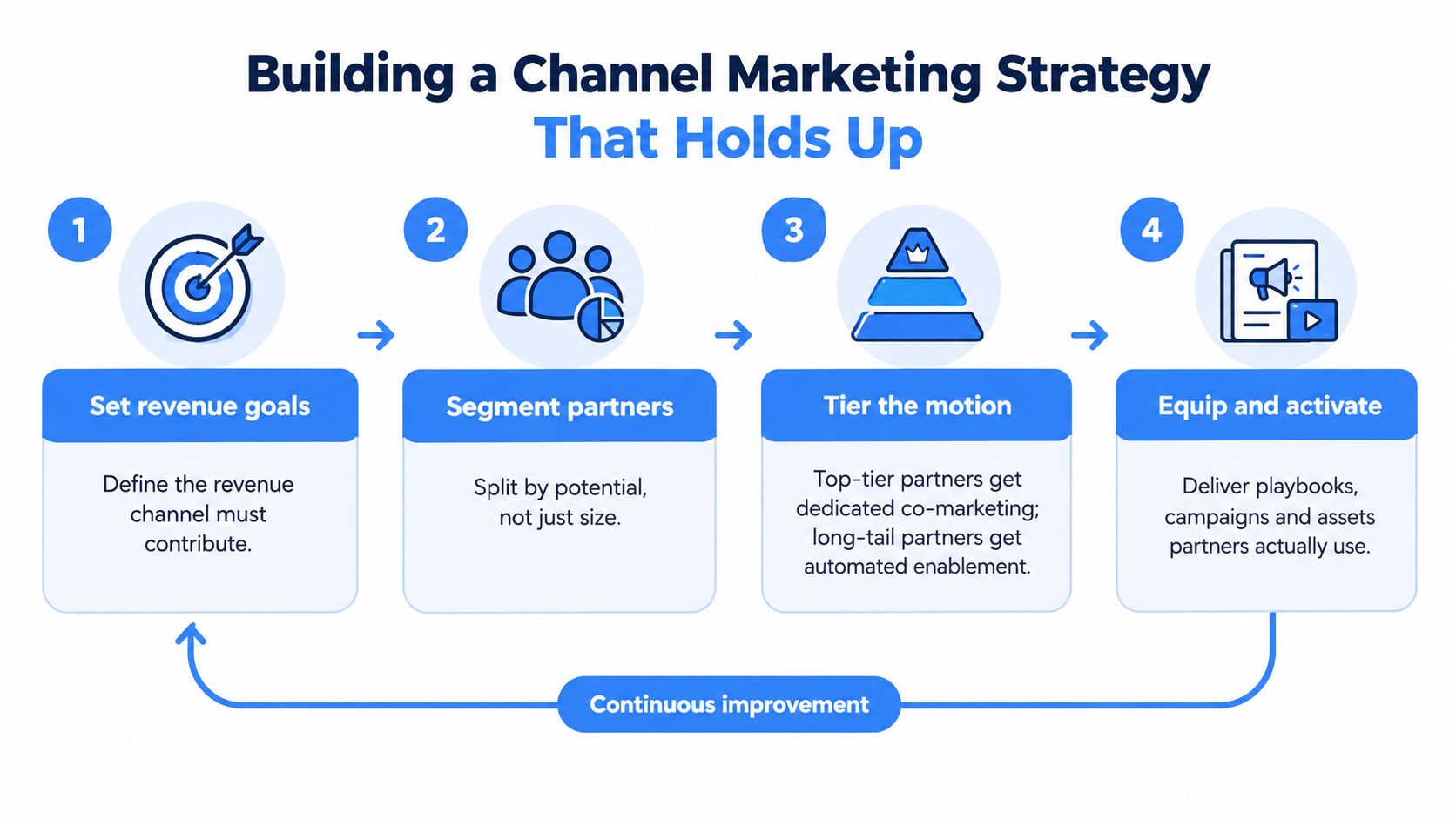
A useful operating sequence is:
- Set the revenue goal. Define whether the channel must source opportunities, influence pipeline, support transactions, or expand accounts.
- Segment partners by potential. Consider fit, access to the ideal customer profile, sales capability, geographic coverage, and willingness to execute.
- Choose the channel mix. Match partner type and customer-facing channel to the buying motion, rather than copying the previous quarter's plan.
- Design the journey. Map recruitment, onboarding, first campaign, opportunity registration, sales handoff, expansion, and advocacy.
- Remove execution friction. Give partners assets they can launch, personalize, and measure without needing a full marketing department.
Tier partners by the work they can absorb
The most ignored constraint is operational capacity. A 2025 industry report says 52% of small partners have no dedicated marketing resource, while also describing partners as inundated with vendor-supplied content that they struggle to make resonate. You can find that context in The Channel Company's analysis of the vendor-partner disconnect.
A practical tiering approach looks like this:
- Strategic tier: Give a small group of high-potential partners joint planning, account mapping, customized content, and shared campaign reviews.
- Growth tier: Provide repeatable campaign kits, office hours, templates, and a clear activation path.
- Scale tier: Use automated onboarding, short playbooks, recorded training, and ready-to-send assets.
The distinction isn't a reward system. It prevents the vendor from promising bespoke support to a long tail that can't absorb it, while ensuring important partners don't receive generic PDFs and a portal login.
Your campaign kit should include a target-account definition, message options by role, email and LinkedIn copy, event promotion text, landing-page language, qualification questions, and a method for reporting outcomes. Keep the global positioning stable, but make adaptation easy. A partner should be able to change the example, sender, market reference, and call to action without rewriting the campaign from scratch.
For a broader framework on aligning acquisition work with commercial goals, see this B2B customer acquisition strategy resource. The same principle applies to channel programs: activity only matters when it supports a defined path to opportunity and revenue.
Integrating Outbound Email and LinkedIn With Channel Campaigns
Partner campaigns become more productive when outbound execution follows the same account logic. The partner supplies credibility, market knowledge, or an introduction. Email and LinkedIn create consistent follow-up around the accounts that matter.
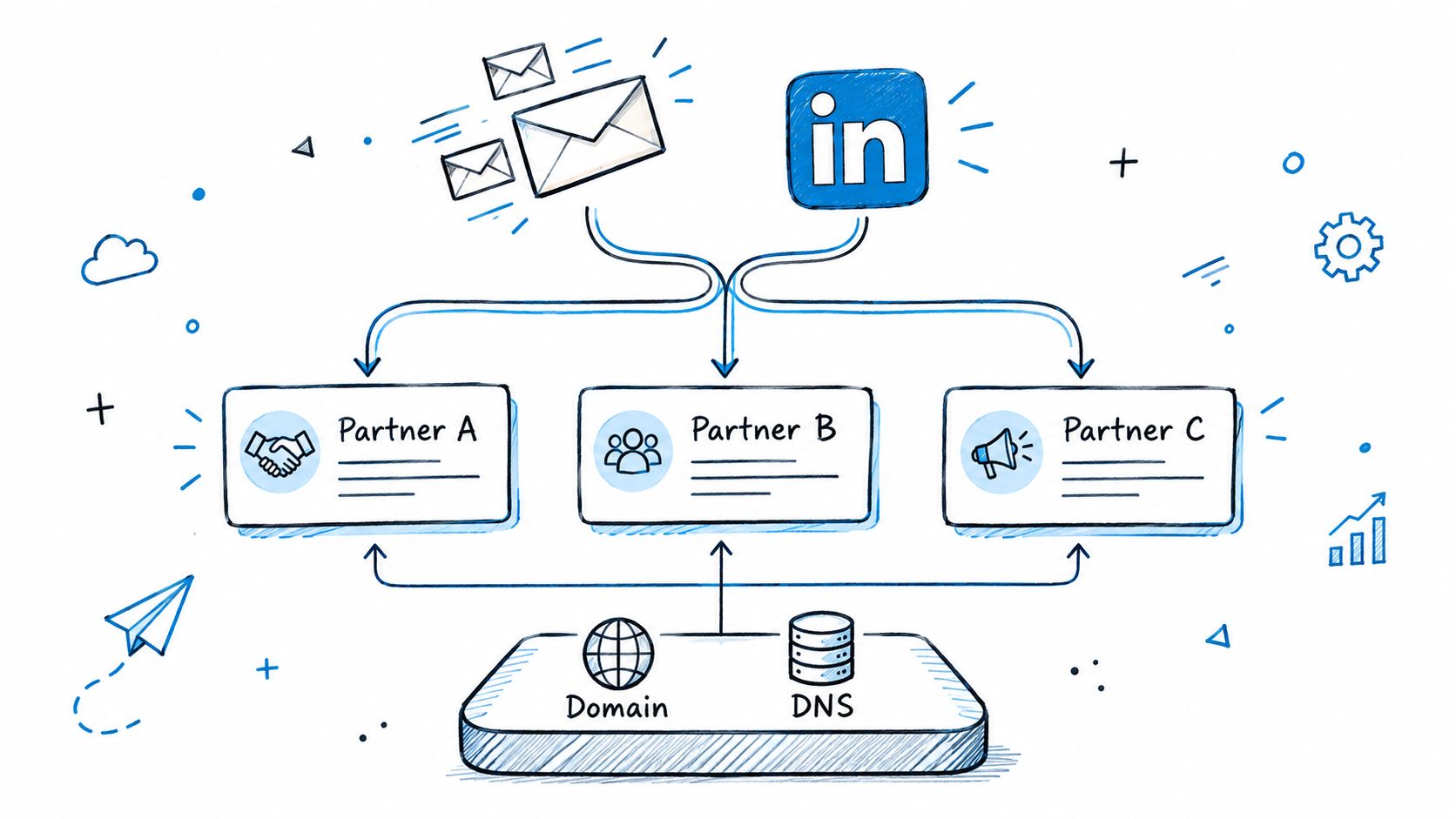
Start with the technical foundation. Authenticate the sending domain, use separate outbound inboxes where appropriate, warm up new sending capacity, and monitor deliverability before increasing volume. Protect the primary corporate domain from careless experimentation, and make unsubscribe handling and suppression rules part of the system rather than an afterthought.
A workflow the team can copy
1. Build the account list. Combine partner account knowledge with LinkedIn Sales Navigator, Google Maps, relevant websites, and national business registries. A partner's local knowledge can reveal buying signals that a broad database misses.
2. Enrich and segment. Match each record against a sharp ideal customer profile. Add role, company type, technology context, geography, partner relationship, and likely business problem. Remove accounts that don't meet the qualification rules.
3. Write for the situation. A partner-sourced introduction should sound different from a cold message. Mention the relevant market, role, use case, or shared context. Keep the offer narrow, and give the recipient a reason to respond even if they're not ready for a sales call.
4. Orchestrate the touches. Coordinate email with LinkedIn profile views, connection requests, direct messages, partner introductions, event invitations, and sales follow-up. Don't repeat the same pitch on every channel. Use each touch to add context or reduce uncertainty.
5. Route and learn. Define who owns replies, how partner influence is recorded, when a lead becomes an opportunity, and what happens after a meeting. Test subject lines, opening messages, calls to action, segments, and partner references. Retire weak variants instead of letting every sequence run indefinitely.
The best outbound program isn't a blast layered on top of partner marketing. It's a controlled extension of the partner motion. For teams building the LinkedIn component, this LinkedIn lead generation guide offers a useful reference for targeting and outreach mechanics.
LinkedIn activity can prepare a prospect for an email, while a relevant email can give a partner conversation a concrete next step. The handoff needs to be visible in the CRM, otherwise sales can't distinguish a warm partner-assisted opportunity from an unrelated response.
A short demonstration of the workflow can help teams align on the handoff between research, outreach, and follow-up:
Localizing Channel Campaigns for US, UK and EU Markets
A global campaign usually contains a global idea, not a finished local campaign. The positioning may travel well, but the sender, proof, language, references, and outreach style often need adjustment.
US campaigns can support a direct commercial tone and a clear next step, especially when the target account has an obvious business problem. UK outreach often benefits from a more restrained approach, sharper relevance, and less aggressive claims. EU programs require more careful treatment of language, market context, consent expectations, and local business practice. These are working assumptions, not rigid cultural rules. Segment by evidence and test with local feedback.
What to localize
- Language: Use local-language messaging where the buyer expects it, especially for markets where English is not the default business language.
- Sender identity: A recognizable local contact, partner, or market representative can reduce distance.
- Subject lines and openings: Reference the local industry, event, regulation, business environment, or customer problem.
- Proof: Use regionally credible examples and partner relationships rather than importing every global claim.
- Call to action: Offer a next step that fits the market, such as a short introduction, a local event, or a practical assessment.
Keep the core positioning, product truth, and qualification standard consistent. Change the route into the conversation.
Prospecting data also needs local treatment. Build lists from regional business registries, mapped data, industry directories, partner records, and LinkedIn searches instead of applying one global database to every country. Verify company status, role relevance, language preference, and local contact conventions before launch.
The case for regional nuance is reinforced by The Channel Company's partner marketing research, which reports that almost 90% of partners rate face-to-face events as very important. That doesn't make events universally superior. It does show why a digital-only plan can miss how partners and buyers build trust in particular markets.
For manufacturers planning market-specific acquisition, this B2B marketing resource for manufacturing provides additional context on industry-focused targeting and messaging. Use the same discipline for channel campaigns: localize the execution, then compare results by market rather than assuming one region represents all others.
KPIs and Measurement That Prove Channel ROI
Most channel reports start with activity because activity is easy to count. Emails sent, partner assets downloaded, event registrations, and leads created can show whether a team did the work. They don't prove that the work improved pipeline quality or revenue.
The attribution gap is substantial. In the cited benchmark set, only 31% of companies track multi-touch attribution beyond first and last touch, while 42% of B2B pipeline is marketing-influenced, according to The Starr Conspiracy's B2B campaign ROI benchmarks. When teams rely on first-touch or last-touch reporting, partner campaigns, localized content, webinars, and co-marketing often receive too little credit for shaping demand early in the journey.
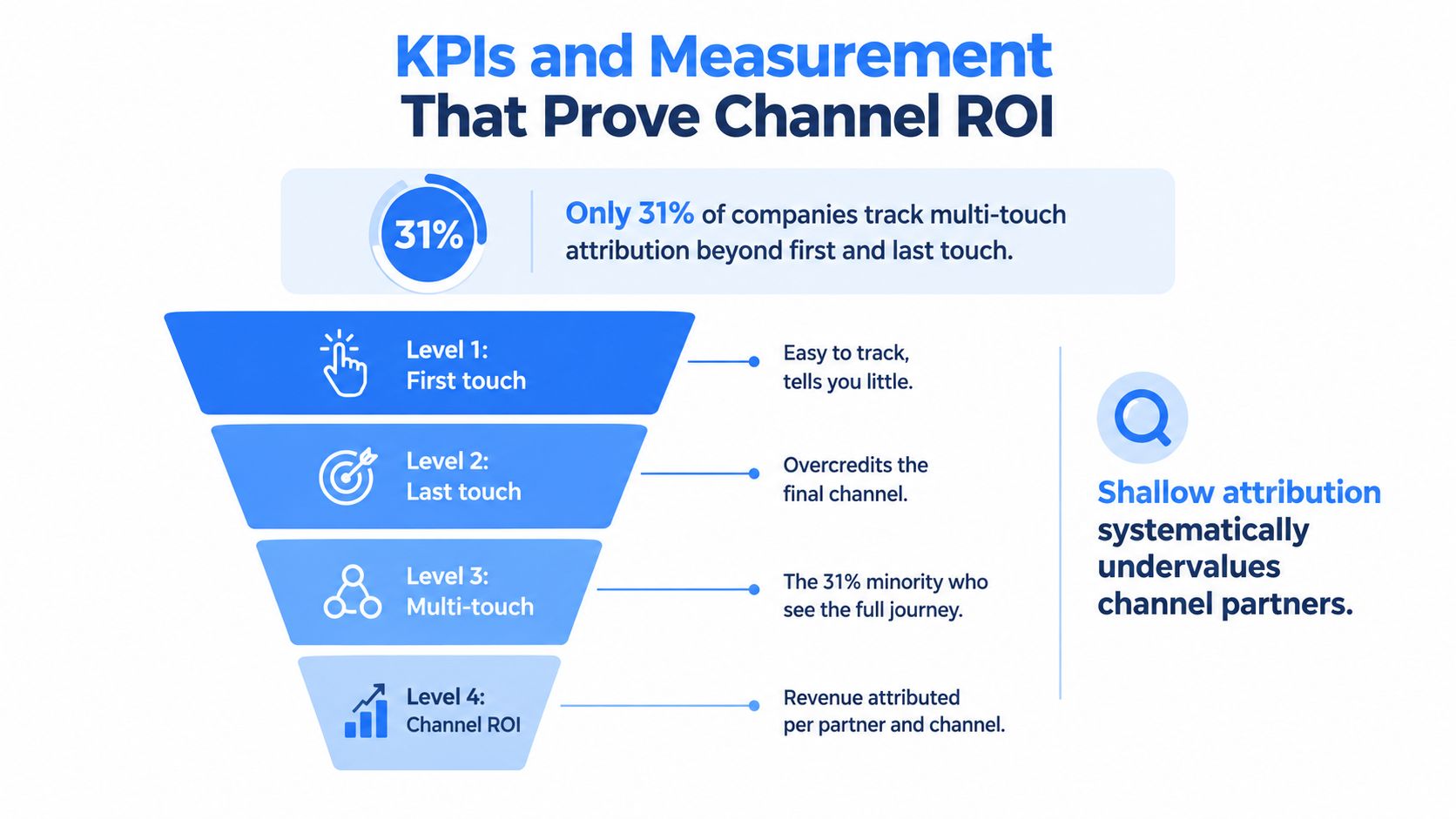
Use a tiered KPI model
Activity metrics belong at the bottom. Track partner activation, campaign launches, target accounts reached, outbound touches, event attendance, and content usage. These metrics diagnose execution, but they shouldn't be presented as commercial success.
Engagement metrics sit in the middle. Track positive replies, meetings booked, partner-sourced leads, accepted introductions, account engagement, opportunity creation, and progression between stages. Separate partner-generated activity from vendor-generated activity so the program can show where collaboration added value.
Revenue metrics belong at the top:
- Pipeline influenced: opportunity value where a partner or channel interaction played a documented role.
- Revenue attributed: closed revenue assigned according to a defined contribution model.
- Cost per opportunity: channel and campaign cost divided by qualified opportunities created.
- Partner contribution: sourced, influenced, transacted, and expanded revenue reported separately.
Don't force every interaction into a single attribution percentage. A sourced opportunity and an influenced opportunity are different commercial events. Use CRM campaign membership, partner registration, meeting source, account engagement, and opportunity-stage history to create a consistent record.
Reporting cadence should match the decision. Review delivery and response signals during campaigns, activation and meeting quality with partner managers regularly, and pipeline movement with sales leadership on a recurring revenue cadence. A channel dashboard should help someone decide which partner to support, which message to revise, and which market to scale.
Forrester reports that 67% of surveyed companies expect indirect revenue transacted through partners to grow above or significantly above the previous year, as described in its State of Partner Ecosystems 2025 report. That expectation raises the standard for measurement. If partner-sourced growth is a serious target, partner contribution can't remain a footnote in the demand report.
Measurement rule: if the report can't distinguish sourced, influenced, and transacted revenue, it isn't yet a channel ROI report.
Case Examples and Your Next Steps
A payment provider can ramp outbound acquisition from roughly 50 to around 300 leads per month while maintaining targeting quality when the work is structured around infrastructure, research, segmentation, copy, launch, and optimization. That type of ramp isn't created by sending more generic messages. It depends on preserving the ideal customer profile as volume grows.
Localized outreach can also improve relevance in EU markets when the team adapts language, sender identity, market references, and qualification logic instead of translating one global sequence. The operational lesson is simple: localization works best when it begins with data and ends with measured response quality.
Use the next 90 days to build the operating system:
- Audit the current mix. List every partner, campaign, email sequence, LinkedIn motion, event, and handoff.
- Tier the partners. Identify which relationships deserve joint planning and which need automated enablement.
- Fix measurement first. Define sourced, influenced, transacted, and revenue-attributed opportunities before increasing spend.
- Pilot one region. Run one integrated email and LinkedIn campaign with a clear partner connection and a narrow ICP.
- Review after 90 days. Compare reply quality, meetings, opportunity creation, partner participation, pipeline influence, and cost per opportunity.
Lead Printer provides outsourced B2B outbound execution across prospect research, data enrichment, email campaigns, LinkedIn outreach, qualification, calendar handoff, and reporting. If your channel team needs practical support turning partner campaigns into localized multichannel pipeline, visit Lead Printer to discuss a focused campaign.