Apollo.io has 9,837 G2 reviews with an average rating of 4.7 out of 5 stars. That strong user signal doesn't change the operational reality: campaign success depends more on list hygiene and verification strategy than on the platform's raw database size.
You may recognize the buying situation. Your team needs a prospecting system quickly, the interface looks capable, and an all-in-one platform appears easier to justify than several disconnected tools. Then the first campaign runs into stale records, verification decisions, credit limits, and inconsistent delivery. The subscription looked affordable, but the cost per usable contact tells a different story.
This Apollo.io review evaluates the platform as an operating choice, not as a feature catalogue. The relevant questions are simple: does the data remain useful as volume rises, what does a verified and deliverable contact really cost, and can a team maintain consistent execution across markets?
Setting the Bar for an Honest Apollo.io Review
Apollo.io has expanded through several distinct stages. The company was founded in 2015, released its first product in 2016, added a free plan in 2018, introduced a freemium experience in 2019, and reached 5,000 paid users in January 2021, 10,000 in October 2021, 40,000 in August 2023, and $150 million in ARR by May 2025. Those milestones show why buyers now treat Apollo as a substantial sales intelligence platform rather than an experimental prospecting tool. Apollo.io's company story provides the underlying timeline.
Popularity still isn't proof of operational fit. A large platform can help a small team launch quickly while creating waste for a mature team that reveals records in bulk, targets several countries, or exports data into other systems. The right benchmark is not how many features appear in the menu. It's how many contacts survive the full journey from search to verified address to delivered message to qualified conversation.
Start with the usable-contact test
Evaluate Apollo in this order:
- Define a usable contact. Decide whether the record needs a current role, a valid business email, a reliable phone number, or all three. A record that matches a filter but fails verification shouldn't count as an acquisition.
- Track credit consumption by workflow. Separate searching, revealing, enriching, verifying, exporting, and rechecking. Otherwise, one blended credit figure hides where waste occurs.
- Measure delivery quality after the data leaves the platform. Apollo's built-in controls matter, but the sender's domain, copy, targeting, and list freshness also shape outcomes.
- Compare cost per qualified opportunity. A low subscription cost doesn't compensate for contacts that require repeated enrichment or create avoidable bounce risk.
Practical rule: Treat every Apollo contact as a candidate record until your own verification process confirms that it is fit for outreach.
G2's review volume is useful because it signals broad adoption and gives buyers a large body of user feedback to inspect. It shouldn't be read as a guarantee that Apollo will perform equally well for every geography, persona, or outbound motion. The review average answers whether many users value the product overall. It doesn't answer whether your next list will be clean enough to send.
Separate product breadth from economic efficiency
Apollo can be attractive when one platform replaces several early-stage tools. That convenience reduces integration work and can make a new outbound motion easier to coordinate. The trade-off appears when the team needs deeper verification, international coverage, or repeated enrichment, because those activities consume operational resources that headline plan comparisons often leave out.
An honest purchase decision therefore needs two scores. Give Apollo a workflow score for search, engagement, and reporting. Give it an economics score for the cost of producing contacts your team can safely use. The second score should control the decision.
What Makes Up Apollo's Core Stack
Apollo is easiest to evaluate as four connected layers rather than as one oversized product. The first layer identifies accounts and people. The second improves or completes records. The third turns selected contacts into an outreach workflow. The fourth shows what happened and routes activity back into the sales process.
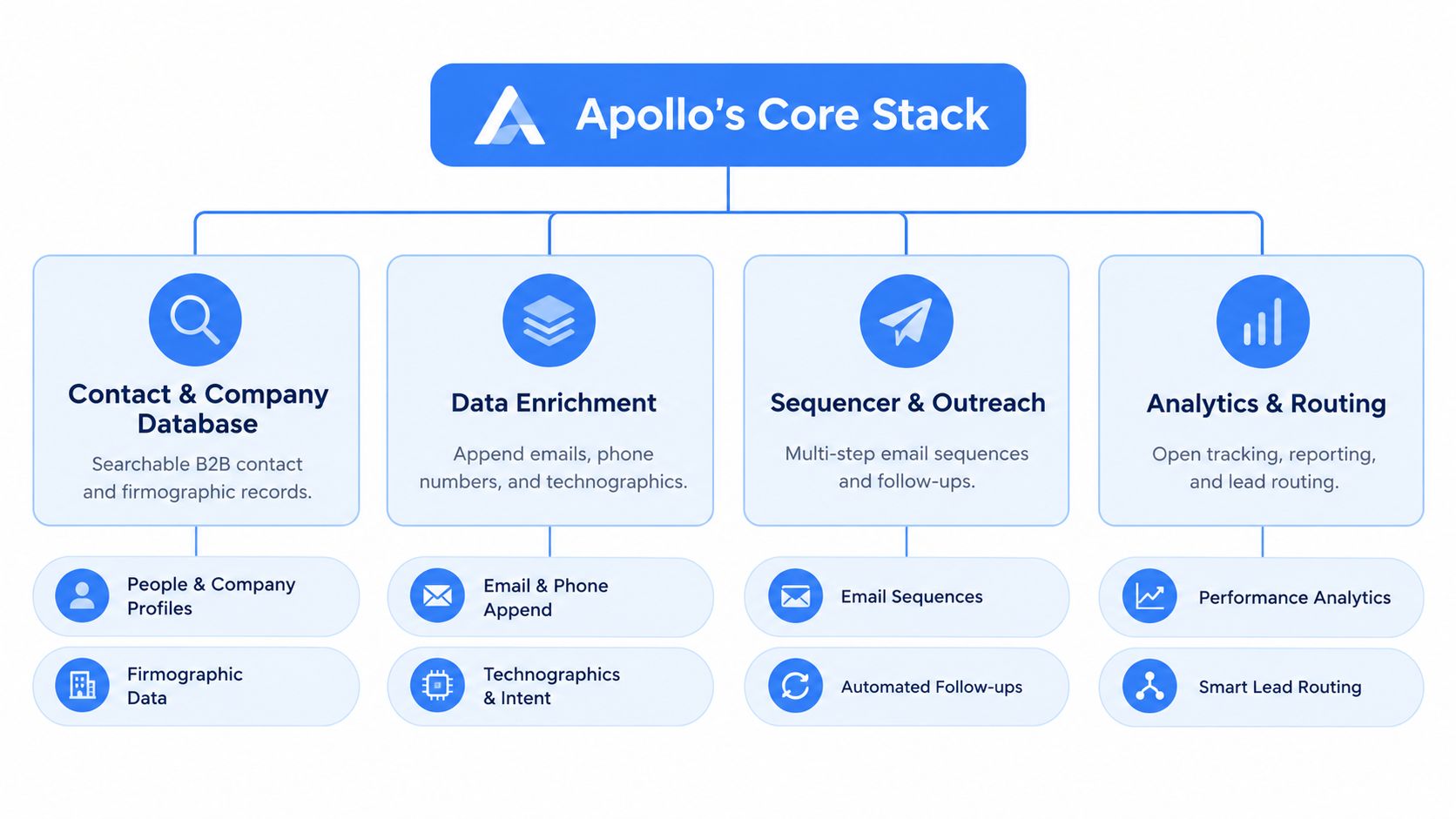
The four functional pillars
Contact and company data is the starting point. Teams use account characteristics, roles, and market criteria to narrow a broad universe into a target segment. This layer creates efficiency only when the filters reflect a precise ideal customer profile. Loose targeting produces a larger list, but not necessarily a more valuable one.
Search and segmentation logic determines which records enter the workflow. Treat filters as a qualification system, not as a convenience feature. A well-built search excludes companies that cannot buy, roles that cannot influence a purchase, and markets where your offer lacks a credible route to conversion.
Enrichment adds context to selected records. It can make a name more useful by associating it with a company, role, or other business information. The important distinction is between finding a record and confirming that the record remains current. Enrichment can fill a field, but it doesn't automatically make every field trustworthy.
Sequencing and outreach turns data into action. A sequencer can organize follow-ups and give representatives a repeatable process. That doesn't mean automation should determine the entire campaign. Human review still matters for exclusions, personalization, compliance, and replies that require judgment.
Analytics and routing closes the loop. Reporting should reveal which segments generate meaningful responses and which lists consume resources without producing conversations. CRM routing then determines whether the useful signal reaches the people responsible for follow-up.
| Module | Primary Purpose |
|---|---|
| Contact and company database | Find and segment prospective accounts and people |
| Data enrichment | Add or complete contact and business context |
| Sequencer and outreach | Coordinate repeatable prospect engagement |
| Analytics and routing | Monitor activity and pass outcomes into the sales workflow |
A broader B2B AI sales review can help teams compare this connected model with tools that specialize in only one part of prospecting or engagement. The comparison is most useful when you map each alternative against the same workflow, rather than comparing feature counts.
Where the stack creates friction
The layers are interdependent. A weak first layer sends poor-fit records into enrichment. Incomplete enrichment makes sequencing riskier. Weak delivery reduces the reliability of analytics, because low replies may reflect bad data rather than bad messaging. Routing then spreads an unclear signal through the CRM.
That hierarchy produces a practical adoption sequence: define the account segment first, test record quality second, establish verification rules third, and automate outreach only after those controls work. Teams that reverse the order often mistake activity volume for pipeline progress.
Data Quality and Deliverability Reality Check
A large database can make prospecting feel solved before a team has tested whether its records are safe to use. Independent review coverage says Apollo becomes less effective at scale or without pre-send verification. The same review notes that lower-tier enrichment may rely on a single source instead of a waterfall across multiple providers, which raises the risk of stale or incomplete contact data and downstream bounces. The independent Apollo review from Salesforge is the basis for that assessment.
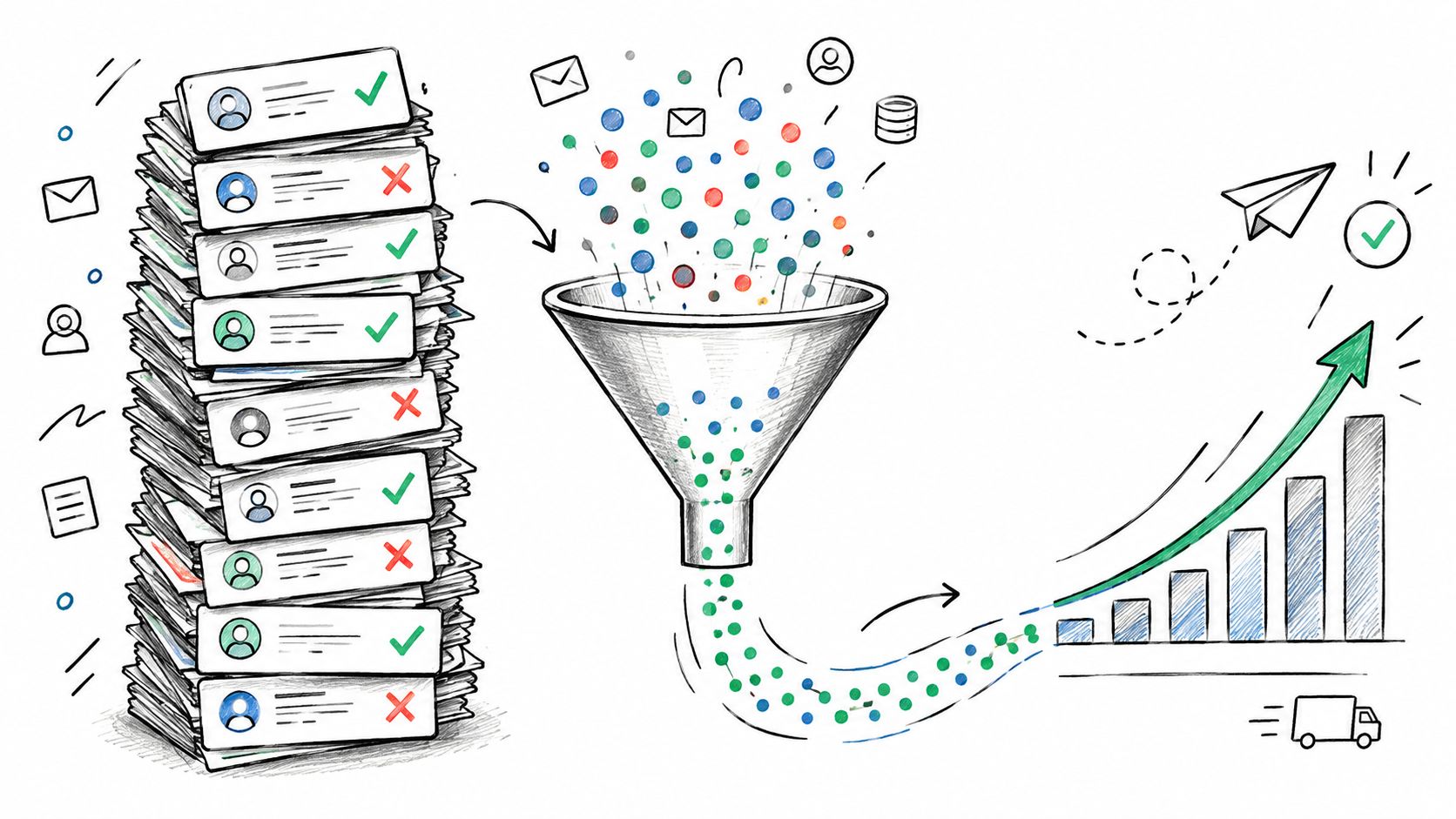
The operational mistake is to treat database access and deliverability protection as substitutes for verification. They solve different problems. Database access helps a team locate prospects. Verification tests whether contact details are usable. Deliverability controls protect sending behavior and sender reputation. None of those functions can fully repair a record that was wrong before it entered the sequence.
Warm-up doesn't repair stale data
Apollo includes sender warm-up and reputation monitoring, as well as a 7-step email validation process. Those controls are meaningful safeguards, but independent review coverage still reports higher-than-expected bounce rates and weaker data accuracy in some regions, particularly EMEA. The evidence points to a central distinction: a healthy sending setup can't compensate for data-quality drift inside a large B2B database. Pipeline's Apollo review coverage documents both the validation controls and the reported trade-off.
Use a layered check before enrollment:
- Fit check: Confirm that the account and role match the campaign's target.
- Freshness check: Look for signs that the person still holds the role and belongs to the company.
- Email check: Validate the address independently before sending at scale.
- Regional check: Review performance separately by market, especially when campaigns include EMEA.
- Suppression check: Remove prior replies, opt-outs, duplicates, and contacts that have already failed validation.
This is also where CRM governance matters. Teams working in HubSpot can use guidance on how to govern CRM data in HubSpot to define ownership, field standards, and cleanup routines around the records Apollo supplies.
The comparison with Instantly versus Apollo is useful only after you define the problem correctly. If the issue is inaccurate contacts, switching sequencers won't solve it. If the issue is sending infrastructure, better data alone won't solve it. If both are weak, the team needs controls on both sides of the workflow.
A practical Apollo test should begin with a limited sample from every important market. Measure valid records, verification failures, bounces, replies, and manual cleanup. Don't approve a larger rollout because the search experience feels fast. Approve it when the resulting contacts remain economical after verification and safe delivery.
The following video can provide additional context for reviewing the prospecting funnel visually:
The Hidden Cost of Apollo Credits and Pricing Friction
Apollo's sticker price is only the first line in the operating budget. Reviewers repeatedly describe a confusing billing and credit system, rapid credit depletion, and actual spend that can rise after overages, verification, and usage limits are included. Recent Apollo reviews on G2 also continue to mention rising prices, AI-related add-ons that reduce perceived value, and requests to separate AI credits from email credits.
The key calculation is not “What is the plan price?” It's “What does one usable contact cost after the team has discarded bad records and completed the required checks?”
Model the workflow, not the subscription
Credit burn usually follows the process. A team searches for a segment, reveals contact details, enriches missing fields, verifies addresses, exports records, and later repeats some of those steps when information changes. Each activity can make the same contact more expensive without improving its commercial value.
| Cost question | Why it matters |
|---|---|
| How many records are revealed? | Bad-fit contacts can consume credits before anyone reviews them |
| How many require verification? | External checks add cost and operational time |
| How many are exported or synced? | Moving data into another system can create additional usage |
| How many fail validation? | Failed records increase the cost of the contacts that remain |
| Are AI credits separate? | Mixed usage makes team-level budgeting harder to interpret |
Reviewers also describe credits disappearing quickly, which creates a dangerous incentive. A representative may reveal a broad list to avoid missing prospects, while a manager sees only the final export and assumes the list was inexpensive. The missing information is the credit cost of records that never entered a sequence.
The credit-separation problem
Separating email, data, phone, verification, and AI usage would make budgeting easier. When those resources share a system or change according to plan and workflow, finance teams struggle to forecast spend and sales leaders struggle to compare campaigns fairly. The result is pricing friction, not necessarily because every individual feature lacks value, but because the unit of purchase doesn't match the unit of commercial output.
Teams comparing usage-based tools can consult credit pricing from Fetchin as a useful framework for thinking about credit economics. The important discipline is to record credits consumed per verified, deliverable, campaign-ready contact, then compare that figure with the value of a qualified conversation.
Budgeting rule: Never approve Apollo from the plan page alone. Build a test list, record every credit-consuming action, and price the contacts that remain after verification.
The value case is strongest when Apollo replaces several disconnected tools and the team primarily needs straightforward prospecting plus outreach. It weakens when the workflow depends on heavy extraction, international enrichment, or repeated data refreshes. Those are the situations in which credit burn and unclear separation between usage types become strategic concerns rather than minor administration.
Who Should Use Apollo and Where It Falls Short
Apollo fits teams that value breadth and speed more than specialized depth. A B2B SaaS company testing a new segment may benefit from having prospect discovery, enrichment, and outreach in one operating environment. A professional services firm can use the same model to organize account research and follow-up. A manufacturer may find the platform useful for building role-based lists, provided the team validates contact data before committing to a broad campaign.

Match the platform to the operating model
B2B SaaS teams are a natural fit when they need to test personas, industries, and account segments quickly. Apollo can reduce the number of handoffs between list building and sequencing. The team still needs a verification checkpoint, especially when a campaign targets more than one region.
Professional services firms may value the account and role filters because a narrowly defined market can be turned into an outreach list without assembling several systems. Their risk is different from a high-volume SDR team. A smaller practice may care more about relationship context and relevance than about extracting every available record.
Ecommerce, payment, and fintech teams should be more selective. Their audiences can span merchants, operators, and technical roles, and a broad database may not capture the commercial context needed for a credible message. Apollo can support initial discovery, but segmentation and message research remain essential.
Manufacturers often need dependable company details, role accuracy, and regional coverage. If the campaign depends on international contacts or niche industrial buyers, the team should pilot each target market separately instead of assuming that database performance is uniform.
Agencies can use Apollo as one component of a repeatable research and outreach process. They shouldn't pass raw records directly to clients as if database access were equivalent to qualified demand. Agency economics must include verification, client-specific exclusions, list maintenance, and reporting.
A match-or-miss framework
Apollo is more likely to fit when:
- The team wants consolidation: One environment can cover several early outbound tasks.
- The motion is still being tested: Fast list experimentation matters more than deep signal coverage.
- The target market is manageable: A verification process can review records before enrollment.
- The team owns operations: Someone is accountable for credit usage, data standards, and deliverability.
It deserves a cautious pilot when international coverage is central, when many records need repeated enrichment, or when different users consume credits for unrelated activities. It may be a poor foundation when the business requires specialized data quality from the first send and has no capacity for independent verification.
Teams that outgrow the bundled approach can review Apollo alternatives by comparing the missing capability, not by collecting another feature checklist. The right alternative might specialize in enrichment, sending infrastructure, intent data, or managed execution. A replacement only helps if it addresses the specific source of waste.
Final Verdict and How to Use Apollo Strategically
Apollo is a reasonable starting point for teams that need a connected prospecting and outreach workflow, especially when consolidation matters. Its 4.7 out of 5 G2 average across 9,837 reviews supports the conclusion that many users find substantial value in the product, but the operational evidence argues against treating that rating as a data-quality guarantee.
Use Apollo strategically:
- Pilot by segment and geography. Don't judge the whole platform from one broad search.
- Verify before sequencing. Count usable contacts after validation, not records revealed.
- Separate credit owners. Give someone responsibility for monitoring data, verification, exports, and add-ons.
- Protect the sending system. Follow a disciplined email domain warm-up process before increasing campaign activity.
- Report commercial outcomes. Track qualified replies, meetings, pipeline contribution, and cost per usable contact.
Choose Apollo now if your team can manage those controls and benefits from an all-in-one workflow. Pilot cautiously if international data or repeated enrichment drives the motion. Avoid making it the sole foundation if your economics depend on predictable credit costs and consistently verified records across multiple markets.
Lead Printer builds and runs data-driven email and multichannel campaigns, combining prospect research, enrichment, personalized messaging, deliverability safeguards, and lead qualification. If Apollo's credit burn or verification workload is slowing your outbound program, visit Lead Printer to discuss a managed campaign built around usable contacts and qualified sales opportunities.