You're probably here because your pipeline target just got harder, hiring another internal SDR feels slow, and CIENCE keeps showing up on shortlist after shortlist. That's a familiar spot for B2B sales leaders in 2026. The problem isn't finding agencies that promise meetings. The problem is figuring out which promises survive contact with deliverability, list quality, and the reality of cold outbound.
Most CIENCE reviews don't go far enough. They recap services, mention dashboards, and stop there. That's not useful if you're deciding between an outsourced SDR pod, a narrower appointment-setting partner, or a pay-for-performance model. What matters is whether the operating model fits your sales motion, whether the metrics are defined clearly, and whether the agency carries any real delivery risk when results slip.
Here's the blunt version. CIENCE is still a recognizable outbound brand, but name recognition isn't performance proof. You need to read CIENCE reviews as inputs into a bigger vendor decision, not as a verdict by themselves.
Why B2B Teams Are Reading CIENCE Reviews in 2026
A VP of Sales gets told to double SQL volume next quarter. Marketing says paid acquisition is getting expensive. RevOps says the CRM is underused. Sales managers say reps need more top-of-funnel support now, not after a long recruiting cycle. So the team starts looking at outsourced outbound.
CIENCE usually lands on that list because it built strong awareness around SDR outsourcing and multi-channel outbound. Buyers have heard the name before. That matters. But it also creates a trap. Familiarity can make a vendor feel safer than it is.
Why reviews matter more now
In 2026, buyers aren't as tolerant of vague outbound claims. They want to know basic things before signing:
- What counts as a qualified meeting
- How inbox placement is measured
- Who owns strategy versus execution
- How fast the team ramps
- What happens if the first months underperform
That shift is rational. Cold outbound performance is less stable than many agencies imply. One independent benchmark found that only 63% of tested emails reached the primary inbox, while 33% went straight to spam and 3% landed in tabs. The same report noted that SPF validation alone reached 93% and DKIM 90%, which is the clearest reminder that technical authentication doesn't guarantee actual inbox placement cold email deliverability benchmark data.
So when you read CIENCE reviews, don't focus on whether a client “got meetings.” Focus on whether the review gives enough operational detail to explain why the program worked or failed.
Practical rule: If an agency can't separate authentication, inbox placement, reply rate, and meeting quality, you're not looking at performance transparency. You're looking at sales copy.
CIENCE reviews are really about accountability
CIENCE reviews have become a stand-in for a larger question. Can this company deliver predictable outbound execution inside a crowded SDR-as-a-service market?
That's why smart teams compare CIENCE against alternative models instead of reading it in isolation. If you're weighing outsourced pipeline options, it's worth comparing agency structure, speed, and reporting discipline against other outbound lead generation approaches, including more focused partners in outbound lead generation services.
Genuine value in CIENCE reviews isn't praise or complaints by themselves. It's what they reveal about consistency, ramp friction, and whether the service model matches the kind of pipeline pressure you're under.
What CIENCE Reviews Say About Reputation and Service Quality
CIENCE reviews tend to split sharply. That's the first thing I'd pay attention to. A polarized review profile usually means the vendor can work well in the right account setup, but delivery quality varies materially by team, onboarding quality, or campaign fit.
What buyers consistently like
The positive patterns are fairly easy to understand. Clients often like structure.
| Theme | Review Pattern | Operational Reality |
|---|---|---|
| Campaign structure | Buyers praise organized workflows and clear task ownership | Outsourced SDR programs work best when the vendor runs a repeatable operating cadence |
| Reporting visibility | Reviews often mention dashboards and visible activity reporting | Agencies with platform layers can show output clearly, even when outcomes lag |
| Multi-channel execution | Clients value email, calling, and LinkedIn coordination | Multi-channel matters most in longer B2B buying cycles where one channel alone stalls |
| Early account management | Buyers often respond well to proactive communication at the start | Strong first-phase customer success can mask deeper execution issues if ramp takes too long |
That doesn't mean the service is bad. It means CIENCE tends to present well when a buyer wants a managed process rather than a freelancer-style lead gen shop.
What buyers complain about
The complaint patterns also make sense if you've seen outsourced SDR programs up close.
| Theme | Review Pattern | Operational Reality |
|---|---|---|
| Ramp time | Clients complain that traction takes longer than expected | Dedicated SDR models often need significant onboarding before messaging gets sharp |
| Team turnover | Buyers dislike retraining replacement reps | Outsourced SDR services depend heavily on individual rep continuity |
| Deliverability volatility | Reviews mention dips after inbox-provider changes or campaign changes | Agencies without exceptional infrastructure discipline can lose momentum fast |
| Upsell pressure | Some buyers feel pushed toward broader managed services | Vendors with layered offers often try to expand account value when core delivery underwhelms |
None of this is unique to CIENCE. It's normal for the category. But CIENCE reviews often surface these trade-offs more clearly because the company sits between two identities. Part platform, part services operation. That can be a strength if you want breadth. It can also create ambiguity about what you're really buying.
Durable signal versus noise
Don't overreact to a single glowing testimonial or a single angry thread. Look for recurring patterns across review sites and community discussions.
What I'd treat as durable signal:
- Consistency of onboarding experience
- Clarity of qualification standards
- Rep continuity over time
- How quickly the agency adjusts targeting and copy
- Whether reporting shows business outcomes or just activity
A review that says “great team, responsive people” is nice. A review that explains how the team handled poor reply quality, no-shows, or list mismatch is much more useful.
CIENCE's reputation story isn't simple. Some clients clearly get a capable outsourced team. Others end up paying for process without enough pipeline movement. That spread is why CIENCE reviews deserve scrutiny instead of a quick skim.
The Performance Metrics Behind the CIENCE Review Conversation
Most outbound agency reviews collapse into soft language. “Good meetings.” “Solid results.” “Strong campaign management.” None of that helps a revenue operator make a call.
The better question is this. What metrics should matter, and how hard are they to achieve in real outbound?
Start with reply-rate reality
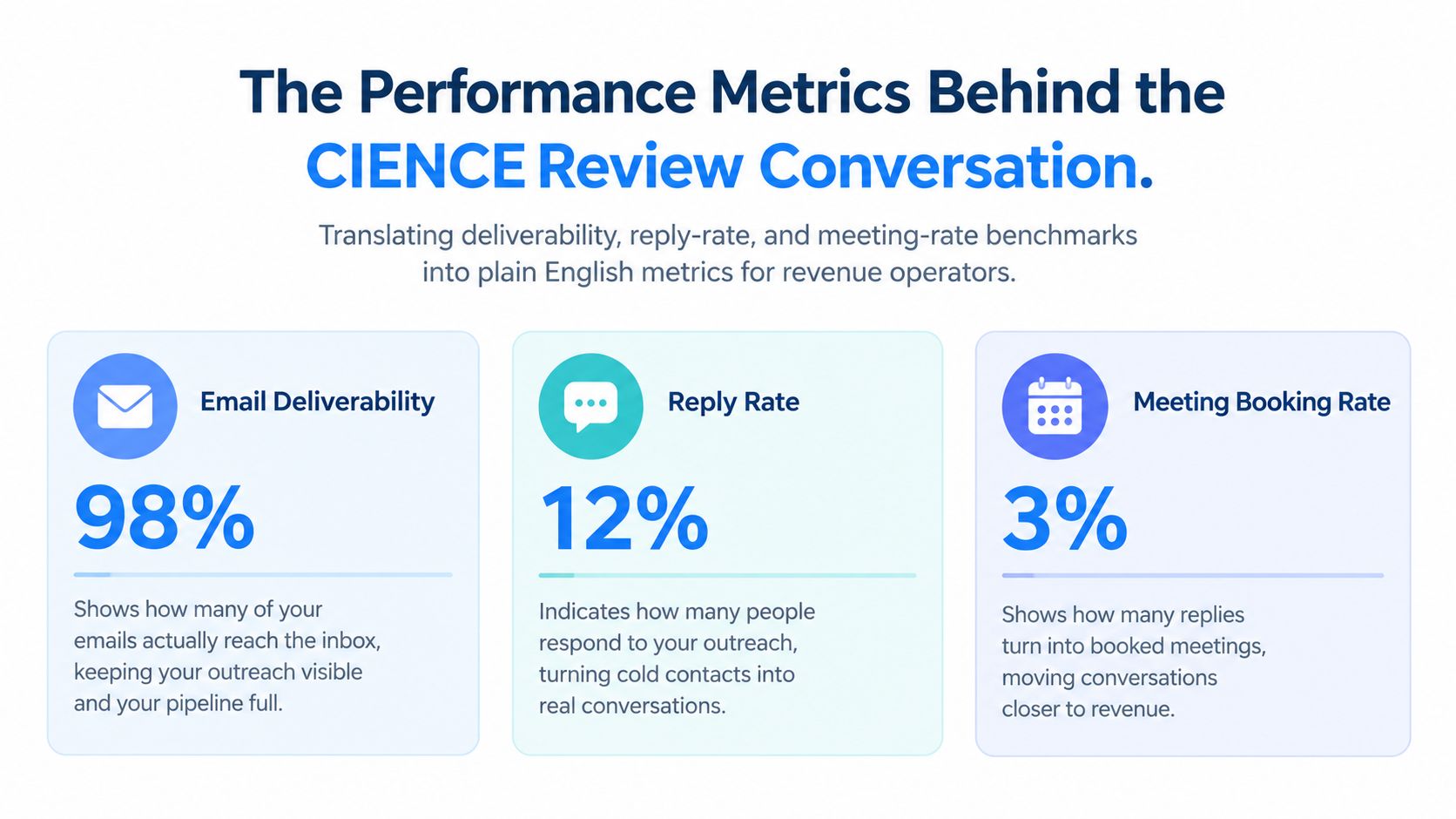
The strongest benchmark framing available for 2025 to 2026 says mass cold B2B reply rates are often weak. One large campaign set reported an average reply rate of 0.45% across 2025 campaigns, while broader industry roundups place strong B2B cold-email programs at roughly 5 to 10% reply rate, excellent at 10 to 15%, and best-in-class at 15%+ when targeting is tight and follow-up sequencing is optimized B2B cold email benchmark data.
That gap matters. It tells you two things:
- Average bulk outbound is usually unimpressive
- Good programs can still perform well when targeting and sequencing are disciplined
So when a review says an agency “books meetings consistently,” ask what reply band they're operating in.
Deliverability is the hidden filter
A lot of outbound agencies still blur authentication and placement. That's sloppy.
If you want a cleaner lens for evaluating vendors, use a practical checklist like this:
- Authentication isn't enough: SPF and DKIM passing doesn't mean primary inbox placement is strong.
- Placement beats activity: Sent volume means very little if too much mail misses the primary inbox.
- Engagement quality matters: Poor targeting drags replies down even when messages technically land.
- Definitions matter: “Qualified meeting” must be defined before launch, not after reporting disappoints.
If your team needs a tighter framework for evaluating these inputs, use a deliverability-specific benchmark lens, not a generic lead gen one. This guide on email deliverability rate benchmarks is useful because it forces the conversation back to inbox outcomes instead of vanity metrics.
Here's a quick primer that helps buyers avoid bad vendor math:
What a credible agency disclosure should include
If an outbound partner wants your trust, it should disclose:
- How it defines a qualified meeting
- How it monitors inbox placement
- What the expected ramp period looks like
- How often copy, targeting, and lists are refreshed
- Whether performance is reported by campaign, rep, or account segment
If a vendor can show send counts but can't explain primary inbox placement or qualification logic, don't treat their metrics as decision-grade.
That's the standard I'd apply to CIENCE. It's also the standard I'd apply to every competitor.
CIENCE vs Lead Printer for Outbound Lead Generation
A lot of buyers get lazy here. They compare feature lists instead of delivery models. That's backwards. Delivery model determines risk, speed, and how much internal work your team still has to carry.
The operating difference
CIENCE is built around a broader outsourced SDR and GTM support model. That appeals to teams that want more than appointment setting. If you need SDR management layers, process coverage, and a wider revops wrapper, that model can fit.
Lead Printer is narrower by design. It focuses on outbound appointment generation through email and multichannel execution, with a stronger emphasis on infrastructure, targeting precision, and defined output.
That's not a small distinction. It changes who should buy each service.
| Capability | CIENCE | Lead Printer |
|---|---|---|
| Delivery model | Broader outsourced SDR and GTM support model | Focused outbound appointment-setting model |
| Channel mix | Multi-channel with broader service coverage | Email-led multichannel outreach with LinkedIn and related support |
| Team structure | SDR pod-style approach with managed service layers | Campaign execution model centered on infrastructure, data, copy, and meeting generation |
| Data sourcing | Broader GTM data and workflow orientation | Prospect research and segmentation built around ICP precision |
| Reporting cadence | Suits teams that want ongoing managed visibility | Suits teams that want clear campaign-level output accountability |
| Onboarding style | Better fit for companies prepared for deeper operational onboarding | Better fit for teams that want a faster launch with tighter scope |
| Best-fit buyer | Enterprise and upper mid-market orgs with internal sales ops maturity | Growth-stage and mid-market teams that want output clarity and lower complexity |
When CIENCE is the better fit
CIENCE makes more sense when your company has these traits:
- You need outsourced SDR capacity, not just meetings
- Your sales motion is complex and multi-threaded
- Your RevOps function wants tighter process integration
- You're comfortable with a longer onboarding and more moving parts
A mature enterprise team can benefit from a vendor that behaves more like a revenue extension layer than a pure appointment engine.
When Lead Printer is the better fit
Lead Printer is the stronger option when your priority is simpler. You need qualified meetings, you need them sooner, and you don't want to absorb a bloated service wrapper.
That tends to fit:
- Growth-stage SaaS teams
- Mid-market service businesses
- Companies validating a new outbound motion
- Lean sales teams that need pipeline support without building an SDR department
If you're comparing providers in this category, it helps to look at more than one model. This shortlist of cold email companies is a useful contrast because it shows how different outbound firms package delivery, not just how they market it.
The real choice buyers are making
Many teams think they're choosing between agencies. They're really choosing between operating assumptions.
Decision shortcut: Choose the broader SDR-as-a-service model when internal complexity is your main problem. Choose the focused appointment-setting model when pipeline urgency is the problem.
That's the cleanest way to read CIENCE against a narrower specialist.
Ideal Customer Profiles and Real-World Use Cases
A lot of outbound disappointments happen before the contract is signed. The buyer picks the wrong service shape for the sales motion, then blames execution later.
Who CIENCE fits best
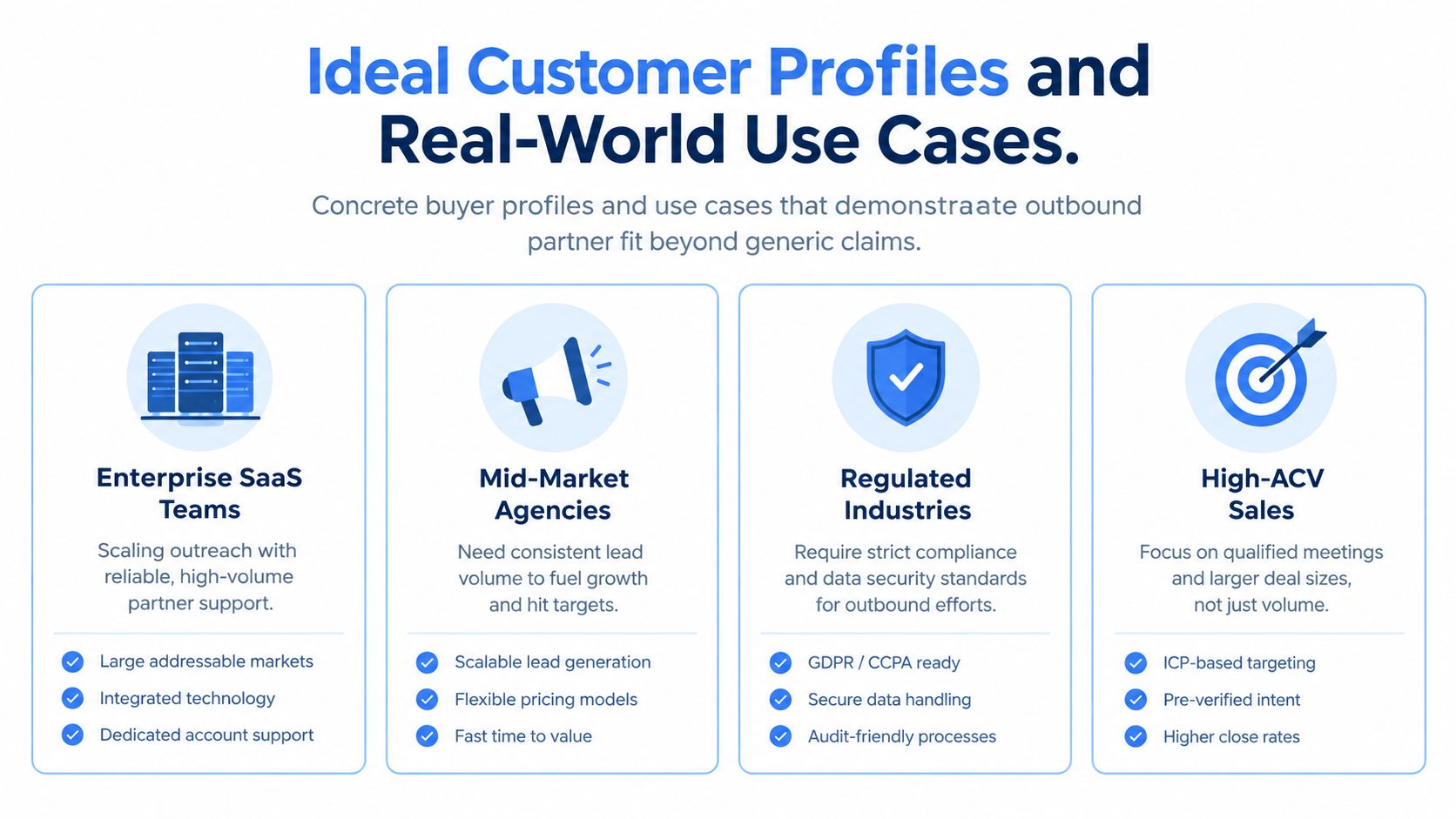
CIENCE is usually a better fit for companies with a more layered sales environment.
That often includes:
- Enterprise SaaS teams with stakeholder-heavy buying cycles
- Fintech or cybersecurity sellers that need structured account coverage
- Upper mid-market firms that already have sales ops support and can manage a deeper onboarding process
These teams usually benefit from dedicated external SDR capacity because the challenge isn't just booking conversations. It's maintaining outreach process, coverage, and internal coordination.
Who Lead Printer fits best
Lead Printer fits companies that want a narrower outcome and fewer internal dependencies.
Typical fit looks like this:
- Growth-stage B2B software
- Agencies and professional services firms
- Vertical SaaS selling to mid-market accounts
- Commercial teams entering the US, UK, or EU with targeted outreach
These buyers usually want a campaign partner that can handle infrastructure, prospecting, messaging, and handoff without requiring a big internal SDR management layer.
Use this self-screen before taking calls
Run through these questions first:
- Do you need SDR headcount coverage, or do you mainly need qualified meetings?
- Can your team support a longer ramp with deeper training?
- Is your offer already clear, or do you still need messaging discovery?
- Are you selling into enterprise buying committees or faster mid-market cycles?
If your sales planning is still muddy, fix that before evaluating vendors. A practical resource for that is this Machine Marketing marketing plan guide. It's helpful because outbound performance usually fails upstream, at positioning and campaign planning, before it fails in execution.
The right outbound partner can accelerate a good go-to-market plan. It can't rescue a vague offer, a confused ICP, or weak internal follow-up.
Pricing, Guarantees, and Risk Comparison
Pricing tells you less about cost than about who holds risk.
That's why buyers should stop asking, “Which agency is cheaper?” and start asking, “Which model punishes failure less?”
Compare the risk posture, not just the invoice
CIENCE generally sits closer to a retainer-driven SDR service model. That usually means broader support, a managed team structure, and service commitments that emphasize execution effort more than hard meeting outcomes.
Lead Printer's positioning is different. It centers more directly on guaranteed qualified lead output, including a 20+ qualified leads guarantee and a refund posture when targets are missed, based on the publisher information provided for this article.
| Pricing Factor | CIENCE | Lead Printer |
|---|---|---|
| Core model | Retainer-style outsourced SDR service | Fixed-fee outbound campaign structure |
| Commitment style | Better suited to longer managed-service engagements | Better suited to buyers who want defined output expectations |
| Guarantee posture | Typically lighter on hard meeting guarantees | Includes a 20+ qualified leads guarantee with refund terms |
| Scope shape | Broader service wrapper can include more delivery layers | Narrower scope focused on qualified opportunity generation |
| Client risk | Buyer carries more ramp and execution variance | Provider carries more visible output pressure |
| Hidden-cost exposure | Broader models can create more add-on complexity | Tighter scope usually reduces surprise categories |
What buyers miss in pricing conversations
Don't ignore hidden operating costs:
- Data acquisition
- List refreshes
- Copy rewrites
- Replacement cycles if team continuity breaks
- Internal time spent training external reps
- Tooling overlap with your existing stack
Those are often bigger than the advertised monthly fee.
A simple rule works here. If you can tolerate a longer ramp and want broad managed support, a retainer model can make sense. If your pipeline gap is immediate and you want a clearer cost-to-output relationship, a guaranteed-output structure is usually the cleaner buy.
Choosing the Right Outbound Partner for Your Pipeline
Most outbound partner decisions get framed too emotionally. Big brand versus smaller specialist. Full service versus niche provider. That's the wrong lens.
The right lens is operational fit.
Use this decision framework
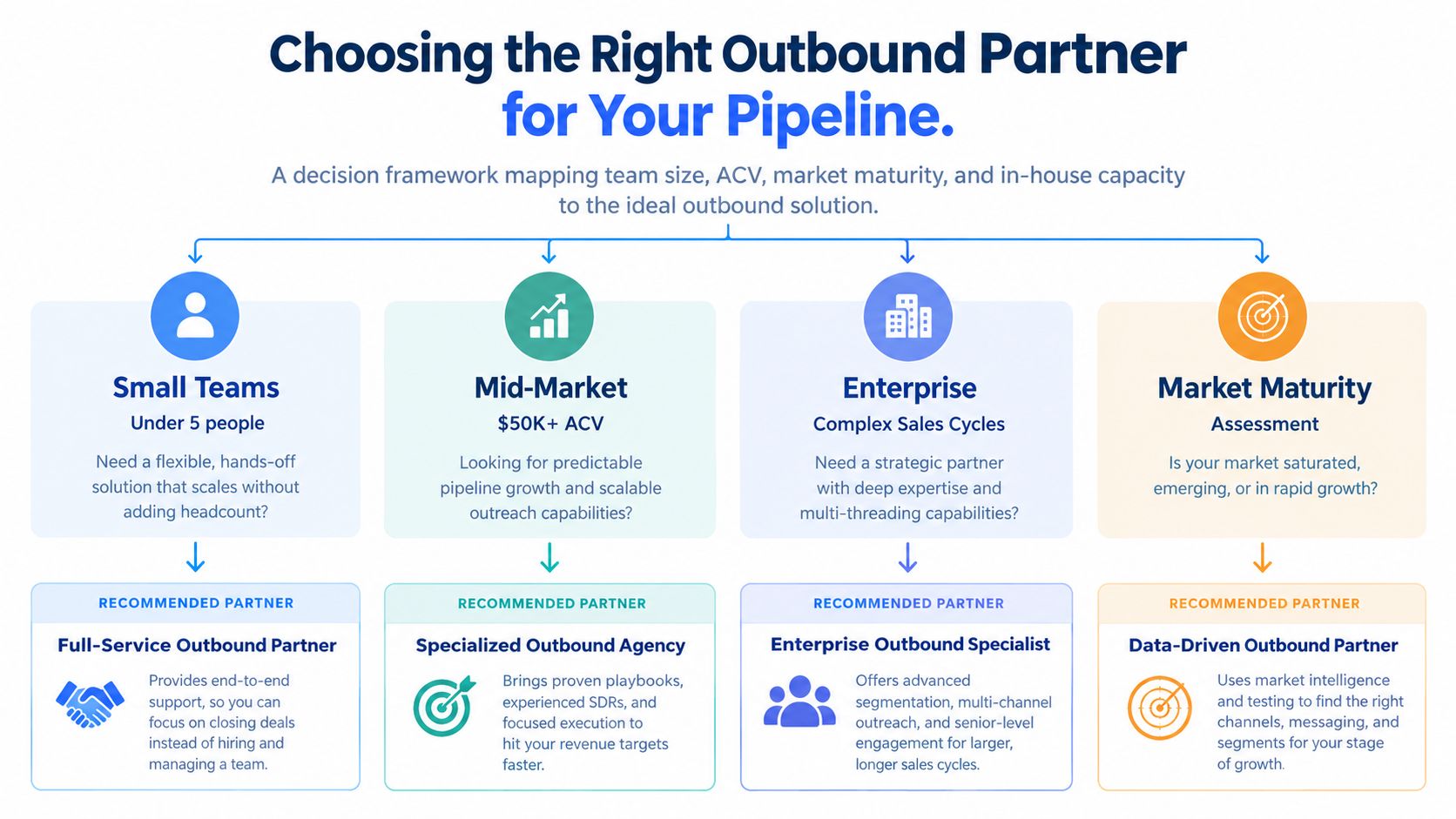
Choose a broader SDR outsourcing partner when:
- Your team needs process coverage as much as pipeline
- Your ACV is high and the sales cycle is complex
- You already have internal operators who can support integration and ramp
- You're fine trading speed for depth
Choose a focused appointment-setting specialist when:
- You need qualified meetings faster
- Your internal team is lean
- You want a tighter scope and less onboarding drag
- You care about output accountability more than service breadth
Choose a hybrid or experimental model when:
- You're still testing ICP
- Your offer positioning is evolving
- You're not sure outbound should be a primary growth channel yet
A short self-assessment checklist
Before you book any discovery call, answer these plainly:
- How many qualified meetings per month do we need?
- What budget ceiling are we willing to hold?
- Can our sales team handle follow-up fast enough to convert interest?
- Are we comfortable paying retainers without a hard output guarantee?
- Can we support onboarding, feedback, and message iteration internally?
If you can't answer those, don't sign anything yet.
Buyers don't usually fail because they picked a bad agency. They fail because they bought the wrong delivery model for the problem they actually had.
CIENCE reviews are useful when you treat them as evidence about model fit, not just vendor reputation. That's the move. Read past the branding, pressure-test the metrics, and choose the risk profile your pipeline can actually afford.
If you want a narrower outbound model with clearer accountability, Lead Printer builds and runs data-driven email and multichannel campaigns designed to generate qualified sales opportunities, with a stated guarantee of at least 20 qualified leads per month. It's a strong fit for teams that care less about buying outsourced SDR infrastructure and more about getting meeting-ready pipeline without extra complexity. You can see how they approach this at Lead Printer.