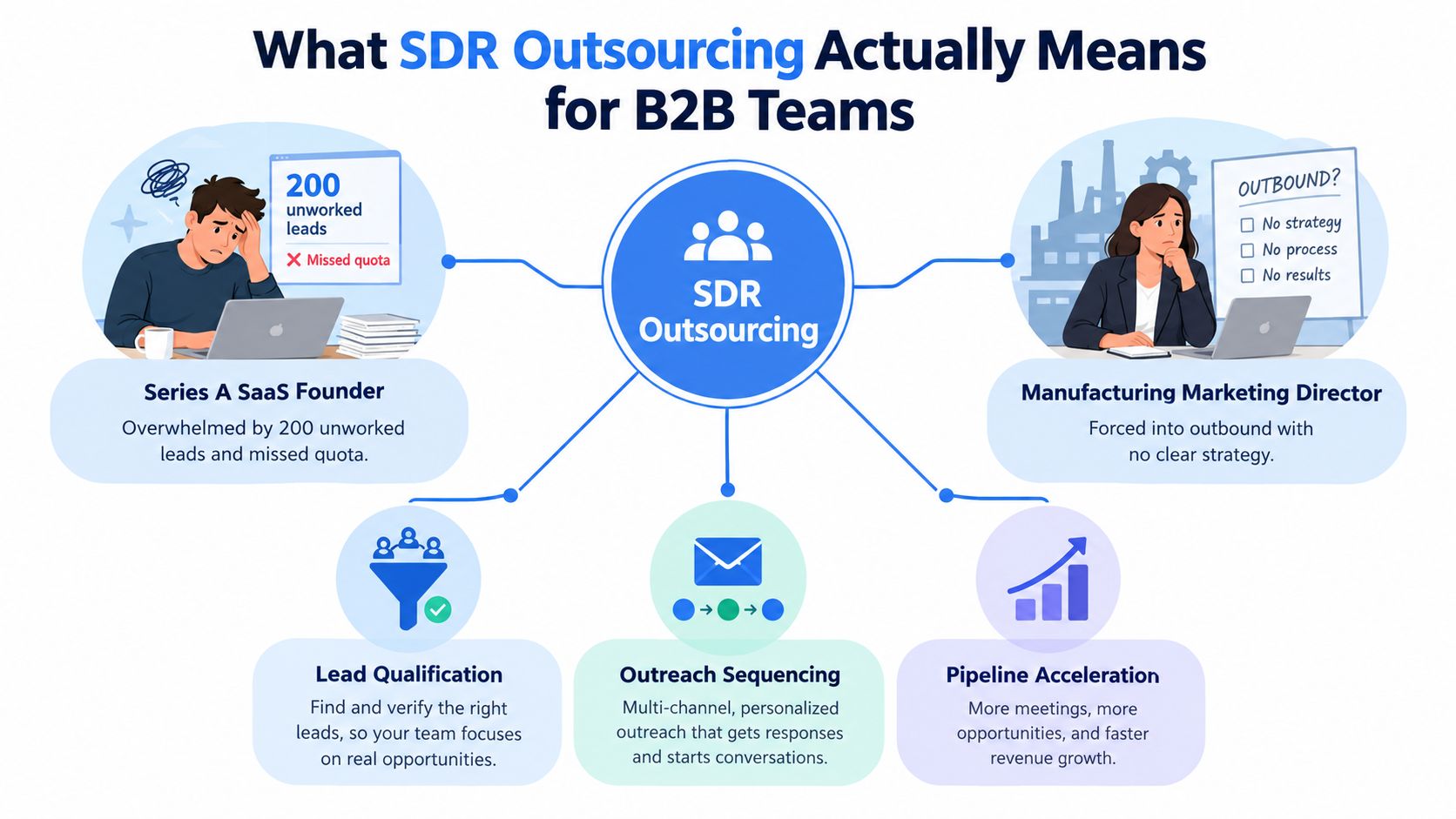
Your sales team has enough demand to grow, but not enough capacity to work it. A Series A founder watches 200 unworked leads pile up while the quarter falls behind plan. A manufacturing marketing director gets told to “just do outbound,” despite having no prospecting team, no tested message, and no clear handoff process.
That's where SDR outsourcing enters the conversation. The wrong question is whether outsourcing is good or bad. The useful question is which parts of sales development your company should keep close, which parts another team can execute, and how you'll measure the handoff between them.
What SDR Outsourcing Actually Means for B2B Teams
SDR outsourcing means hiring an external provider to perform some or all of the work that happens before an account executive takes over. That can include account research, list building, email and phone outreach, LinkedIn follow-up, lead qualification, meeting scheduling, CRM updates, and campaign reporting.
The provider may supply only rep capacity, or it may run a broader operating system that includes targeting, messaging, data, management, quality assurance, and reporting. Those are different services, even when both vendors describe themselves as outsourced SDR companies.
Keep strategy and accountability internal
Outsource execution, not revenue ownership. Your internal team should normally define:
- The ideal customer profile, including account types, buyer roles, exclusions, and priority segments.
- The commercial message, including the problem you solve, proof you can use, and claims your legal or product teams approve.
- The qualification standard, including what must be true before a meeting reaches an account executive.
- The handoff process, including response time, CRM stages, meeting preparation, and rejection reasons.
- Revenue accountability, because a vendor can create activity and meetings, but your company owns the offer, sales process, pricing, and close.
The outsourced team can then handle the repetitive operating work. That includes building contact lists, enriching records, launching sequences, making calls, monitoring replies, qualifying interest, and scheduling conversations. This division gives you an advantage without handing strategic decisions to a vendor that may not understand your product, market, or sales constraints.
Practical rule: If a vendor says it can own everything while your team provides no product training, feedback, or AE follow-up, expect a volume program rather than a pipeline program.
The market's growth supports the idea that this is now a specialized function, not merely temporary admin support. The outsourced SDR services market was estimated at USD 4.85 billion in 2025 and is projected to reach USD 11.06 billion by 2032, with a projected 12.5% CAGR, according to market data on outsourced SDR services. The same source reports that full-service outsourcing held 53.8% of service-model share in 2025, while Technology and SaaS represented about 58.2% of global demand.
Those figures don't prove that outsourcing will work for your company. They do show that buyers increasingly use external teams for structured, repeatable prospecting, particularly in complex B2B and software-led sales environments.
Comparing the Three Main SDR Outsourcing Models
The three models differ mainly in operating ownership, rep allocation, control, and flexibility. Don't choose based on the label alone. Ask who owns the list, the message, the rep, the CRM workflow, and the quality review.
Fractional SDR capacity
A fractional SDR arrangement gives you limited rep capacity, often shared across clients or restricted to a defined workstream. It can suit an early-stage company that wants to test outbound, a niche business with a small account universe, or a team that already has strong messaging and RevOps discipline.
You retain more control, but you also retain more management responsibility. Your team may need to provide lists, approve sequences, direct daily priorities, inspect CRM records, and coach the rep. This model is a poor choice if you expect the provider to discover your market and build the entire outbound system.
Dedicated outsourced SDRs
A dedicated team assigns reps primarily to your program. That usually improves product familiarity, continuity, and account context, but dedicated staffing doesn't automatically mean the vendor provides strong data, management, messaging, or qualification.
This model fits a company with a reasonably proven ICP, enough target accounts to support consistent work, and internal account executives who can act on the meetings created. Clarify whether “dedicated” means one rep, a pod, or a named team with shared management and research support.
Full-service agency partner
An agency partner combines SDR execution with strategy, data, copywriting, campaign management, tooling, QA, and reporting. This is the right direction when you lack internal RevOps capacity or need to enter a new segment with a complete operating process.
The tradeoff is reduced day-to-day control. You must still approve the strategic foundation and maintain a strong feedback loop. For a broader view of how outsourced calling services differ by scope and delivery model, use this guide to compare outsourced call center options.
| Model | Monthly Cost per Rep | Control Level | Best For | Ramp Time | Key Risk |
|---|---|---|---|---|---|
| Fractional SDR | Quote-dependent | High client control | Testing outbound or serving a narrow niche | Depends on enablement | Internal team carries management burden |
| Dedicated team | Quote-dependent | Shared control | Proven ICP and steady account coverage | Depends on staffing and training | Dedicated allocation may hide weak support |
| Agency partner | Quote-dependent | Lower day-to-day control | Teams needing strategy, data, execution, and reporting | Depends on setup complexity | Scope can become opaque or overly broad |
A mid-market SaaS company may pair a dedicated SDR with an agency that handles list building, messaging, and QA. A complex manufacturer might use internal product experts for qualification while an external team handles research and first-touch outreach. You can review how a specialized SDR agency model handles that division before comparing proposals.
Benefits and Risks You Should Weigh Before Signing
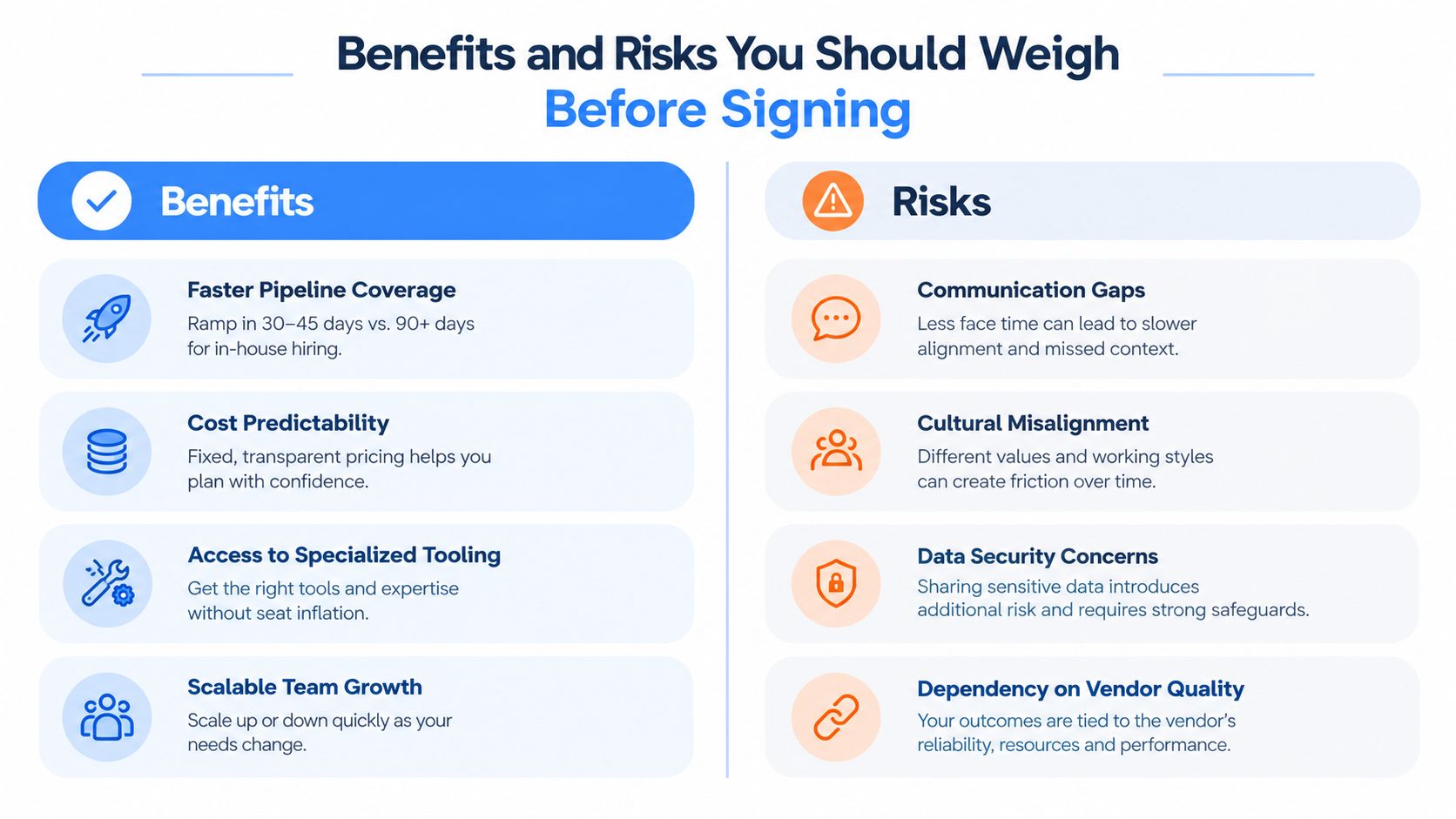
Outsourcing can give a revenue team faster access to prospecting capacity without making every sales leader recruit, train, manage, and replace another rep. It also gives you access to sequencing tools, data workflows, call recording, list operations, and campaign management that would otherwise require several internal roles.
The economic case depends on execution quality. One industry benchmark cited in SDR-as-a-service cost analysis estimates fully loaded US SDR cost at about $134,000 per year, with average ramp time around 3.9 months and median productivity around 14.6 meetings per month. The same source says top outsourced providers often target 25 or more meetings per month, with cost-per-meeting benchmarks under £300 and show rates above 90% when confirmation and pre-meeting nurture are used.
Treat those figures as comparison points, not promises. A vendor with poor list quality or weak qualification can make a lower retainer expensive because your account executives spend time on unsuitable calls.
The benefits are operational
A well-designed program can provide:
- Faster coverage: More accounts receive consistent outreach while internal sellers focus on discovery and closing.
- Predictable resourcing: You can add or reduce execution capacity without restructuring your internal headcount.
- Specialized infrastructure: The provider may already operate data enrichment, sequencing, calling, CRM, and QA workflows.
- External process discipline: A mature partner can bring campaign reviews, call coaching, deliverability controls, and reporting routines.
- A controlled market test: You can test a segment before committing to a permanent internal team.
The risks are predictable
Most failures begin before the first campaign launches. The provider receives a vague ICP, outdated personas, no approved proof points, and no mechanism for AEs to reject or improve meetings. The SDR team then optimizes for the easiest visible output, usually activity or booked calls.
A widely cited SaaS survey reported that only 7% of companies said outsourced SDRs “really worked,” while 26% said they “sort of worked,” as summarized by outsourced SDR performance analysis. That adoption-success gap points to enablement and operating alignment, not an automatic failure of the channel.
You also need to protect against brand damage, poor list hygiene, weak deliverability, unclear data ownership, and reps who support too many accounts to learn yours properly. Run a bounded pilot with explicit exit terms, inspect calls and emails every week, and make held, sales-accepted meetings more important than booked-calendar volume.
KPIs, Pricing Benchmarks, and SLA Metrics That Matter
Your contract should make the operating model measurable. Don't accept a report that celebrates emails sent while hiding whether the meetings were held, accepted by sales, or converted into opportunities.
Start with the funnel in order:
- Target account coverage: Are the right companies and buyer roles being reached?
- Conversation quality: Are prospects responding with relevant business context?
- Qualified meetings held: Did the prospect attend and meet the agreed criteria?
- AE acceptance: Did the account executive confirm that the meeting was worth taking?
- Opportunity conversion: Did the conversation create a real sales opportunity?
- Cost per qualified meeting: What did each accepted meeting cost?
- Pipeline contribution: Which opportunities and revenue stages can be traced to the program?
Activity metrics still matter. Dials, connects, reply rates, positive replies, list accuracy, and response time help explain performance. They shouldn't replace outcome metrics.
Use benchmarks as questions, not guarantees
The market data indicates that only 60% of SDRs hit quota in 2025, median annual SDR turnover was 40%, and average ramp time was 3.0 months, according to the outsourced SDR market benchmark. Those conditions explain why buyers outsource, but they also show why you must ask about management, backfill, training, and continuity.
| Metric | Benchmark | Acceptable Range | Red Flag |
|---|---|---|---|
| Qualified meetings held | Defined by your ICP and handoff rules | Stable quality with documented acceptance | Provider counts every booked call |
| Show rate | Provider-specific, with confirmation process explained | Improving through reminders and nurture | No ownership of no-shows |
| AE acceptance | Tracked separately from meetings booked | Feedback leads to targeting changes | Rejected meetings aren't reviewed |
| Opportunity conversion | Measured after the AE handoff | Segment-level visibility | Vendor refuses downstream reporting |
| Cost per meeting | Calculated from accepted meetings | Compared across identical scopes | Quote focuses only on retainer |
| Ramp time | Written into the launch plan | Milestones tied to readiness | Immediate volume before QA |
| Data accuracy | Audited against CRM outcomes | Errors corrected through a repeatable process | No validation or replacement policy |
| SLA response time | Defined for replies and inbound handoffs | Fast enough for buyer intent | Inbox sits unattended |
Add deliverability and data-quality checks to the SLA. An Email Verification Benchmark can help your team establish a shared vocabulary for contact validation, but the contract still needs to state who verifies records, how errors are handled, and whether bad contacts are replaced.
For a buyer comparing external execution options, B2B prospecting services should be evaluated against the same scorecard. Require weekly reporting, CRM access, recorded call review where lawful, rejection reasons, and credits or remediation when the provider misses a material obligation.
A Vendor Selection Checklist for SDR Outsourcing
A polished sales presentation proves almost nothing. Evaluate the vendor through a written scorecard, then ask the same questions to every finalist.
Start with domain and ICP fit
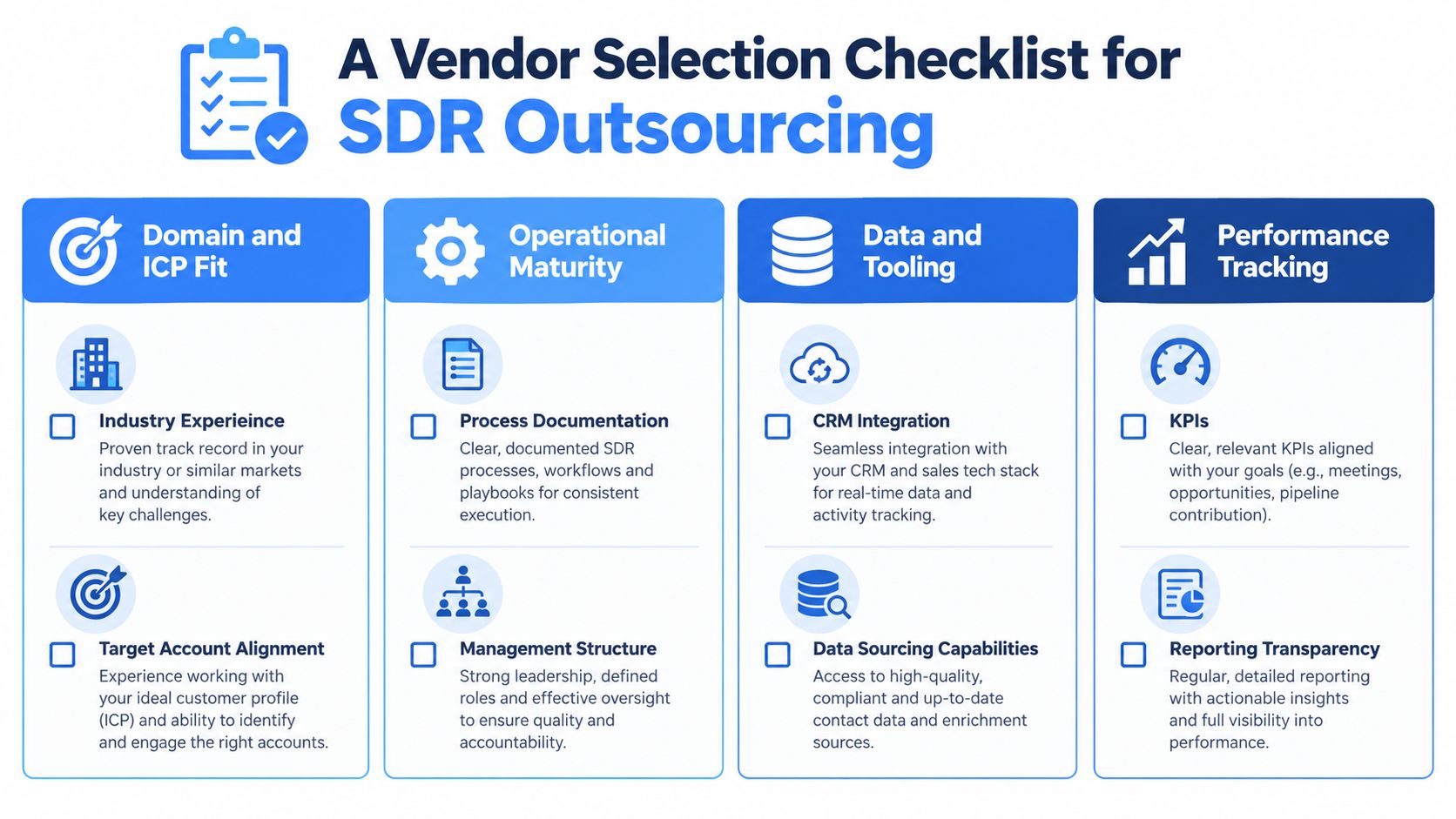
Ask the vendor to describe companies it has supported with similar buyer roles, sales complexity, geography, and product education requirements. You don't need an identical case, but you do need evidence that the team understands how your buyers evaluate solutions.
Request a sample account list and ask:
- Which accounts would you exclude?
- How would you prioritize the list?
- Which job roles would you approach first?
- What trigger would justify a personalized message?
- What would disqualify a prospect before outreach?
A vendor that accepts every account in your database without challenging the ICP is selling labor, not judgment.
Test operational maturity
Ask to see a sample cadence, qualification form, reporting dashboard, call-review process, and escalation workflow. Find out who manages the SDR, who changes messaging, who approves new segments, and who handles a rep absence.
Disqualify any vendor that refuses to identify the assigned team, won't explain its quality process, or treats reporting as a monthly PDF. You should also be cautious when a provider prices only on a retainer and refuses to tie part of the commercial arrangement to clearly defined quality or delivery obligations.
Inspect the data and tooling
Your vendor should explain how it sources, enriches, verifies, and refreshes contact records. Ask which systems it can connect to, how it prevents duplicate outreach, how it stores client data, and who owns the sending infrastructure and campaign records when the engagement ends.
Tool names matter less than workflow. A provider may use LinkedIn Sales Navigator, Clay, a CRM, a sequencing platform, and a calling system, but those tools won't fix an undefined audience or weak qualification rules.
Run a reference call
Don't ask a reference whether it “liked” the vendor. Ask:
- What did the provider promise during the sales process?
- Which responsibilities were unclear after launch?
- How quickly did the team respond to bad meetings?
- Did the vendor accept feedback or defend the numbers?
- What did your internal team still have to do?
- Would you sign the same agreement again?
Weight technical fit, reporting access, team quality, and commercial flexibility ahead of a small price difference. A cheap vendor that creates unusable meetings can consume more executive and AE time than a more expensive partner with reliable qualification.
Implementation and Transition Plan from Kickoff to Steady State
A strong rollout starts slowly enough to catch bad assumptions. It doesn't begin with maximum volume.
Days 1 to 30 build the foundation
Your internal team should document the ICP, priority segments, buyer roles, exclusions, value proposition, objections, competitors, and meeting criteria. The provider should build and validate the first account list, prepare messaging, configure approved tools, establish CRM workflows, and train the SDRs.
Have the outsourced team shadow internal sellers or review real discovery calls. Product knowledge transfers faster when reps hear the language buyers actually use, not just a presentation full of approved phrases.
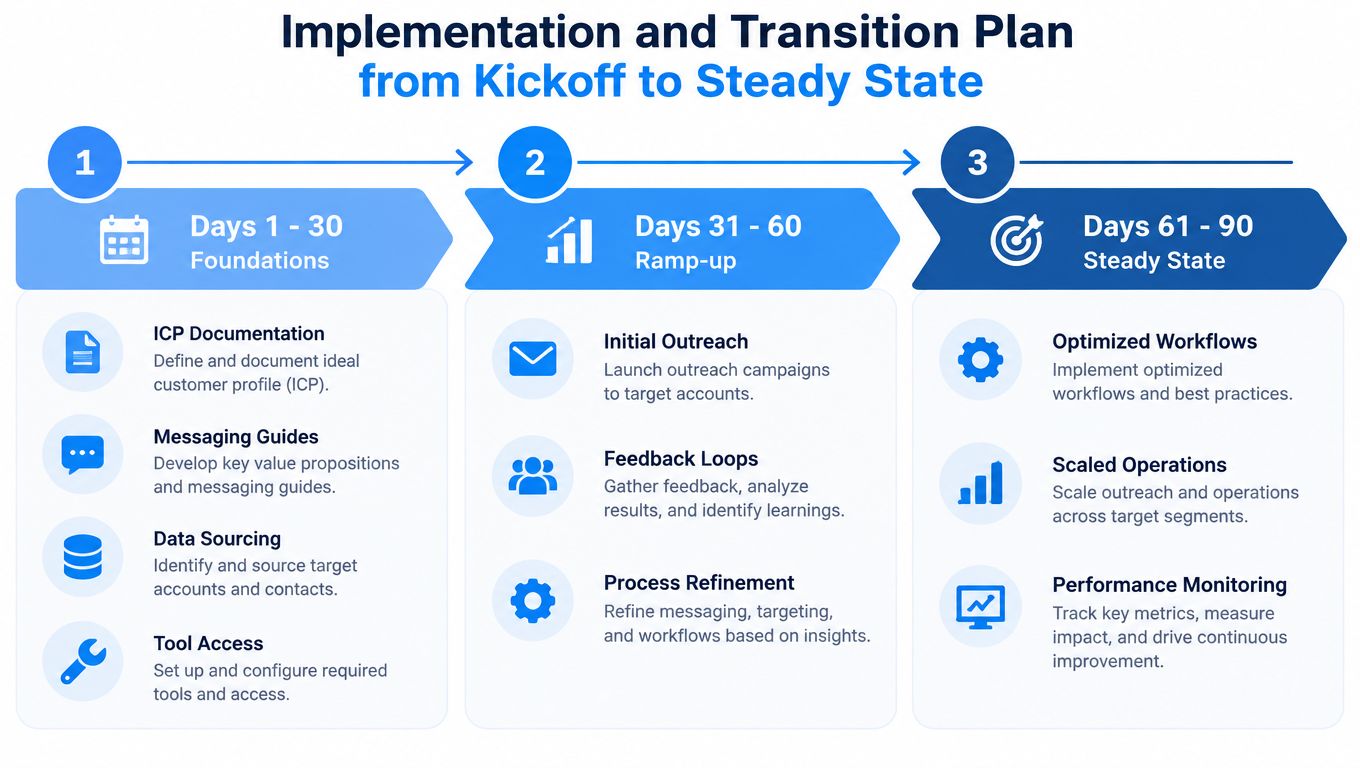
Days 31 to 60 introduce controlled campaigns
Launch with a narrow segment and a manageable account set. Review emails, call notes, replies, objections, and early meetings every week. The purpose of this phase isn't to maximize volume. It's to identify whether the message attracts the right buyer and whether the qualification standard survives contact with the market.
Your account executives must report on every meeting. “Good,” “bad,” and “not sure” aren't enough. Record why an account was accepted, rejected, rescheduled, or moved toward an opportunity.
Days 61 to 90 move toward steady state
Scale only after the team can show consistent list quality, acceptable meeting attendance, usable handoff notes, and a functioning feedback loop. Formalize the SLA scorecard, define ownership for campaign changes, and document objections and account intelligence for internal sellers.
Use a written transition plan from the start. Outsourced lead generation can support execution, but your company should retain account history, messaging assets, CRM records, domain ownership, and lessons learned if you pause or change vendors.
Exit when the provider misses material obligations, can't correct poor meeting quality, or no longer fits your sales motion. Restructure when the market response is promising but the segment, message, channel mix, or rep allocation needs adjustment.
Sample Outreach Cadences and SLA Examples by Audience
The same cadence shouldn't be sent to a software buyer, a merchant services prospect, and a plant operations leader. The outsourced SDR needs a playbook that reflects how each audience evaluates risk, timing, and relevance.
B2B SaaS
Use a 14-day sequence that combines email, phone, and selective LinkedIn activity. Lead with a concrete trigger such as a relevant product category, a hiring pattern, a workflow change, or evidence that the account may be evaluating a related solution.
A qualified meeting should include the correct account profile, a relevant operational problem, and a buyer willing to discuss current priorities. The SLA should require documented qualification notes, prompt CRM updates, and a replacement or review process for meetings that fail the agreed standard.
Ecommerce and payments
Use a 21-day cadence built around merchant economics, catalog complexity, checkout friction, pricing, integrations, and implementation timing. A generic "grow your store" message will disappear among competing vendor pitches. Segment by business model and operational context, then tailor the first conversation to the commercial problem your product can solve.
The meeting definition should include a relevant merchant or commercial owner, a plausible use case, and enough information for the AE to understand the existing setup. The SLA should separate interested replies from qualified meetings and require clear notes on platform, integration, and timing.
Manufacturing
Manufacturing outreach needs more patience and more research. Use a 30-day sequence that can include email, phone, and account-specific research around plants, production lines, procurement roles, technical requirements, and RFP windows.
A qualified meeting should involve the correct plant, engineering, procurement, operations, or commercial stakeholder and a credible business reason for the discussion. The SLA should account for longer response cycles, require technical qualification before the handoff, and specify how the vendor handles duplicate contacts across locations.
| Audience | Cadence Length | Core Channels | Qualified Meeting Definition | Sample SLA Threshold |
|---|---|---|---|---|
| B2B SaaS | 14 days | Email, phone, selective LinkedIn | ICP account, relevant workflow problem, appropriate buyer, agreed next conversation | Complete qualification notes and CRM handoff for every accepted meeting |
| Ecommerce and payments | 21 days | Email, phone, LinkedIn where relevant | Relevant merchant owner, identifiable use case, commercial or integration context | Separate interested replies, booked calls, held calls, and accepted meetings |
| Manufacturing | 30 days | Email, phone, account research | Correct site or business unit, relevant stakeholder, technical or operational reason | Document plant, role, timing, requirements, and duplicate-account checks |
The right program is a coordinated system, not a rented inbox. Keep ICP decisions, qualification, AE ownership, and revenue accountability internal. Hand repetitive research and outreach to a partner only when its process, reporting, and incentives are visible.
Lead Printer builds and runs data-driven email and multichannel campaigns, including prospect research, enrichment, personalized messaging, qualification, CRM handoff, and reporting for B2B teams. If you need an outsourced SDR system designed around your ICP and sales handoff, visit Lead Printer to discuss your market, audience, and pipeline goals.