A cold email can show 98.16% delivery and still reach the inbox only 83.1% of the time, according to independent cold email benchmark research. That gap changes how digital lead generation should be managed. If the message never reaches a visible inbox, copy testing, send volume, channel mix, and follow-up logic aren't being measured against the buyer. They're being measured against a delivery system that has already failed upstream.
Digital lead generation works when it connects four things: a precise audience, verified data, reachable channels, and revenue-level measurement. The teams that create consistent pipeline don't treat outreach as a sequence of clever messages. They build an operating system that identifies the right accounts, earns attention across several touchpoints, routes buying signals quickly, and protects the infrastructure that makes every interaction possible.
What Digital Lead Generation Actually Means
Email's contribution to B2B demand illustrates why lead generation should be judged by pipeline quality, not raw contact volume. Benchmark data reports that email contributes roughly 1.3% of total marketing-qualified leads but 2.24% of revenue, while email-generated leads move through the sales cycle about 7% faster than inbound leads overall and convert about 11.3% faster than the blended average. The figures are summarized in B2B email marketing benchmark data, and they point to a practical conclusion: a smaller flow of well-targeted leads can matter more than a larger flow of weak prospects.
Digital lead generation is the process of identifying accounts that fit an ideal customer profile, finding the relevant people inside those accounts, reaching them through digital channels, and routing meaningful responses into a CRM for qualification. The channels can include email, LinkedIn, paid media, search content, landing pages, webinars, and retargeting. The work isn't complete when a contact fills out a form or replies to a message. It becomes useful when the contact has a plausible business need, a relevant role, and a path toward a sales conversation.
The operating definition
A senior outbound team usually treats the process as a sequence of decisions:
- Define the ICP. Specify industry, business model, geography, company characteristics, technologies, buying roles, and disqualifiers.
- Build and verify the data. Enrich account records, confirm contact relevance, remove duplicates, and validate addresses before sending.
- Select the trigger. Prioritize a business event, pain point, role change, technology adoption, or other signal that gives the outreach a reason to exist.
- Run the channel motion. Combine email, LinkedIn, content, paid exposure, and human follow-up where each adds a distinct role.
- Route and measure. Send qualified responses to the right owner, record source and touch history, and connect activity to opportunities.
Teams new to the discipline can use this practical overview of lead generation for sales pros to clarify the difference between prospecting, qualification, and sales execution. It's also useful to distinguish lead generation from demand generation, because creating awareness and creating a sales-ready conversation require different offers and measurements.
What separates a system from activity
A list of contacts and a sending tool don't constitute a strategy. A working system has signal quality, deliverability control, clear qualification rules, and attribution that reaches pipeline. It tells the team why an account was selected, what action should happen next, and whether the sequence produced commercial value.
Modern programs also engage buyers earlier, before a form submission or direct sales inquiry. Intent data, enrichment, content engagement, and account research help sales teams recognize interest that would otherwise remain invisible. The rest of the operating model follows from that foundation: choose the right channel, make the infrastructure trustworthy, measure the path to revenue, and remove the failure points that distort the results.
Inbound vs Outbound Lead Generation Compared
Inbound and outbound solve different timing problems. Inbound earns attention through search, useful content, paid acquisition, social distribution, and nurture. It can build a durable market presence, but it often requires sustained investment before a prospect identifies themselves. Outbound starts with a defined account universe and creates a reason for a specific person to respond. It can produce a sales conversation sooner, but poor targeting or weak deliverability makes it intrusive and wasteful.
The comparison below is directional rather than a promise of fixed performance. Cost, speed, intent, and scale vary by market, offer, reputation, and execution quality.
| Dimension | Inbound | Outbound |
|---|---|---|
| Cost per lead | Higher upfront investment in content, media, search visibility, and conversion assets. Costs can become more efficient as strong assets continue attracting demand. | Lower marginal cost after infrastructure and data are in place, but verification, research, sending, and sales labor still require investment. |
| Speed to pipeline | Usually slower for organic channels, with faster feedback from paid campaigns and high-intent conversion pages. | Usually faster to first conversation when the account, trigger, and contact are well matched. |
| Intent strength | Intent is often self-selected, but many visitors and content leads aren't ready for a sales discussion. | The team chooses accounts based on fit and signals, but the prospect may not yet be actively searching. |
| Scalability | Scales through content distribution, paid reach, search coverage, and automation, subject to budget and audience demand. | Scales through account coverage and sequencing, subject to data quality, sender reputation, personalization capacity, and channel limits. |
| Primary risk | Paying for attention that doesn't convert or collecting leads without a clear qualification path. | Treating volume as strategy and damaging deliverability or brand trust with irrelevant outreach. |
| Best role | Capture existing demand, educate buyers, support evaluation, and create brand familiarity. | Create conversations with named accounts, activate signals, and test a market or offer directly. |
The blended motion
The strongest B2B programs don't force a choice between the two. Email and content remain central because B2B lead generation benchmarks report that 87% of B2B marketers successfully used content marketing to generate leads, 83% say email marketing is important for lead generation, and 59% rate email as the most reliable channel for driving leads. The same source reports that 77% of B2B buyers prefer email as a communication channel, while LinkedIn is used by 89% of B2B marketers for lead generation.
That combination creates a practical division of labor. Inbound content answers the buyer's questions and creates evidence of expertise. Outbound identifies named accounts that fit the commercial profile. Retargeting and matched audiences keep the company visible to people who have already interacted with content or landing pages, while CRM routing gives sales context for the next conversation.
Audit your mix by asking three questions. Are inbound leads being followed up with enough context to separate curiosity from buying intent? Is outbound reaching accounts that have a credible reason to care? Can the team see how content exposure, paid interaction, email response, and sales activity combine before an opportunity is created? If the answer to any question is no, adding another channel won't fix the underlying design.
Channel-Specific Strategies for Lead Generation
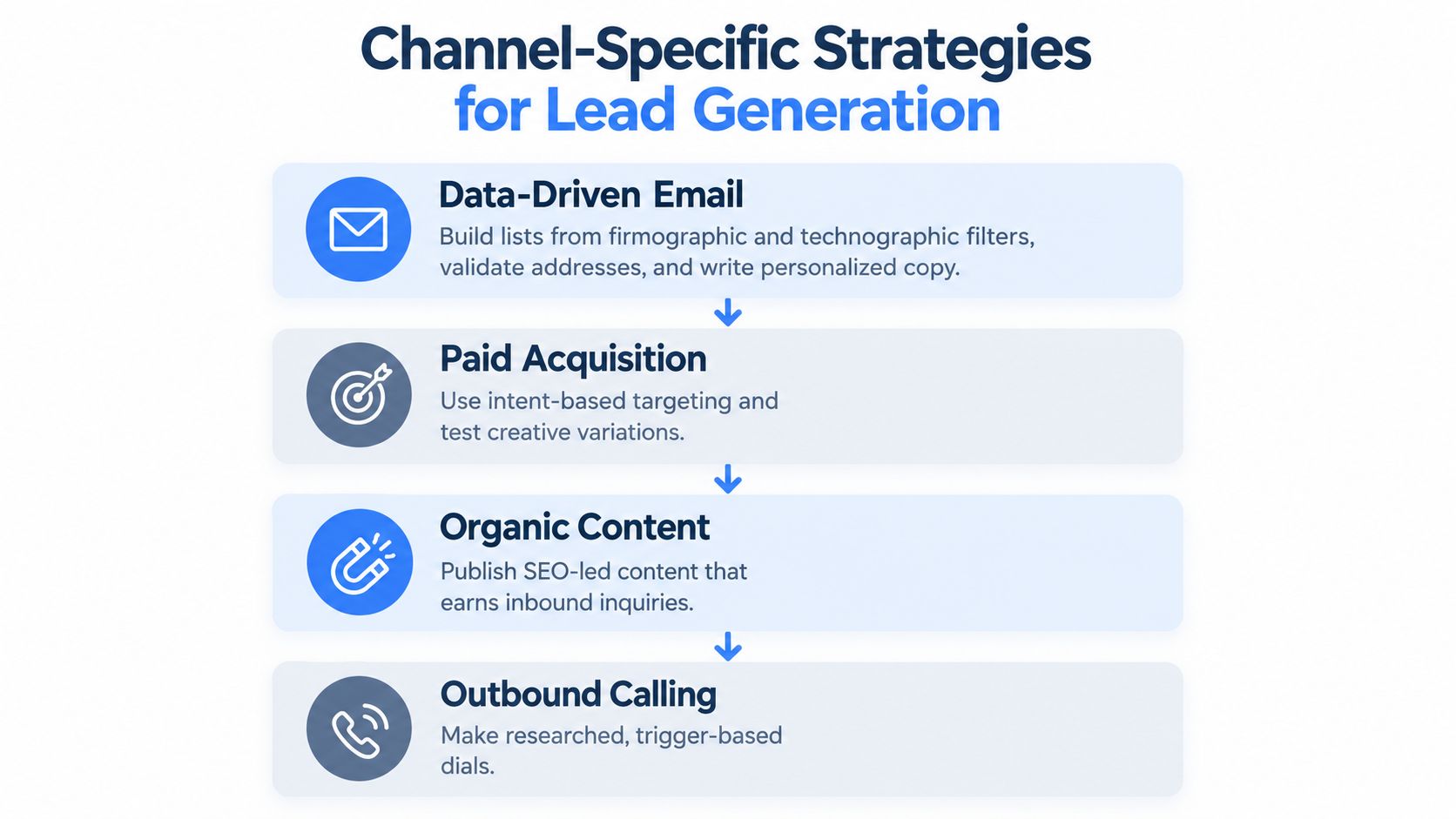
Channel selection matters less than the job assigned to each channel. Email should create a relevant reason to reply. LinkedIn should add familiarity and context. Paid media should reinforce a message for a defined audience. Content should answer questions and support evaluation. When every channel carries the same generic pitch, adding more channels only multiplies the noise.
Email starts with the account
Build lists from firmographic and technographic filters before writing copy. Company type, market, geography, relevant software, role, and business trigger should narrow the audience. Validate addresses and remove uncertain records before launch. A credible message usually leads with one observation about the prospect's business, connects that observation to a plausible problem, and asks for a small next step instead of presenting a full product catalogue.
A short sequence is easier to diagnose than an endless cadence. Use several purposeful touches, with each follow-up adding a new angle, proof point, question, or resource. Avoid pretending that a first-name token or a company variable is personalization. Buyers recognize those fields as automation when the substance doesn't reflect their situation.
LinkedIn supports the conversation
LinkedIn works best as a nurture layer rather than a standalone substitute for research. Review the person's role and recent activity, send a connection request without an immediate pitch, and use later messages to share a relevant observation or answer a question. The channel should make the email feel more credible, not repeat it in a different interface.
Paid acquisition can support both motions. Use intent-based audiences, account lists, and retargeting to keep a specific problem and offer visible. Don't send every visitor to the same demo page. A research-stage visitor may need an ungated guide, while a returning account with clear commercial intent may be ready for an assessment or conversation.
Orchestration follows the trigger
Multichannel orchestration is most effective when all touches respond to one business event, such as a funding announcement, hiring pattern, tool adoption, expansion, or leadership change. Email can introduce the observation, LinkedIn can build recognition, an ad can reinforce the category, and a call can test urgency when the account warrants human follow-up. The sequence should feel like one coordinated point of view.
For a practical framework on combining these motions, see cross-channel lead generation. Content should support the sequence with cornerstone pages for search and more focused assets for capture. It isn't the entire strategy. Sequencing quality and personalization depth beat channel count.
Technical and Data Infrastructure That Powers It
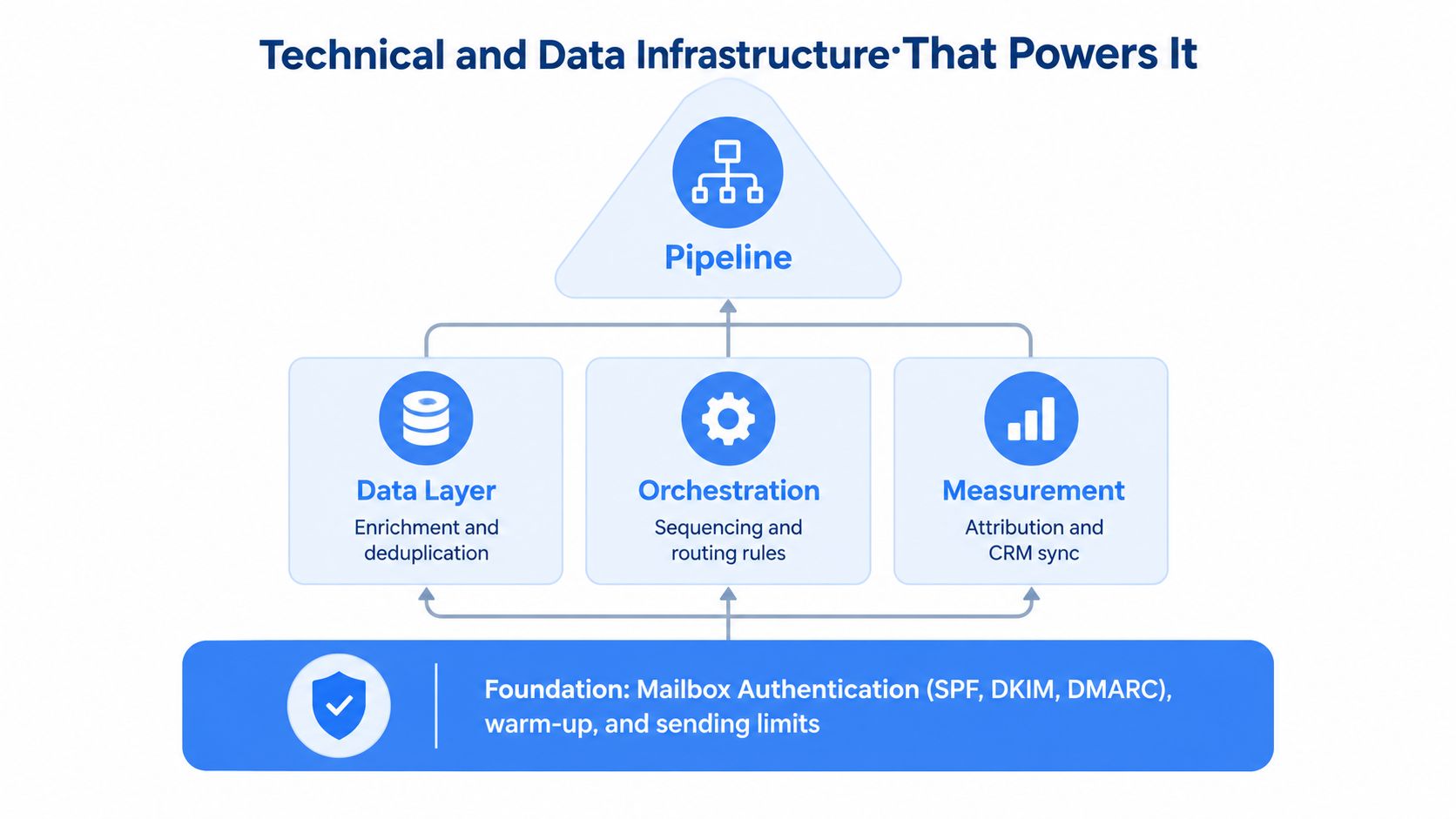
Lead generation breaks when the plumbing is treated as an implementation detail. A well-written email can't compensate for an unauthenticated domain, an unverified address, a duplicated record, or a CRM rule that sends a qualified reply to the wrong queue.
The foundation is mailbox authentication. SPF, DKIM, and DMARC give mailbox providers signals that help distinguish legitimate sending infrastructure from spoofing. In one 2026 deliverability report, DMARC adoption in the tested domain set fell from 59% to 48% year over year, reinforcing why authentication needs regular monitoring rather than a one-time setup. Dedicated sending domains, sensible sending limits, inbox warm-up, bounce control, and complaint monitoring protect the reputation that every later campaign depends on.
Data needs several control points
Account research and contact enrichment should happen before sequencing. Firmographic filters establish fit, technographic data adds context, and intent providers can identify accounts showing relevant activity. Real-time email validation removes hard bounces before they affect sender reputation. Deduplication prevents several team members from contacting the same person with conflicting messages.
A useful data model stores more than a name and an address. Record the source, role, account fit, trigger, verification status, last touch, response classification, owner, and next action. If a field can't change a decision, question whether it belongs in the operating workflow.
Orchestration turns signals into action
A CRM should hold the definitions that sales and marketing use. Lead scoring can combine account fit, role, engagement, and buying signals, but the score needs observable rules. Round-robin assignment can distribute qualified leads, while alerts in Slack or the CRM can reduce the delay between a reply and a sales response.
Signal-based targeting is more useful than a static list. Job changes, funding activity, hiring patterns, market expansion, and technology shifts can give an account priority, but none of these signals proves readiness by itself. Treat them as reasons to investigate and personalize, not as permission to send an irrelevant pitch.
Operational details matter in adjacent systems too. Teams managing high-volume event or enrichment workflows can apply production Redis TTL tips to control stale data, reduce unnecessary processing, and keep temporary records from polluting downstream systems. The same principle applies across the stack: fresh, traceable data enables better decisions.
Before scaling, use this email domain warm-up guidance alongside authentication checks, verification, routing tests, and suppression rules. Infrastructure isn't a checkbox. It determines whether channel performance can be observed.
KPIs and Measurement That Matter Most
Open rates and clicks can help diagnose delivery or message engagement, but they don't tell the team whether the campaign created commercial value. The operating dashboard should start with meetings booked, qualified opportunities, pipeline created, and cost per qualified meeting. Response rate and positive reply rate are useful leading indicators, provided the team separates genuine interest from objections, automated replies, and requests to be removed.
Use a stage-based scorecard
A practical dashboard can include:
- Positive reply rate: Measures how often outreach creates a meaningful buying conversation. Segment it by ICP tier, role, industry, trigger, and message angle.
- Qualified meeting rate: Shows whether replies become conversations that meet the agreed qualification standard.
- Opportunity creation: Tracks whether sales accepts the meeting as a real commercial possibility.
- Pipeline contribution: Connects sourced or influenced opportunities to the value recorded in the CRM.
- Cost per qualified meeting: Combines media, data, tooling, and labor costs to show whether the motion is economically viable.
- Sales feedback speed: Shows how quickly the team classifies and acts on a response.
For email context, independent cold email response rate benchmarks report an average B2B reply rate around 3.43%, with broad campaigns commonly landing in the 1% to 5% range. Performance above 5% is described as strong, while 10% or more is generally associated with tighter ICP targeting, cleaner data, and better inbox placement. Treat these as directional context, not a target detached from segment quality and commercial outcomes.
| KPI | What It Measures | Healthy Benchmark Range |
|---|---|---|
| Positive reply rate | Whether the audience and message create relevant conversation | Compare against your own qualified segments and trend by campaign |
| Qualified meeting rate | Whether replies contain enough fit and intent for sales | Stable or improving after qualification rules are applied |
| Opportunity rate | Whether meetings progress into accepted commercial opportunities | Reviewed by source, segment, and sales owner |
| Pipeline contribution | Whether activity connects to opportunity value | Traceable through CRM source and touch history |
| Cost per qualified meeting | Economic efficiency of the acquisition motion | Falling over time without reducing qualification quality |
| Sales response speed | Operational ability to act on demand | Consistently fast enough to preserve buyer context |
Attribute the path, not just the last click
A buyer may see a LinkedIn impression, read an email, visit a landing page, and reply after a follow-up. Last-click attribution gives too much credit to the final touch and hides the role of the earlier interactions. Use multi-touch reporting to record the sequence, then review sourced and influenced pipeline separately so the team doesn't confuse exposure with conversion.
Review performance weekly by account tier, industry, seniority, geography, trigger, and offer. Cut weak segments, repair promising ones, and keep the definitions stable long enough to learn. A dashboard that only reports activity can make an underperforming program look busy. A dashboard tied to opportunity stages tells you what to keep funding.
Common Pitfalls and How Top Teams Avoid Them
The most expensive mistake in digital lead generation is often launching more volume before proving that the system can reach the right people. Benchmark research places average B2B cold email reply rates around 3.43%, with broad campaigns often within 1% to 5%, as reported in the cold email response rate analysis. A low result can reflect weak copy, but it can also reflect poor fit, bad data, weak inbox placement, or an offer that gives the buyer no reason to respond.
The familiar traps
Volume obsession treats a large send count as progress. A fuzzy ICP multiplied across a large list produces more irrelevant contacts, more complaints, and less trustworthy measurement. Start with a narrow segment and expand only after the team can explain which accounts respond and why.
Weak segmentation hides behind personalization tokens. First names, company names, and generic references don't demonstrate account understanding. Useful personalization connects a specific role or business trigger to a plausible operational problem.
Copy-only optimization tests subject lines while leaving the offer, list, timing, and deliverability untouched. Change one layer at a time, but diagnose the whole system before declaring a copy winner.
Practical rule: If a campaign underperforms, check inbox placement, list validity, ICP fit, and offer relevance before rewriting the opening sentence.
Identical cadences ignore market conditions. Time zone, language, seniority, buying process, and local expectations affect how a sequence should be written and scheduled. A message that feels appropriately direct in one market may feel careless or overly aggressive in another.
Diagnose the upstream bottleneck
Delivery and inbox placement aren't the same outcome. The research cited earlier reports 98.16% delivery against 83.1% inbox placement, so a campaign can appear technically successful while many prospects never see it. That makes deliverability the upstream bottleneck for every downstream decision. Check authentication, sender reputation, bounce rates, complaints, mailbox distribution, and suppression logic before interpreting response data.
Top teams use a ruthless ICP, signal-led prioritization, verified records, monitored infrastructure, and weekly pipeline reviews. They don't ask only whether the sequence received replies. They ask whether the right accounts replied, whether sales accepted the conversations, and whether those conversations created opportunities.
Localizing Lead Generation for US, UK, and EU
Localization is more than translating a sequence. It changes the evidence used, the level of directness, the form experience, the data basis, and the moment when a buyer expects a sales conversation.
| Dimension | US | UK | EU (DACH, Nordics, France) |
|---|---|---|---|
| Tone | Direct, benefit-led, concise, and clear about the requested next step | Understated, practical, and supported by credible proof | More formal where appropriate, with careful attention to local business conventions |
| Copy | Use plain language and make the business outcome easy to identify | Avoid exaggerated claims and let evidence carry the argument | Localize idioms, salutations, spelling, and formality rather than translating literally |
| Data sourcing | Use account and role data that supports relevant prospecting | Check source quality and document the basis for contact | Use regionally appropriate sources and maintain clear records for enrichment and consent |
| Sequencing | Schedule around the prospect's working hours and test direct outreach | Allow space for consideration and use measured follow-up | Adjust for country, language, holidays, time zone, and longer internal review |
| Compliance focus | Include a physical address and opt-out process under CAN-SPAM requirements | Follow applicable ICO guidance and maintain clear suppression practices | Document GDPR lawful basis, consent where required, and the handling of enrichment data |
| Proof | Use specific commercial outcomes and recognizable customer context | Prefer restrained, evidence-led proof | Provide localized customer evidence and explain data handling clearly |
Compliance belongs in campaign design
For EU programs, document the lawful basis for processing, the purpose of enrichment, retention rules, and suppression handling. Forms should capture consent where consent is the basis, while imports and enrichment workflows should have an auditable reason for processing. Don't assume that a vendor's data license transfers your compliance responsibility.
US campaigns should include the required physical address and a clear opt-out route. UK campaigns need a process aligned with applicable ICO guidance. Canada-adjacent campaigns require particular attention to CASL express consent requirements. These aren't footer details to add after launch. They affect which records can enter the sequence and how the CRM stores permission and suppression status.
Localize proof as well as language. A prospect is more likely to trust a relevant industry example, regional reference, or familiar business context than a translated global claim. Build separate messaging inputs for market, role, language, and compliance status, then review the sequence with someone who understands the local buying culture.
Implementation Checklist and Mini Case Studies
A reliable rollout starts small enough to diagnose. Pick one ICP segment, define the qualification rule, and make every system record the reason the account entered the campaign.
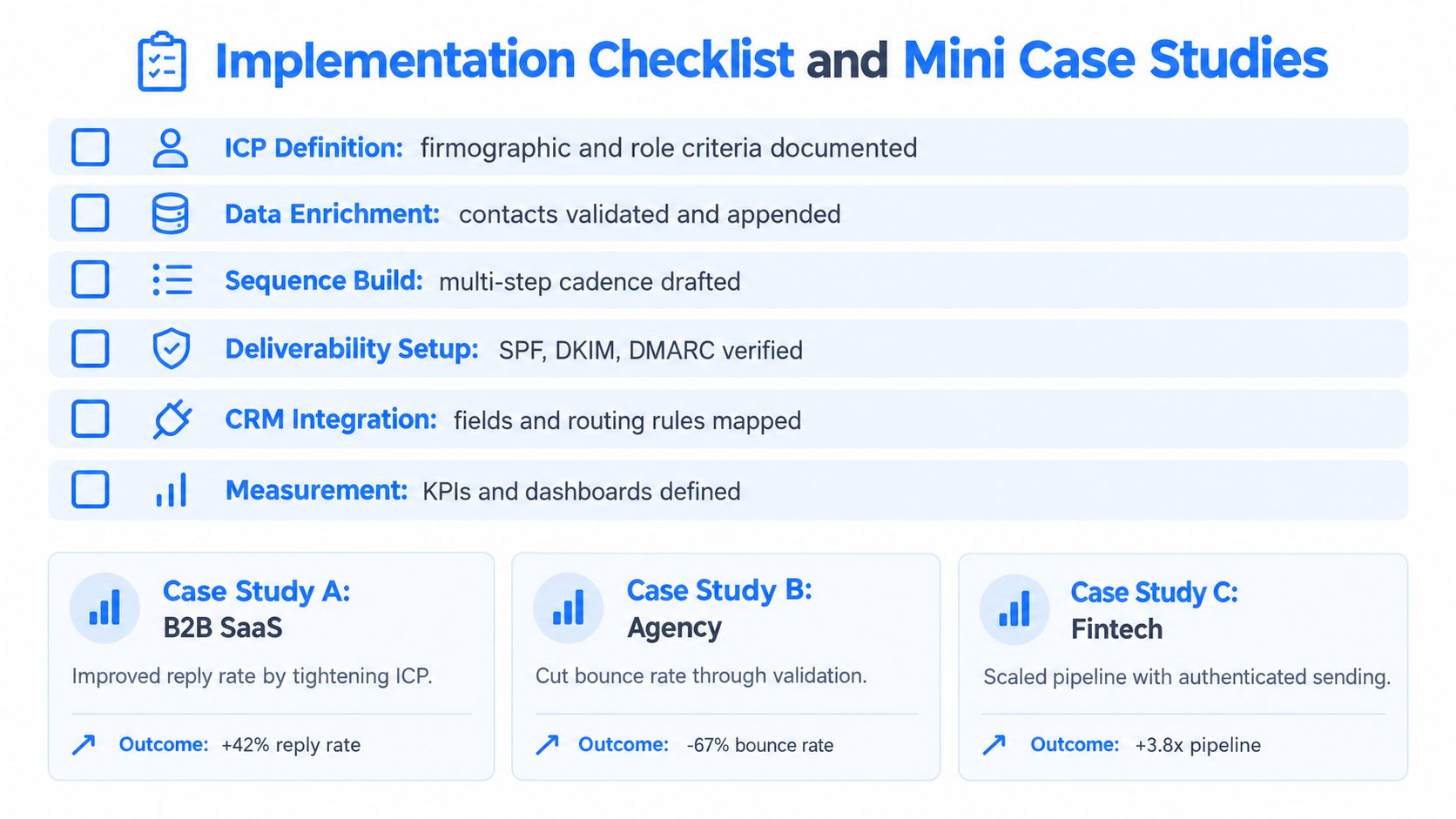
The rollout checklist
- Define the ICP: Document company, role, geography, trigger, exclusions, and the business problem you can credibly address.
- Enrich the data: Append relevant firmographic and technographic context, verify contact details, remove duplicates, and record source provenance.
- Build the sequence: Map the first message, follow-ups, channel changes, reply handling, and stop conditions before launch.
- Set up deliverability: Verify SPF, DKIM, and DMARC, prepare sending domains and inboxes, establish warm-up routines, and monitor bounces and complaints.
- Integrate the CRM: Map fields, ownership, lifecycle stages, qualification rules, suppression status, and routing alerts.
- Define measurement: Track positive replies, qualified meetings, opportunities, pipeline contribution, cost, and sales feedback by segment.
The following mini cases are illustrative operating scenarios, not claims of client results. A SaaS team might replace a broad persona list with accounts showing a relevant technology change, then rewrite the sequence around that trigger. An agency might pause sending, validate its records, repair authentication, and restart with a smaller segment so response data becomes trustworthy. An enterprise team might combine inbound engagement and outbound fit in one routing model, giving sales a shared view of why a contact is being prioritized.
Each scenario uses the same discipline: fix the upstream constraint before adding volume. A signal-led list is useless if the inbox can't reach it. A healthy domain is wasted if the offer doesn't match the account. A qualified reply loses value if nobody owns the next action.
Choose one ICP segment, ship one channel in 14 days, and instrument its pipeline contribution before scaling. Review the evidence with sales, keep the parts that create qualified conversations, and remove activity that only makes the dashboard look full.
Lead Printer builds and runs data-driven email and multichannel campaigns, including prospect research, enrichment, personalized messaging, qualification, CRM handoff, and reporting for B2B teams across the US, UK, and EU. Visit Lead Printer to discuss an outbound system that treats deliverability, targeting, and pipeline measurement as one operating problem.