Approximately 67% of the B2B buying journey happens before salesperson involvement, so effective LinkedIn sales prospecting must establish relevance and trust during independent research rather than rely on cold outreach alone. Buyers spend only about 17% of their purchasing time meeting potential suppliers, which makes visibility before the first conversation commercially important.
You've probably seen the pattern. A team launches a new LinkedIn campaign, sends a large batch of connection requests, follows each acceptance with the same pitch, and waits for meetings to appear. Instead, prospects ignore the messages, accept without responding, or associate the sender with automated outreach.
The better approach is more deliberate. Use LinkedIn to understand accounts, demonstrate useful expertise, and create context. Then coordinate LinkedIn with email, communities, referrals, and other channels so the prospect receives a coherent experience rather than repeated versions of the same pitch. This playbook explains how to build that system without turning professional networking into a high-volume spam operation.
Why High-Volume LinkedIn Outreach Fails
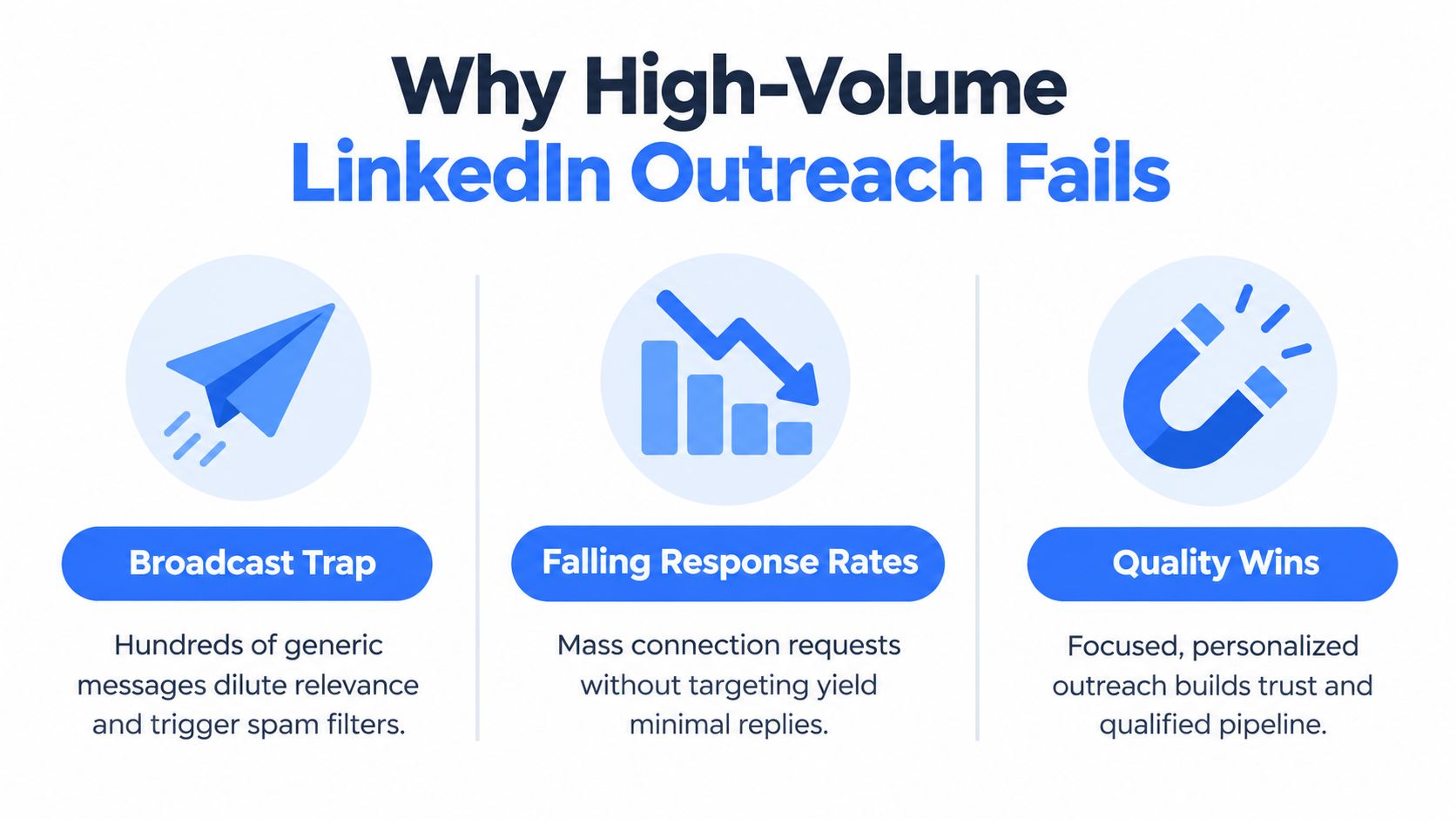
Volume feels measurable, so it often becomes the default strategy. A sales manager can count connection requests, messages, and follow-ups immediately, while the less visible work of building authority and helping buyers research is harder to report. That creates a dangerous substitution: activity replaces relevance.
The timing of the buyer's journey explains why this fails. Gartner research cited in industry reporting found that B2B buyers spend about 27% of their purchasing time researching independently online and 18% researching independently offline, compared with about 17% meeting potential suppliers (industry reporting on Gartner's B2B buyer research). A prospect may encounter your profile long before they're willing to answer a sales message.
Published summaries also report that buyers first contact sellers around 61% of the way through the journey (2025 B2B buyer journey discussion). By then, they may already understand the problem, have formed an initial shortlist, and know which criteria matter. A generic “I'd love to connect” message arrives after the prospect has done much of the thinking, yet offers no reason to reconsider the shortlist.
Visibility comes before conversation
A useful LinkedIn presence answers the questions a buyer asks privately:
- Do you understand my operating context?
- Have you worked with organizations like mine?
- Can I verify who you are and why you're contacting me?
- Will a conversation teach me something useful?
That means your profile, posts, comments, and shared connections all contribute to prospecting. The first conversion isn't always a meeting. It may be a profile visit, a repeat interaction, a branded search, or a prospect recognizing your name when the buying project becomes active.
Practical rule: If the prospect can't explain why your message is relevant after reading it once, the problem is targeting or research, not follow-up frequency.
Lower-volume outreach works particularly well for complex or unfamiliar offers because the buyer needs interpretation before they need a demonstration. Publish a point of view about a specific operational problem, comment on relevant industry discussions, and connect the insight to the role you're targeting. The direct message then becomes a continuation of an existing context instead of an interruption.
LinkedIn's own buyer research supports this trust-oriented approach. In a 2024 study of more than 1,700 B2B technology buyers and decision-makers in the United States, United Kingdom, and India, 91% said they used industry influencers during their purchase journey. Among those respondents, 67% said influencer content played a critical role during IT-buying consideration, and 53% identified subject-matter expertise as the most important trait for B2B influencers (LinkedIn's 2024 buyer influence research).
The practical conclusion is straightforward. Don't ask a stranger to trust your pitch before giving them evidence that you understand their problem. Build useful visibility first, then use outreach to make the next step easy.
Building Your Prospect Foundation
A strong prospect foundation decides whether outreach feels informed or interchangeable. Before a rep writes a note, the account needs a clear reason to belong on the list, a likely buying group, and enough context to explain why now.
That starts with an account-level ideal customer profile, not a stack of job titles. A title tells you who someone is. An ICP defines which companies are worth pursuing, why they may need the offer, and which buying group members influence the decision.
Write the ICP in operating terms. Set the target geography, industry, company characteristics, business model, relevant technology environment, trigger events, and problem severity. Then split required criteria from priority signals. A company may need a specific go-to-market model to qualify, while a leadership change or visible hiring push can move it higher on the list.

Make the profile part of the proof
Your LinkedIn profile is part of the prospecting system. Buyers who get a message often check your headline, current role, featured content, recommendations, and recent activity before they decide whether to reply. If those elements read like a quota announcement, trust drops fast.
Use a headline that states the problem you help solve. Replace internal wording with customer language. Fill the featured section with something a serious buyer can use, such as a diagnostic checklist, a short teardown, or a clear point of view on the issue you address. Recommendations help most when they describe the problem solved and the context around the work, not when they offer generic praise.
Credibility matters more than polish. The profile should look specific, useful, and active enough to support a business conversation.
Build account lists before lead lists
Low-volume prospecting works best when account selection comes first. Use LinkedIn filters to narrow accounts and leads by geography, industry, company size, function, seniority, and recent job changes. Save the accounts that fit, then map the people who may shape the purchase. The budget owner is only one part of that picture. Operations, technical evaluators, finance, and end users often define whether a deal moves at all.
For each account, record:
- Account fit: Why does the company match the ICP?
- Buying group: Which roles may experience, influence, approve, or implement the problem?
- Trigger: Is there a recent job change, hiring pattern, launch, funding event, or public discussion?
- Evidence: Which independent source confirms the role, company, or business context?
- Next action: Should you engage publicly, request an introduction, connect, email, or wait?
Tools can speed up research. They should not replace judgment. Sales Navigator is useful for filtering, list building, relationship mapping, and spotting changes across target accounts. The mistake is treating those signals as a green light to send the same AI-assisted message to everyone who matches a search.
Verify LinkedIn data against the company website, leadership pages, registries, conference materials, or other independent sources before outreach starts. If a role or initiative is unclear, do not invent personalization around it. Accurate, restrained relevance converts better than detailed fiction, especially now that buyers can spot templated outreach quickly.
If you want a broader operating model, this guide to LinkedIn lead generation shows how to connect research, targeting, and outreach. The core rule stays the same: contact fewer people, but know exactly why each person belongs in the account plan.
Crafting Connection Requests That Get Accepted
A connection request has one job: establish a credible reason to connect. It isn't a compressed sales page, and it shouldn't contain a meeting request before the relationship has any context.
The strongest note usually combines one real reference, a short explanation of who you are, and no commercial pressure. The reference could be a post, a public company development, a shared professional connection, or a specific issue visible in the prospect's work. Avoid praise that could apply to anyone in the industry.
Four useful request patterns
Warm introduction
“Hi Maya, Daniel suggested I reach out after your discussion about partner-led growth. I work with B2B teams on that operating model and would value connecting.”
The mutual connection creates context, but do not imply an endorsement the person has not given. If you have not asked Daniel for an introduction, say that you share a network rather than claiming he referred you.
Comment-based outreach
“Your point about onboarding friction in yesterday's post was useful, especially the distinction between product education and implementation support. I work on adjacent problems and would be glad to connect.”
This works because it demonstrates attention without pretending the post created a buying signal. Don't turn a thoughtful comment into an excuse for an immediate pitch.
Cold but contextual request
“I noticed your team is expanding its merchant operations work across the UK. I research payment workflows for growing commerce businesses and would be interested in connecting.”
The message gives the prospect a reason to evaluate the request. It doesn't claim that expansion proves they need your service.
Shared professional context
“We're both involved in B2B revenue operations, although from different sides of the process. I've been comparing how teams handle handoffs between marketing and sales, and I'd like to add you to my network.”
This is useful when the common ground is genuine but there's no obvious trigger.
Timing and localization
Don't send the next message the instant someone accepts. That pattern often feels automated. Give the connection room to exist, then reference the original reason for connecting in a short follow-up. If there's no response, add a new insight or public interaction rather than sending “just checking in.”
US audiences often accept direct business language when the relevance is clear. UK audiences may respond better to a less forceful invitation, especially when the relationship is new. Across EU markets, privacy expectations, language, local business customs, and professional hierarchy vary considerably. Localize the wording, not just the spelling. A translated pitch still feels generic if it ignores how the recipient's market communicates.
Keep the first sequence finite. A connection acceptance isn't consent to unlimited follow-ups, and a profile view isn't an invitation to mention that you've been watching someone's activity. Use observable business context, not surveillance language.
The purpose of a connection request is to open a professional channel. If the prospect accepts but shows no interest, continue building credibility through useful public content or a relevant email only when you have a legitimate reason to use that channel.
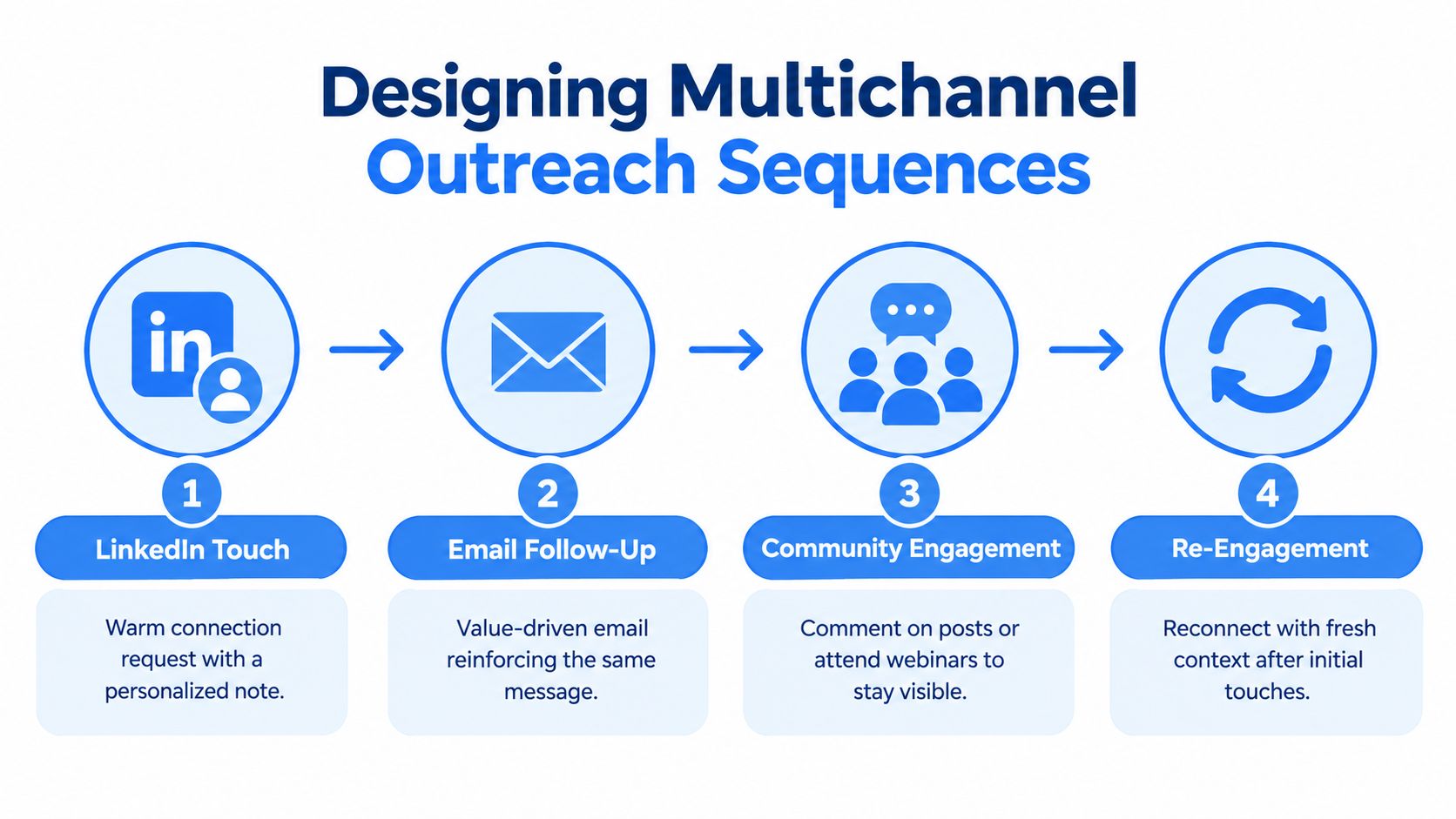
Designing Multichannel Outreach Sequences
LinkedIn is strong at identity, context, and relationship discovery. Email is often better for a structured explanation, a resource, or a clear reply path. Communities, webinars, referrals, and industry events can supply credibility that neither channel creates alone.
The mistake is treating each channel as a separate campaign. A prospect receives a LinkedIn connection about growth efficiency, an email about pipeline visibility, and a webinar invitation about revenue operations. Each message may be reasonable in isolation, but together they sound like three disconnected sellers.
Use one insight across several touchpoints
A coordinated sequence can follow this logic:
- LinkedIn context: Engage with a relevant post or send a connection request that references a real business issue.
- Email depth: Send a concise note that develops the same insight, adds a useful resource, and gives the prospect a simple reply option.
- Community visibility: Participate in a discussion, attend a webinar, or share a relevant contribution without forcing a private pitch.
- Re-engagement: Return only when you have fresh context, such as a new publication, role change, company initiative, or directly relevant observation.
The channels should support one another, not repeat one another. LinkedIn can establish that you understand the person and account. Email can make the response path practical. Community activity can show that your expertise exists outside a private sales exchange.
Define the human-review threshold
Automation is useful for reminders, record keeping, routing, and alerts. It becomes counterproductive when it decides that a weak demographic match deserves a personal message. Rising distrust of generic and AI-generated outreach makes this distinction especially important. A 2025 buyer survey summary reported that 76% of B2B buyers use LinkedIn to discover and shortlist vendors, while also describing distrust of overly sales-oriented or AI-generated content (2025 B2B buyer survey summary).
Before sending, require a human to confirm:
- The account matches the ICP.
- The recipient's role is current and relevant.
- The trigger is observable and recent enough to matter.
- The message contains a specific reference that another prospect wouldn't receive.
- The proposed channel fits the relationship and market.
A weak signal is just matching a title, industry, and geography. Stronger signals include a recent job change, hiring initiative, public product launch, funding announcement, operational change, or thoughtful comment about the problem you solve. Even strong intent doesn't guarantee readiness, so the message should still offer a low-friction next step.
LinkedIn's role may end after context and trust are established. Don't force every reply into a LinkedIn DM if email, a referral, or a community conversation is more natural. A managed program such as LinkedIn outreach strategy planning should coordinate channels around the buyer's experience, not maximize the number of touches.
A useful test is to read the entire sequence as the prospect would see it. If every touch asks for time, the sequence is extraction. If each touch adds context, evidence, or a useful question, it has a chance to earn attention.
Measuring What Actually Matters
A campaign can look busy and still be failing. If one dashboard rolls list quality, message quality, and sales execution into a single response number, you cannot see what to fix. Break measurement into stages so each problem has an owner.
Start with the account set. Qualified-account rate is the first filter because low-volume prospecting only works when the list is narrow and right. If that rate is weak, new copy will not rescue performance. Recheck ICP rules, enrichment, and the research standard used before an account enters outreach.
Track the handoffs
Use separate measures for:
| Stage | What it tells you |
|---|---|
| Qualified-account rate | Whether the target list reflects the ICP |
| Connection acceptance | Whether the profile and request create enough relevance |
| Response rate | Whether the conversation opener earns attention |
| Positive-response rate | Whether replies show genuine commercial interest |
| Meeting conversion | Whether interest becomes a scheduled discussion |
| Opportunity conversion | Whether meetings produce qualified pipeline |
These handoffs matter because each one points to a different failure mode. High acceptance with weak replies usually means the request felt safe but forgettable. Replies with little buying intent often mean the topic got attention, but the pain point, timing, or commercial angle was off. Meetings that do not become opportunities usually trace back to poor qualification, the wrong stakeholder, or an offer that does not fit the problem the buyer wants solved.
Track results by account segment, role, geography, trigger, and message angle. Keep the test clean. Change one meaningful variable at a time, such as a role-led opener versus a company-trigger opener, while holding audience and offer steady. If you add intent-based prioritization, keep a holdout group so you can compare the workflow against your previous baseline instead of giving the new process credit for everything.
Earlier research in the article already covered the cited Sales Navigator benchmarks. The useful lesson is not the headline number. It is that timing and buyer context tend to outperform volume when the comparison is controlled. That fits what strong teams see in practice. Smaller pools, better triggers, and tighter coordination across LinkedIn, email, and referrals usually produce fewer total replies but more conversations with real buying potential.
Measurement principle: A bigger reply count isn't automatically better. A smaller number of replies from qualified buying-group members can create more pipeline than broad engagement from poor-fit accounts.
Review performance weekly with decisions in mind. Which segment deserves deeper research. Which trigger produces useful conversations. Which message angle should be cut. If your team publishes thought leadership alongside direct outreach, you can browse LinkedIn scheduling options and keep content reporting separate from prospecting metrics, so awareness activity does not hide weak sales execution.
Avoiding Deliverability and Compliance Pitfalls
A thoughtful message can still fail if the infrastructure makes you look unreliable. Before launching email alongside LinkedIn sales prospecting, authenticate the sending domain, use legitimate mailboxes, establish a sensible sending pattern, and monitor sender reputation. Keep prospecting domains separate from critical operational email when your risk assessment supports that structure.
Warm-up isn't a substitute for relevance. It can help a new sending setup establish a history, but sending poor messages more slowly still creates complaints and weak engagement. Authenticate the domain correctly, maintain clean records, remove invalid addresses, and stop contacting people who ask not to be contacted.
Protect the relationship across channels
Identical messages create two problems. Email providers may treat repetitive campaigns as low-quality traffic, and prospects may recognize that the LinkedIn message and email were generated from the same template. Use one account insight, but adapt the expression to the channel.
Apply these controls:
- Verify data: Confirm the person, role, company, and business context before outreach.
- Limit repetition: Don't send the same pitch through LinkedIn, email, and a community in quick succession.
- Honor objections: Record unsubscribe requests, do-not-contact requests, and negative replies centrally.
- Review vendors: Understand how enrichment, scraping, automation, and storage providers process professional data.
- Document decisions: Keep a clear record of the campaign purpose, audience, source, retention approach, and suppression process.
EU outreach requires particular care. GDPR analysis depends on the data, purpose, legal basis, transparency, legitimate-interest assessment where relevant, and the recipient's rights. National rules and professional expectations can differ, so a campaign approved for one European market may need adjustment for another. Legal counsel should validate the process for your organization and target markets.
For a plain-language reference, review these digital compliance definitions from Freeform Company. Then turn the principles into operating rules rather than leaving them in a policy document.
Email infrastructure deserves its own checklist, including domain authentication, mailbox setup, suppression handling, and monitoring. This guide to warming up an email domain can help teams organize that preparation.
LinkedIn also has platform rules that should shape execution. Avoid tools or workflows that imitate human activity at scale, flood accounts with repetitive actions, or conceal automation. Use alerts and CRM records to support human decisions. Responsible prospecting protects both deliverability and the credibility you're trying to build.
Putting It All Together
Consider a software company selling a complex workflow solution to mid-market operations teams. Its first campaign relied on broad title matching and repeated LinkedIn messages. The team created activity, but the conversations were shallow because the recipients had no reason to believe the offer applied to their current priorities.

The team rebuilt the campaign around accounts rather than isolated contacts. It defined the industries and operating conditions that made the workflow problem expensive, mapped operations, finance, and executive stakeholders, and used recent hiring and product expansion signals to prioritize research. Each selected account received a short written hypothesis explaining why the issue might matter, what evidence supported it, and which stakeholder should be approached first.
The sales team then published practical content about workflow bottlenecks and implementation trade-offs. The posts weren't disguised product announcements. They gave prospects language for diagnosing the problem, including situations where the company's own solution wasn't appropriate. That honesty helped the profile function as a pre-sales resource.
The sequence followed the buyer's context
A prospect who engaged with the content received a connection request tied to the specific topic. After acceptance, the seller asked a question about the operational issue rather than proposing a demonstration. If the prospect responded with a relevant challenge, the seller moved to email with a short explanation and an optional resource. If there was no response, the team didn't keep repeating the same request. It waited for a new trigger, such as a role change, company initiative, or public comment.
A second stakeholder at the same account might receive a different message because that person cared about implementation risk rather than executive visibility. The account record connected the conversations, but each message reflected the recipient's role. This prevented the buying group from receiving several identical pitches from the same vendor.
The campaign produced fewer superficial interactions than the original volume-first approach, but the conversations were more specific. Prospects discussed current processes, internal ownership, and evaluation criteria. That made qualification easier and reduced the time sellers spent on meetings with no realistic path forward.
The lesson isn't that every low-volume campaign will outperform every high-volume campaign. Results depend on the offer, market, data quality, timing, sales execution, and channel fit. The reliable principle is narrower and more useful: high-touch automation can't compensate for weak relevance. Research, insight, and coordinated timing create the conditions in which a direct message can work.
Use this operating sequence:
- Define the account-level ICP and buying group.
- Verify the account and contact data independently.
- Identify a real trigger or problem context.
- Make the profile and public content support the claim.
- Start with a relevant LinkedIn interaction.
- Use email or another channel when it provides a better response path.
- Review every message before sending.
- Measure qualification, response, meetings, and opportunities separately.
- Pause when the prospect declines or the sequence stops adding value.
The team in this example didn't win by hiding more automation behind friendlier copy. It improved the quality of the decision made before every touch. That's the operating discipline LinkedIn sales prospecting requires as buyers become better at filtering generic outreach.
Lead Printer builds verified B2B prospect databases, LinkedIn-assisted targeting, personalized email and LinkedIn sequences, qualification workflows, and calendar handoffs for teams selling across the US, UK, and EU. If your current outreach creates activity without enough qualified conversations, visit Lead Printer to discuss a lower-volume, insight-led multichannel campaign built around your ICP.