Your account executives have capacity, your product works, and referrals aren't filling the calendar. Someone suggests adding outbound, someone else buys a list, and three weeks later you've got sent emails, a few unsubscribes, and no clear owner for what happens next. That gap between activity and pipeline is exactly what a disciplined BDR lead generation system is meant to close.
BDR Lead Generation Stages and Owners
A business development representative, or BDR, finds and qualifies prospects so account executives can spend their time closing. Five stages carry that work. Skip an owner or an output on any one of them and the next stage inherits a mess.
| Stage | Core work | Output | Owner |
|---|---|---|---|
| Targeting | Define the ideal customer profile and build account lists | Named accounts and decision-maker contacts | BDR or agency researcher |
| Research and enrichment | Verify roles, company size, tech stack and buying triggers | Enriched prospect records | Data specialist or BDR |
| Outreach | Run multichannel sequences across email and LinkedIn | Replies and booked conversations | BDR |
| Qualification | Score replies against fit and need criteria | Qualified or disqualified lead with a reason code | BDR |
| Handoff | Book the meeting and pass full context to the account executive | Meeting-ready opportunity with notes | BDR and account executive |
Why Sequence and Ownership Matter
Weak targeting poisons enrichment. Weak enrichment makes personalization shallow, and shallow outreach produces replies that fail qualification. By the time an account executive sees the problem, the team has already burned sender reputation and prospect attention on the wrong accounts.
Buyers use several channels before they agree to a conversation. A single cold email rarely carries a deal. It has to sit inside a coordinated mix of email, remote conversation, digital self-service, and human follow-up, which is why the outreach stage is multichannel rather than a one-off send.
The BDR owns the front of the funnel, from named account to qualified, meeting-ready lead. The account executive owns the close: discovery depth, commercial terms, and the final decision process. In an outsourced program, the owner column names whoever does the work, such as an agency researcher building lists or an agency BDR running sequences. Stage and output stay the same when the employer changes.
Self-check for today: Name the owner and the output of every stage in your current process. Wherever you can't answer both parts, that's where leads leak out.
Run that check before you add tools or volume. If targeting has no owner, you get convenient lists instead of good accounts. If qualification has no output beyond "interested," account executives redo the BDR's job on live calls. I would fix ownership gaps first. They cost less than a new platform, and they make every later metric readable.
Targeting Accounts Before They Enter a Buying Cycle
Most BDR campaigns start too late. Teams wait for funding rounds, job changes, website visits, or technology changes, then compete with every other vendor watching the same signals. That approach assumes efficient prospecting begins once a buyer is already researching options.
The screenshot below shows the kind of account and signal view a BDR needs before deciding how, or whether, to approach a company.
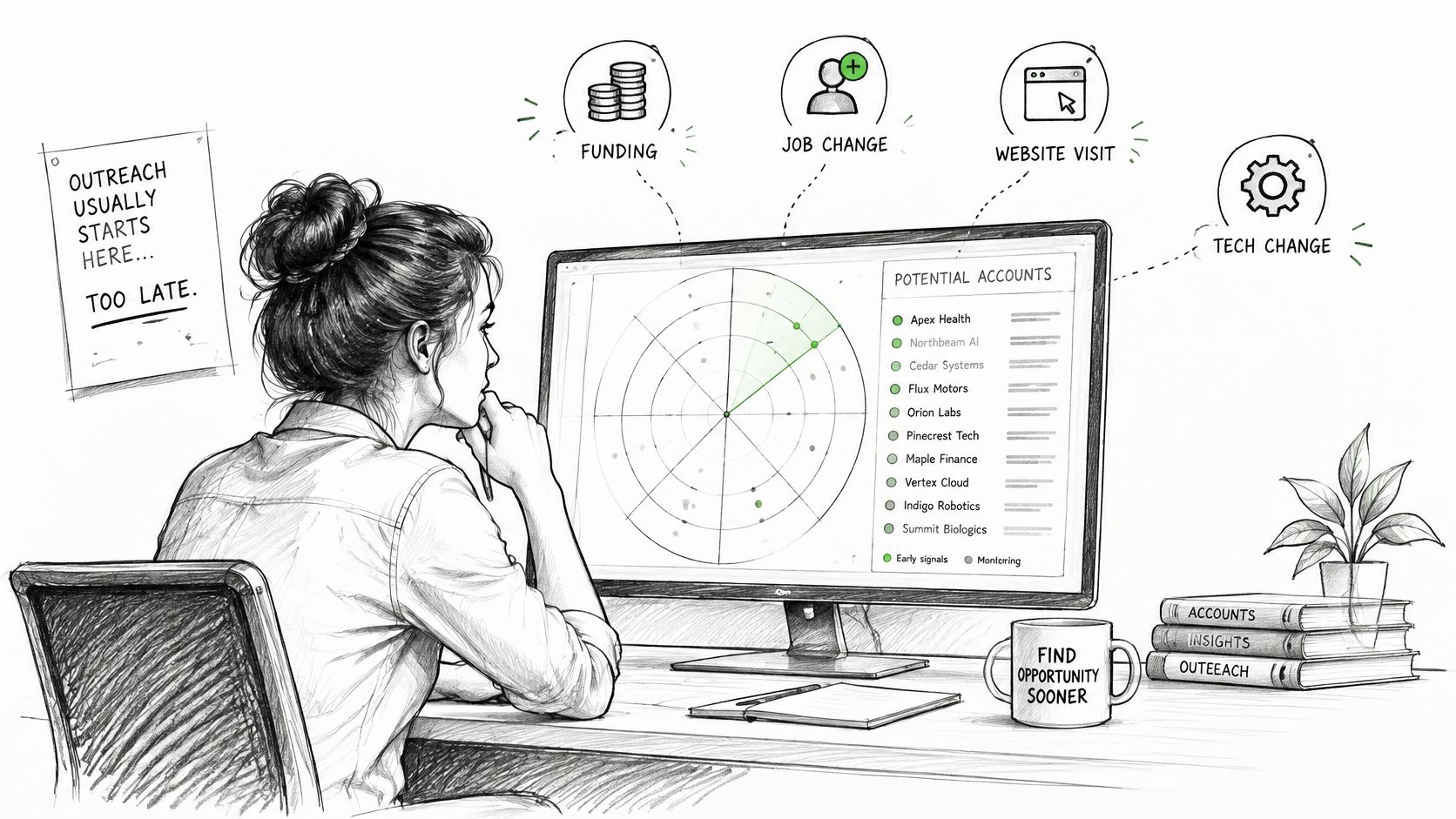
Gartner's April 2025 research found that only 2% of B2B buyers begin the purchase process with no vendors already in mind. Most future opportunities take shape before a formal project appears. If you're unknown when the shortlist forms, strong late-stage outreach may still arrive after preferences have hardened.
Run Two Tracks, Not One Pitch
- Category education track: For well-fit accounts with no active project, send low-pressure material that names a costly problem, shows how peers handle it, and can be forwarded to finance, operations, IT, or procurement.
- Conversion track: For accounts showing a live need, use problem-specific sequences tied to the trigger and ask for a meeting.
That split prevents the common waste of pitching every account as if it's ready to buy this month. Education accounts need familiarity and internal consensus. Active accounts need speed and specificity. Judge the first track on new stakeholders reached, repeat engagement, and forwards, not only immediate meetings.
For research, define the ideal customer profile by role, company size, geography, technology stack, and industry workflow, then build the database to match. In our Research step, we build prospect databases using Clay and collection from LinkedIn Sales Navigator, Google Maps, and targeted websites. Use licensed enrichment sources and a sales intelligence platform for prospect data rather than scraping LinkedIn in ways that break its terms and risk account restrictions. If you need a structured starting point, Pipecorn's guide on how to build a targeted prospect list is a useful companion to that research work.
The video below walks through the practical side of spotting and acting on buying signals without treating every signal as equal.
We find prospects for customers and use live buying signals to reach out when prospects are most likely to say yes. A new hire in a relevant role or a tech stack change doesn't guarantee budget, but it does tell you where a conversation is more timely.
Apply this checklist to a list you already own. Remove accounts that fail the profile. Tag accounts with live signals for conversion sequences. Sort the remaining well-fit accounts into category education.
Email Infrastructure That Protects Inbox Delivery
A sound list and relevant message still fail if the email never reaches the inbox. Set up sender infrastructure before launch, then monitor it as campaign volume grows.
Gmail's sender requirements call for SPF or DKIM authentication, valid forward and reverse DNS records, and TLS for messages sent to personal Gmail accounts. Senders reaching approximately 5,000 or more Gmail accounts within 24 hours must also configure SPF, DKIM, and DMARC. Gmail recommends keeping user-reported spam rates below 0.1% and preventing them from reaching 0.3%, which can affect mitigation eligibility and inbox placement.
Operating Checklist Before You Scale
- Authenticate every domain: Configure SPF, DKIM, and DMARC before launch, and align the visible From domain with SPF or DKIM.
- Warm up new inboxes: Start with low daily volumes and increase gradually over several weeks before adding campaign volume. See this guide to warming up an email domain.
- Monitor complaints daily: Check Google Postmaster Tools, suppress invalid or disengaged contacts, and pause or revise sequences when complaints rise.
- Control list quality: Verify addresses, remove role accounts you do not intend to contact, and deduplicate across campaigns.
The failure chain is straightforward: weak authentication or rising complaints can reduce inbox placement; fewer delivered messages mean fewer opportunities for replies and qualified meetings. Adding inboxes or domains does not remove that risk. Monitor aggregate volume and complaint patterns as you scale.
Set up authentication, warm new inboxes, and monitor complaints before the first outreach touch. These controls are harder to fix after a campaign is already underperforming.
Check consent and opt-out rules before sending, including GDPR requirements for European contacts and CAN-SPAM requirements for US recipients. Include a working unsubscribe option in every message. If placement drops, check authentication, complaint rates, bounce patterns, and engagement suppression in that order. This guide to diagnosing email deliverability issues can help distinguish a technical failure from a list or content problem.
Outreach Sequences Built on Relevance
You've seen the failure mode. A generic template goes to a large list, a handful of people reply, several mark it as spam, and the team responds by sending more. Volume alone isn't a strategy. It accelerates whatever targeting and relevance problems already exist.
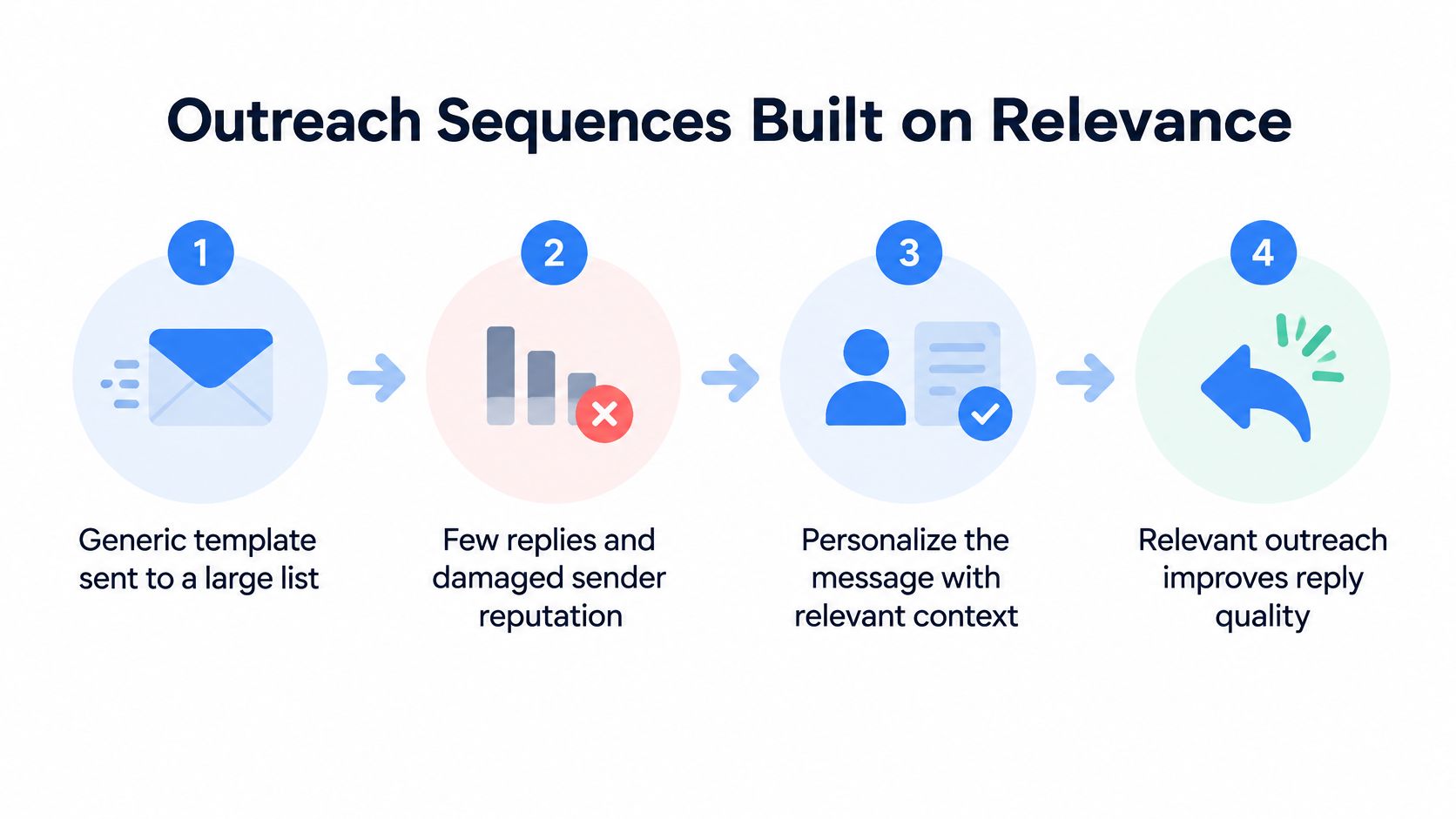
Personalization isn't inserting a first name. It's segmentation around variables that change the prospect's business problem, such as role, company size, geography, technology stack, buying trigger, and industry workflow. Give each segment one value hypothesis and one call to action. A head of operations at a manufacturer and a founder at a small SaaS company shouldn't receive the same problem statement with different names swapped in.
McKinsey's personalization research reports that personalization commonly produces a 10% to 15% revenue lift, with observed company-specific results ranging from 5% to 25%. That lift depends on accurate underlying data and a message that connects a specific operational issue to a credible next step. Wrong tech stack data or a stale role title doesn't just fail to help, it signals carelessness.
A Three to Five Touch Sequence
- Touch one: A relevant observation tied to the segment's problem and a short, specific question.
- Touch two: A brief case angle or peer example that shows how the problem gets solved, sent a few business days later.
- Touch three: A LinkedIn direct message that references the same issue without repeating the email word for word.
- Touch four: Material a contact can forward to another stakeholder, such as a one-page cost or workflow breakdown.
- Optional touch five: A closing question that makes it easy to decline, redirect you, or name a better time.
Space touches so each one adds information. "Just bumping this" adds pressure without value and trains prospects to ignore you.
Research should feed the copy directly. In our Copywriting step, we write personalized email sequences based on deep research, including technology stack analysis, mutual connections, and competitive intelligence. We also plan volume realistically. We need to send 200-300 emails on average to generate one warm lead for a client, so a tiny test on a weak list tells you very little.
Close with a controlled test plan. Change one variable at a time, such as the subject line or call to action, keep the list and sending setup constant, and judge variants on positive reply rate. Don't declare a winner on opens alone.
Qualifying Leads and Handing Off to Sales
Qualification is where a reply becomes something sales can use, or gets stopped before it wastes an account executive's calendar. Without shared stage definitions, BDRs pass curiosity as demand and account executives stop trusting the pipeline.
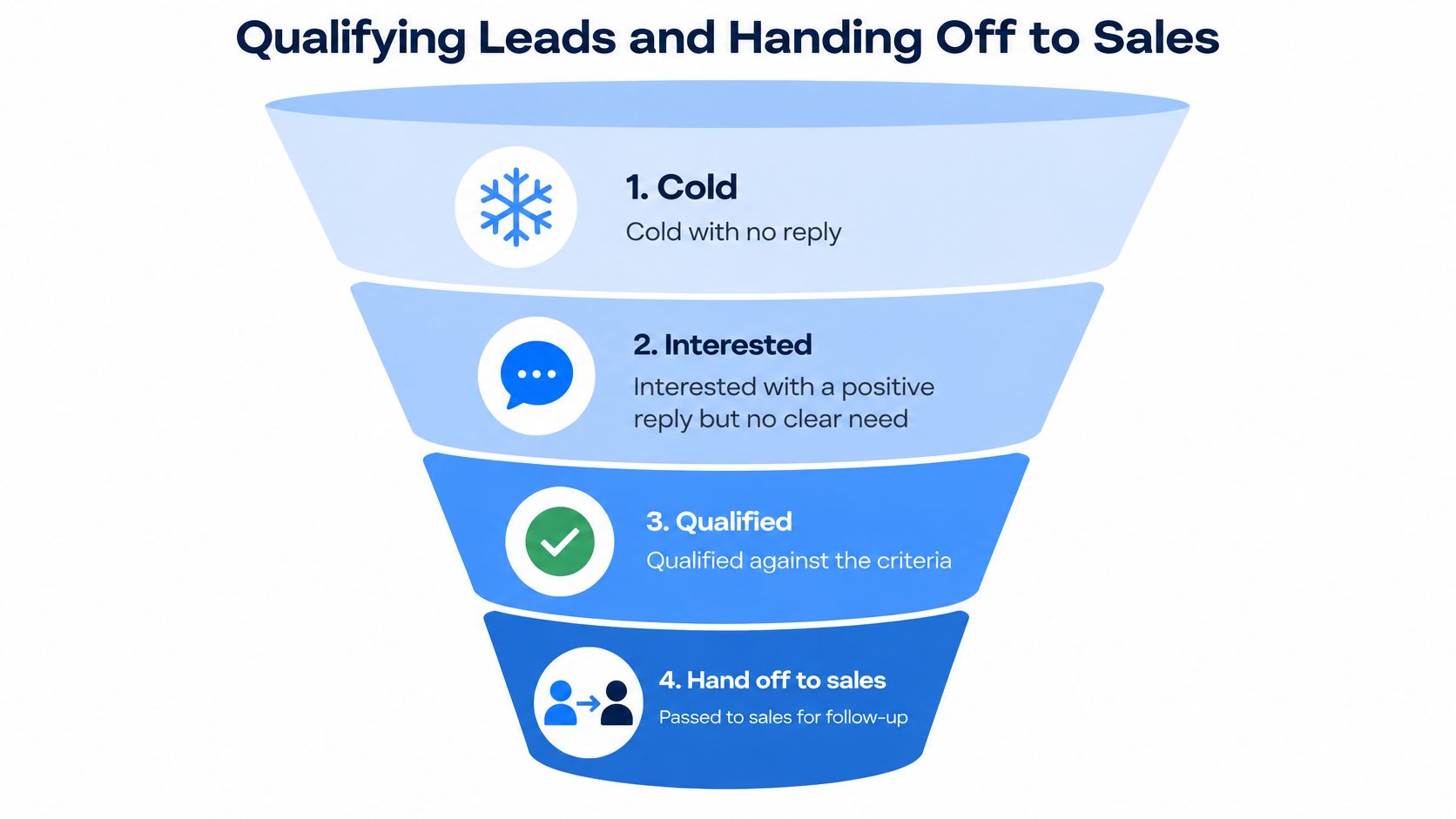
Use four stages consistently.
- Cold: No reply yet, however strong the account fit looks on paper.
- Interested: A positive reply, but no clear need, owner, or timing established.
- Qualified: The account matches the profile and the prospect confirms the problem.
- Meeting-ready: A confirmed time, a named attendee, and enough context for a useful first call.
The test for qualified should be explicit. The account matches the ideal customer profile. The prospect has the problem your offer solves. There's a named budget or decision owner, even if that person isn't the contact who replied. If one of those three is missing, the lead may still be worth nurturing, but it isn't ready for handoff. Our fuller breakdown of what lead qualification means in practice can help you turn those checks into CRM fields.
What the Handoff Package Must Contain
An account executive shouldn't have to reconstruct the conversation. Pass company context, the trigger that prompted outreach, the full reply thread, a stakeholder map, and the questions the prospect already answered. Add the agreed reason for the meeting in one sentence. If the prospect asked for pricing, implementation detail, or a competitor comparison, say so plainly.
That package matters because responsibility changes hands at handoff. We don't provide end-to-end sales. Our job is to generate leads and the client's job is to close them. A thin handoff breaks that model because the closer starts from zero and the prospect has to repeat themselves.
Set disqualification reason codes and use them every time. Useful codes include wrong role, no problem, no budget, bad timing, and account outside the profile. Those codes turn rejected leads into targeting feedback. If "wrong role" spikes, your persona definition or data source is at fault. If "no problem" spikes, your segment hypothesis is wrong.
If account executives reject a large share of handoffs, tighten the criteria before adding volume. More weak leads won't fix a weak definition.
Hold a short weekly review where the BDR hears why leads were accepted or rejected. That conversation improves the next list more than another copy rewrite usually does.
Metrics That Show Whether BDR Outreach Works
Read metrics in funnel order, or you'll optimize the wrong stage. A cheap lead that never becomes an opportunity isn't efficient, and a high reply rate from the wrong accounts isn't progress.
| Metric | Formula | What it diagnoses |
|---|---|---|
| Positive reply rate | Positive replies divided by delivered emails | Message and offer fit |
| Qualified meeting rate | Qualified meetings divided by contacts reached | Whether replies become real conversations |
| Show rate | Meetings held divided by meetings booked | Quality of the handoff and confirmation process |
| Opportunity conversion | Opportunities created divided by meetings held | Accuracy of qualification |
| Cost per qualified lead | Total program cost divided by qualified leads | Efficiency compared with hiring in-house |
Start with positive reply rate to check whether the right people see the message as relevant. Then check whether replies become qualified meetings, whether those meetings happen, and whether account executives convert them into opportunities. Only then judge cost per qualified lead, because cost means little until you know the leads are real.
The Open Rate Trap and the Backward Calculation
Open rate misleads as a success measure. It mostly reflects tracking, mail client behavior, and image loading, not interest. Use it only as a rough deliverability signal. A campaign can show healthy opens and produce no positive replies because the offer is wrong for the segment.
Work backwards from revenue instead. Decide how many closed deals you need, estimate how many qualified leads produce one deal, then calculate the meetings and leads required each month. For a clearly hypothetical example, if one in fifteen qualified leads closes, then 60 qualified leads a month produce about four deals. Change any assumption and the required volume changes with it.
Our own operating pattern gives a practical sense of those ratios. Our clients book meetings with every 3-4 leads, and they need 10-20 leads to close a sale. Your numbers will differ with deal size and sales cycle length, so set internal baselines during the first 30 days rather than adopting a published benchmark that came from a different market.
Reporting rule: Tie every monthly report to pipeline and revenue, not lead counts alone. Volume without opportunity conversion is activity reporting.
That discipline also exposes trade-offs. Tightening qualification may lower lead volume while raising opportunity conversion. That's usually a good trade if account executive time is your scarce resource.
In-House or Outsourced BDR Lead Generation
There's no universally better model. The right choice depends on how much control you need, how fast you need meetings, and whether outbound is a permanent motion or a test.
| Factor | In-house BDR team | Outsourced agency |
|---|---|---|
| Control over messaging | Full, set and approved internally | Shared through a brief and approval step |
| Data and tooling | Bought, configured and managed by the company | Provided and run by the agency |
| Cost structure | Salaries, benefits, tools and management time | Monthly fee or retainer |
| Time to first meetings | Hiring and ramp-up first | Onboarding and warm-up first, then campaign launch |
| Best fit | Steady deal flow and deep product discovery | Testing new segments, regions or languages |
An in-house team suits steady deal flow, products that need deep technical discovery, and companies that can fund hiring, ramp-up, tooling, and day-to-day management. You get tighter feedback loops with product and account executives. You also carry the full cost when a segment fails or a BDR leaves.
An outsourced agency suits teams testing new segments, regions, or languages, or teams where hiring would take longer than the test window. The trade-off is shared control. You'll need a sharp brief, message approval, and agreed qualification criteria, or the agency will optimize for lead volume because that's the easiest number to report. If you're comparing providers, MarTech Do's lead generation agency selection criteria is a helpful checklist to adapt to your own requirements.
Verdict by Situation
- No pipeline and a tight budget: Outsource a narrow test first, provided the fee buys verified leads and clear reporting, not vague activity.
- Entering a new country: Outsource if localized language and market-specific list building matter more than internal control at this stage.
- Long enterprise cycles: Lean in-house, because the BDR needs deep account context, stakeholder history, and patience across many touches.
Whichever route you consider, including sales development outsourcing, ask the same questions. What do you guarantee and how is it measured? How are leads verified? Who owns deliverability? Which data sources do you use? Who handles replies and the handoff? A provider that can't answer those in writing isn't ready to run your pipeline.
Choose a Model and Test One Segment First
Don't settle the build or buy question with opinions. Pick the model provisionally, choose one segment, and run a 30-day test that can produce a decision.
- Choose one ideal customer segment with a clear problem and a named buyer.
- Confirm authentication, warm-up, and complaint monitoring on every sending domain before the first send.
- Build a list of about 60 accounts from research and tag each with a live buying signal, or mark it for the category education track.
- Run a three-to-five touch sequence across email and LinkedIn with one value hypothesis.
- Track positive reply, meeting, and show rates weekly against the baselines you set for the test.
- Choose the in-house or outsourced path based on cost per qualified lead and the share of handoffs accepted by account executives.
Proof can show what's possible in a defined engagement, but it doesn't guarantee your segment will behave the same way. For the client B2B Growth, our campaigns generated 237 interested leads and 40,000€ in revenue. We promise 20+ qualified leads within 30 days, or we refund the client, which is the kind of written, measurable commitment you should demand from any provider you shortlist.
Ask any provider, whether it's an in-house hire or an agency, for the same metrics in writing before committing. Define in advance which result would justify extending the test to a second segment, and treat the test as a decision tool, not a guarantee of results.
If you want that 30-day test run without hiring, tooling, and warming domains yourself, Lead Printer builds the prospect research, email infrastructure, and personalized multichannel sequences, then hands qualified leads to your team to close. Start with one segment, judge us on positive replies, meetings held, and accepted handoffs, and scale only if the numbers earn it.