You've added mailboxes, cleaned the list, approved a sequence, and scheduled the launch. Then the replies slow down, bounces appear, and your team starts checking several dashboards just to find out whether the problem is the copy, the data, the warm-up process, or the sending platform.
That's the point at which Smartlead vs Instantly stops being a feature comparison. The more useful question is which operating model your team can run safely. Smartlead gives technical teams deeper control over infrastructure and automation. Instantly reduces friction by combining prospecting, sending, warm-up, and reply management in a simpler workflow.
The distinction matters because a platform can be inexpensive and still create a costly operating burden. A tool that requires careful mailbox configuration, list validation, suppression management, and ongoing deliverability analysis may suit an experienced agency operator. The same tool can overwhelm a lean sales team that needs to launch campaigns without a dedicated deliverability specialist.
This comparison evaluates the decision through that lens. It considers positioning, independent deliverability benchmarks, scaling economics, workflow fit, regional governance, and the point at which managing the machinery yourself no longer makes commercial sense. The recommendations apply to B2B SaaS, ecommerce, professional services, and manufacturing teams, but the underlying test is consistent: how much control do you need, and who will operate it?
Introduction Why Smartlead vs Instantly Matters Right Now
A founder usually faces this decision after a first campaign works. One mailbox no longer covers the prospect list, follow-ups must run across several sender accounts, and the team now manages warm-up, sending limits, replies, unsubscribes, bounced addresses, and CRM updates alongside sales work.
That scaling point reveals the gap between software access and operational readiness. Smartlead fits teams that can manage APIs, mailbox-level settings, data pipelines, and campaign diagnosis. Instantly fits teams that need a shorter route from lead discovery to sending and reply handling.
The trade-off is operational risk. More control gives experienced operators more ways to separate clients, segments, mailboxes, and workflows, but it also creates more configuration and monitoring work. Simplicity reduces setup friction, yet teams may have fewer levers when a campaign needs investigation or a sending process needs adjustment.
Neither platform removes the work that protects inbox placement. Prospect data quality, message relevance, sending patterns, and responses to negative signals still shape mailbox reputation. The platform determines how easily a team can apply those controls, not whether the controls are applied.
Operational rule: Choose the tool your team can monitor correctly every week, not the one with the longest feature list.
Independent benchmarks disagree on inbox placement, as detailed in the deliverability analysis below. That disagreement matters more than a superficial winner. Results can vary with list quality, mailbox configuration, sending practices, and operator skill, so a benchmark result should inform testing rather than replace it.
A technical team with time to inspect infrastructure may benefit from Smartlead's control. A smaller team without dedicated deliverability ownership may reduce execution risk with Instantly's shorter workflow. If neither team can consistently manage those variables, a managed agency is safer than adding another DIY platform.
The practical question is how much control can your team operate without weakening deliverability?
Smartlead and Instantly at a Glance
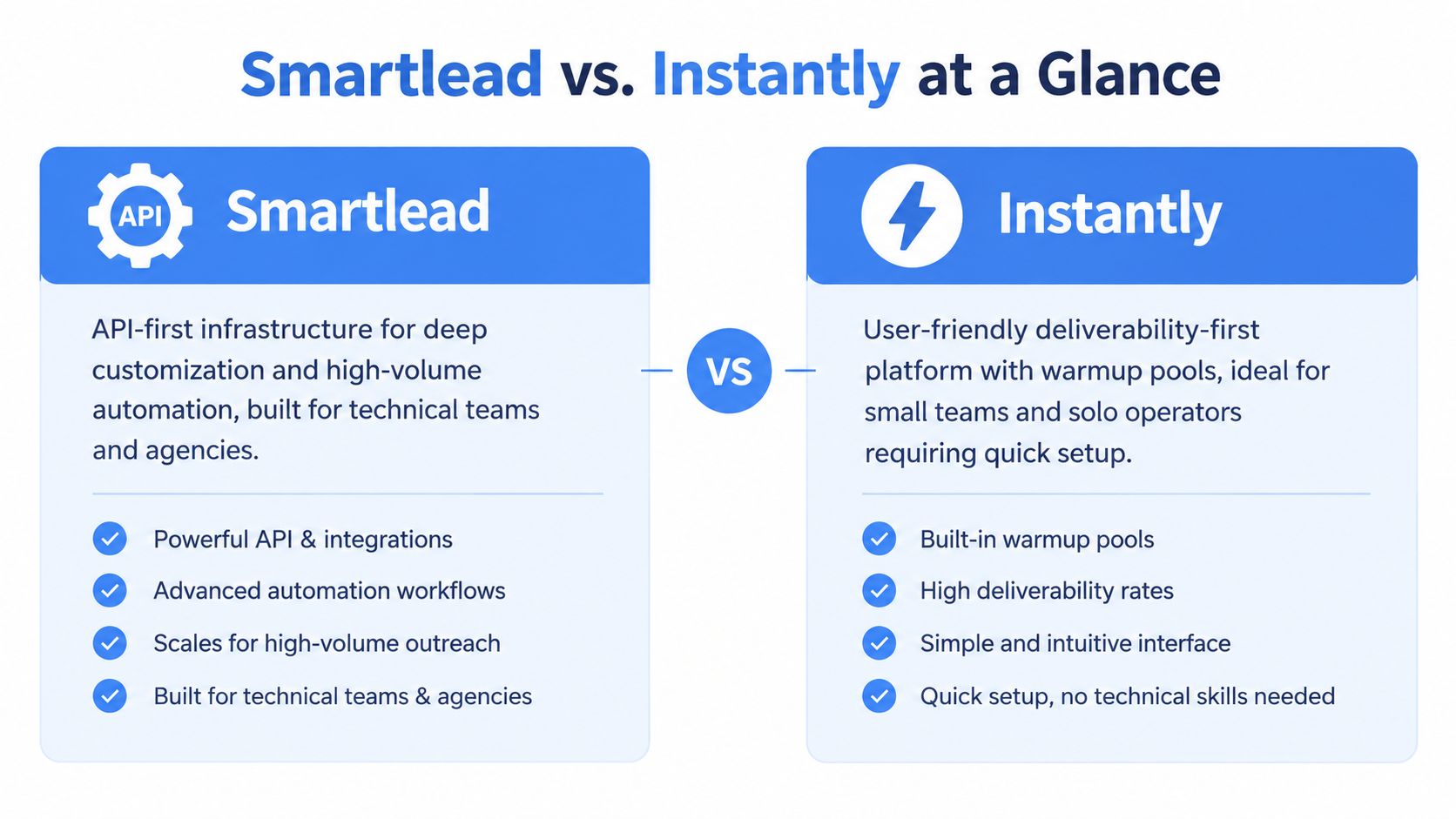
A team with a technical operator and an existing data stack will evaluate these tools differently from a founder running outreach alone. Smartlead and Instantly occupy adjacent categories, but the operational risk sits in different places. Smartlead provides API-first infrastructure for granular control over mailboxes, integrations, and campaign logic. Instantly presents a more unified growth platform, combining outreach with prospecting and inbox workflows.
Smartlead suits controlled, technical operations
Smartlead fits agencies, technical sales operations, and teams that already maintain a data stack. An operator can enrich contacts elsewhere, send records through an API, route replies into a CRM, and apply different campaign rules by client, segment, or mailbox.
The trade-off is operational ownership. Someone must maintain field mapping and integrations, monitor account health, manage suppression logic, and investigate failures. Smartlead gives experienced teams more ways to control the system, while also requiring them to understand the consequences of each configuration choice.
That distinction matters for inbox protection. Extra controls help only when a team can review them consistently and respond to negative signals before they affect more mailboxes.
Instantly reduces the number of moving parts
Instantly compresses the workflow. A smaller team can find prospects, prepare campaigns, connect sending accounts, manage warm-up, and review replies within a more unified environment. That structure suits founders, lean sales teams, and operators who value faster execution over custom infrastructure.
Its broader product direction is also visible in a separate 2026 market summary, which reported growth in Instantly's lead database from “just a few million” contacts to more than 160 million to 450 million contacts. The same summary cited pricing of $39 per month for Instantly and $47 per month for Smartlead. Those figures appear in Sparkle's 2026 market comparison. The operational implication is clear: Instantly has expanded from sending into prospecting and proprietary data access.
Who actually uses them
G2's public comparison shows that both products are concentrated among smaller businesses. 94.8% of Instantly reviewers are in the small-business segment, 5.0% are mid-market, and 0.2% are enterprise users. Smartlead's mix is 93.9% small-business, 6.1% mid-market, and 0% enterprise, according to G2's Smartlead and Instantly comparison.
G2 also lists Instantly's entry-level offer as a free trial per month, while Smartlead starts at $39.00. These positions help explain their prevalence among small outbound teams rather than large enterprise sales organizations.
The sharper buying question is team capability. Choose Smartlead when someone can operate its controls. Choose Instantly when reducing setup and maintenance work lowers execution risk. If neither condition holds, a managed agency may be safer than another DIY platform.
Deliverability and Safeguards Compared With Real Numbers
Inbox placement is not a permanent property of either platform. Independent tests point in different directions, so operators should treat these figures as controlled observations, not guarantees.
| Metric | Instantly | Smartlead | Takeaway |
|---|---|---|---|
| Inbox placement, independent benchmark | 94% | 89% | Instantly led by 5 percentage points in the Prospeo benchmark |
| Bounce rate, same benchmark | 1.2% | 2.1% | Instantly recorded the lower bounce rate |
| Inbox placement, separate 30-day comparison | 84.1% | 87.4% | Smartlead led in the Cotera comparison |
| Bounce rate, separate comparison | 2.3% | 2.1% | The gap was narrow in that comparison |
The first dataset, from Prospeo's benchmark, covered 8 million-plus emails across more than 200 campaigns. It reported 94% inbox placement for Instantly versus 89% for Smartlead, alongside bounce rates of 1.2% and 2.1%. At scale, that difference matters because additional bounces can weaken the reputation of the sending infrastructure.
A separate test produced the opposite placement result. Cotera's 30-day comparison reported 87.4% placement for Smartlead and 84.1% for Instantly, with bounce rates of 2.1% and 2.3%. Smartlead led on placement in that test, while bounce performance was nearly identical.
Why the result changes
Platform selection is only one variable. List hygiene controls how many addresses fail. Warm-up discipline shapes mailbox history. Domain configuration, message relevance, recipient engagement, suppression handling, and volume control affect how mailbox providers assess sending activity.
The reported 2 to 5 percentage point spread therefore calls for investigation rather than automatic brand preference. Changing the platform, list source, copy, domains, and sending behavior together removes the ability to identify the cause of an improvement or decline.
A repeatable control process should follow the email deliverability best-practices guide. Authenticate each sending identity before launch, warm new mailboxes gradually, remove risky or invalid contacts, suppress unsubscribes and negative replies, and review placement and bounce signals by mailbox instead of relying only on campaign totals.
Deliverability risk comes from the system around the sender. Smartlead gives more room to customize that system. Instantly makes more of the system easier to operate. Neither absolves the team from monitoring it.
What the numbers mean for the buyer
Smartlead fits teams with an operator who can diagnose mailbox-level variation and adjust infrastructure deliberately. Its control has value when the team can use it consistently.
Instantly fits teams that reduce execution risk by applying core safeguards through a simpler workflow. If operators cannot explain why a mailbox is underperforming, additional control may create more mistakes instead of fewer. Simplifying the process, or using managed execution, can then be safer than adding another DIY tool.
Pricing Scaling and Hidden Operational Costs
Subscription price is only the first line in an outbound budget. The larger cost is operating the system: connecting accounts, validating data, maintaining warm-up, reviewing campaign health, handling replies, and correcting mistakes before they affect sender reputation.
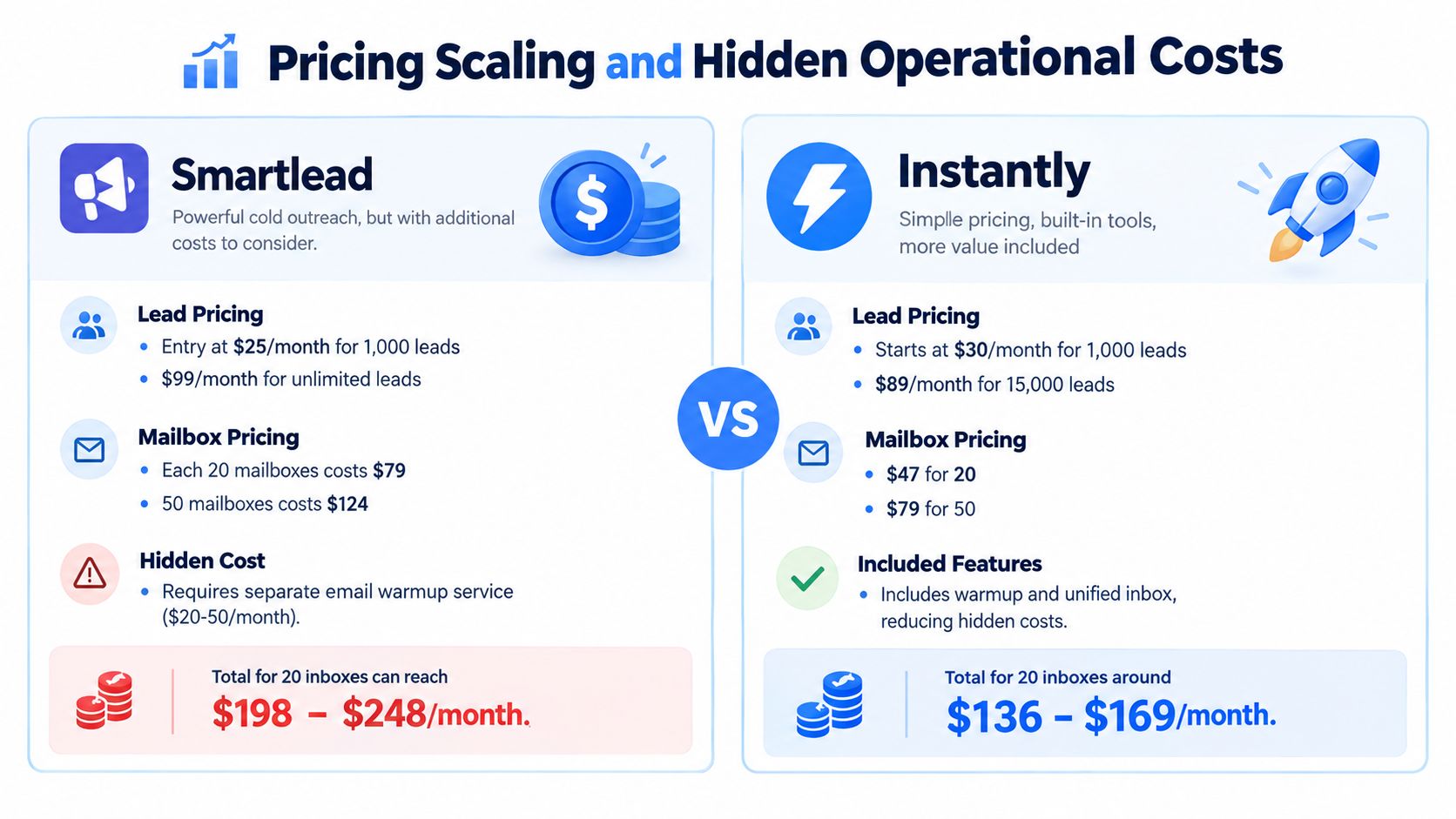
G2 lists a $39.00 starting price for Smartlead, while Instantly's entry-level listing appears as a free trial per month in its public comparison. A separate 2026 market summary cites $39 per month for Instantly and $47 per month for Smartlead. The figures do not align perfectly, so buyers should verify current plans and billing terms before building a scaling model. A comparison table is a starting point, not a total-cost forecast.
The cost that appears after checkout
Smartlead's deeper configuration can increase operator workload. A technical agency may accept that burden when custom integrations, mailbox rules, and client-specific workflows produce measurable value. A lean team can experience the same flexibility as delayed launches, inconsistent setup, and dependence on one person who understands the infrastructure.
Instantly's bundled approach reduces the number of systems an operator must coordinate. Its database expansion, reported at more than 160 million to 450 million contacts by 2026, shows its broader prospecting direction, according to Sparkle's market summary. Bundling can reduce tool sprawl, but it does not ensure accurate targeting or compliant contact-data use. The team still owns list quality and campaign judgment.
A practical decision matrix
| Team condition | Lower-risk direction | Why |
|---|---|---|
| Small team with limited technical capacity | Instantly | A unified workflow reduces setup burden |
| Technical agency with custom data pipelines | Smartlead | API and infrastructure control can justify operator effort |
| Team expanding across regions | Either, with governance review | Data sourcing, localization, and suppression processes matter more than the label |
| No internal deliverability owner | Managed execution | Daily operation creates the risk, not software selection alone |
For agencies managing many accounts, a low monthly price can conceal substantial labor. Every added client brings another audience, suppression list, messaging context, and mailbox-health issue. If operators spend their time repairing workflows, the platform with the lower subscription fee may carry the higher ownership cost.
Team skill changes the answer. Smartlead rewards an operator who can maintain custom infrastructure and diagnose failures. Instantly suits teams that value fewer handoffs and a simpler operating path. If neither capability exists internally, a managed agency can be safer than adding another DIY tool.
Read the Instantly alternatives guide when the evaluation expands beyond these two platforms. Compare software cost plus operational labor plus the expected cost of deliverability mistakes, rather than subscription prices alone.
Features Integrations and Workflow Fit for Different Teams
A feature matters only when it changes a real operating task. Smartlead's control is valuable when a team needs to connect systems and create differentiated workflows. Instantly's simplicity is valuable when the team would otherwise lose time moving between prospecting, sequencing, warm-up, and reply management tools.

Agencies need control, but control creates ownership
An agency running different campaigns for several clients may need separate audiences, messaging rules, CRM destinations, and reporting logic. Smartlead's API-oriented position fits that environment because an operator can connect external prospecting, enrichment, and workflow tools instead of forcing every client into one standard process.
That flexibility supports advanced stacks built around tools such as Clay, CRM platforms, and custom automation. It also creates failure points. A broken mapping, stale enrichment field, missing suppression rule, or disconnected mailbox can affect campaign quality without a simple all-in-one warning.
Lean teams need fewer handoffs
Instantly is more suitable when one operator owns the path from contact discovery to reply review. A unified workflow can make it easier to launch a targeted sequence, monitor basic health indicators, and keep replies visible without maintaining several integrations.
That doesn't make Instantly the automatic choice for every small team. A business that needs complex routing, custom triggers, or highly specialized enrichment may quickly outgrow a simpler workflow. The question is whether those requirements are frequent enough to justify the added operating burden.
Cross-border governance changes the decision
Compliance and data governance receive less attention than features or placement rates, but they become more important as campaigns cross the US, UK, and EU. Teams need to know where contact data comes from, how they record lawful outreach decisions, how they apply suppression lists, and how they localize messages by geography and sector.
Neither platform choice solves those questions by itself. A data provider, enrichment layer, CRM, and outreach platform can each introduce separate governance requirements. For EU and UK campaigns, the operator should document data provenance, retention, opt-out handling, regional messaging rules, and access controls before scaling.
A practical workflow should answer four questions:
- Data source: Can the team identify how each contact entered the campaign?
- Segmentation: Can operators separate markets, industries, and messaging permissions?
- Suppression: Can an unsubscribe or negative response stop future outreach everywhere?
- Auditability: Can the team show who changed a campaign, list, or sending rule?
Smartlead is the better fit when these controls require custom orchestration. Instantly is the better fit when the team values a standardized workflow and can enforce governance through process. If neither can be operated reliably, the problem isn't a missing feature. It's a mismatch between the tool and the team's capacity.
Which Tool to Choose by Use Case and When to Choose Lead Printer Instead
The right choice depends on the job the outreach program must perform, not the category label on the pricing page.
B2B SaaS
A SaaS company with technical sales operations, multiple segments, and frequent CRM automation should lean toward Smartlead. Its control is useful when product signals, enrichment fields, or account segments need to trigger different sequences.
A smaller SaaS team with one clear ideal customer profile may prefer Instantly. The simpler path can reduce the time between finding a prospect and reviewing the reply, especially when the team doesn't have an engineer or deliverability operator assigned to outbound.
Ecommerce and payment providers
Ecommerce and payment businesses often need precise merchant segmentation, regional messaging, and event-driven campaigns. Smartlead is the stronger fit when custom triggers and external data sources determine the sequence. Instantly is more practical when the campaign is straightforward, the audience is tightly defined, and speed of execution matters more than complex orchestration.
Professional services
Consultancies, accounting firms, training companies, and similar providers often have small commercial teams. Instantly's reduced setup burden can help those teams maintain consistent outreach without building a large technical stack.
The risk is overextension. If the firm targets several countries, industries, or seniority groups, a simple campaign can become a governance problem unless segmentation and suppression are carefully managed.
Manufacturing
Manufacturers frequently need account-based research, territory logic, and CRM coordination. Smartlead fits when the campaign depends on custom data enrichment and bulk workflows connected to an existing sales process. Instantly can work for a focused regional campaign where the sales team wants a more direct operating interface.
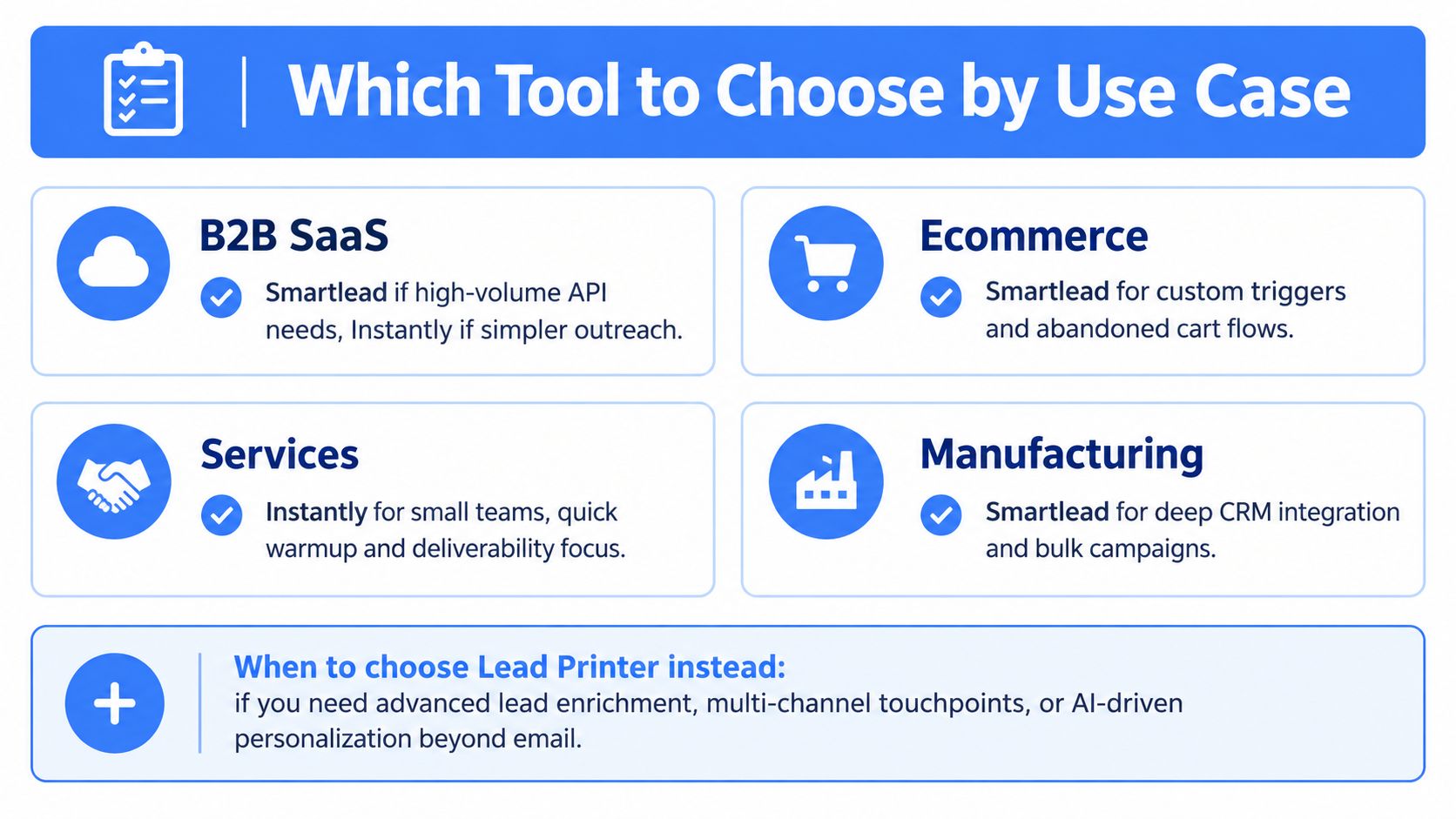
When DIY is the wrong operating model
If nobody owns deliverability, list quality, personalization, and reply qualification, buying more automation won't fix the outbound program.
A managed option becomes more rational when the team lacks time to maintain infrastructure, needs localized outreach, or wants someone else to coordinate research, enrichment, messaging, launch, inbox management, and reporting. Lead Printer provides those services across email and LinkedIn outreach, including infrastructure setup, prospect research, data enrichment, personalized sequences, campaign optimization, qualification, and calendar handoff. Its stated engagement model guarantees a minimum of 20 qualified leads per month, with the publisher reporting that many clients receive an average of 50 leads per month and some receive 200 to 300, as described in its outsourced lead generation service.
That route doesn't remove the need for client input. The client still has to define the target market, approve positioning, and handle qualified sales conversations. It does shift the operational burden away from a team that isn't equipped to manage it.
Migration and Implementation Without Losing Deliverability
Switching platforms safely requires separation between infrastructure changes and campaign changes. Don't migrate mailboxes, lists, copy, and targeting at the same time, because you won't know which variable caused a performance change.
- Audit the current system. Export contacts, campaign logic, reply history, suppression records, and performance by mailbox. Remove unsubscribed, invalid, and unsuitable contacts before importing anything.
- Prepare the new environment. Authenticate sending domains, connect mailboxes, confirm tracking settings, and check that replies route to the correct owners. Run test messages and inspect personalization fields manually.
- Warm and validate gradually. Keep proven sending infrastructure active while the new environment establishes its own history. Start with a small controlled audience and increase only when bounce, placement, and reply signals remain stable.
- Test one variable at a time. Use the same audience and a comparable message when testing Smartlead against Instantly. Change the platform first, then evaluate copy, segmentation, and volume separately.
- Protect suppression workflows. Sync opt-outs and negative responses before launch. A contact who has opted out must not re-enter through another list or client workspace.
- Review by mailbox. Campaign averages can hide one damaged sender. Pause individual mailboxes when their signals deteriorate, investigate the cause, and avoid transferring the problem to the new platform.
Bring in a specialist when no team member can explain the health indicators, when campaigns cover multiple jurisdictions, or when a migration affects revenue-critical pipeline. A careful launch may feel slower, but it protects the sending assets that every future campaign depends on.
Lead Printer builds and manages the infrastructure, prospect data, enrichment, personalized sequences, and multichannel execution needed to turn the Smartlead versus Instantly decision into a working outbound program. If your team wants qualified opportunities without taking on daily deliverability and campaign operations, visit Lead Printer to discuss the right managed approach.