Direct mail's 4.4% average response rate compares with 0.12% for email, making physical mail roughly 37 times more likely to generate a response in the widely cited ANA/DMA benchmark (2025/2026 direct mail response benchmark). That sounds like a decisive victory in the email marketing vs direct mail debate. It isn't.
The hidden variable is audience temperature. A warm customer list, a recently engaged account, and a completely cold prospect file behave differently before the first message arrives. If you compare direct mail sent to known customers with email sent to unqualified prospects, you're not comparing channels. You're comparing audience intent.
For B2B teams, the useful question is narrower: which channel creates profitable pipeline for this audience, offer, and buying stage? Email usually provides the scalable testing layer. Direct mail earns its place when the account value, intent, or need for attention justifies a higher unit cost.
The Response Rate Gap and What It Really Means
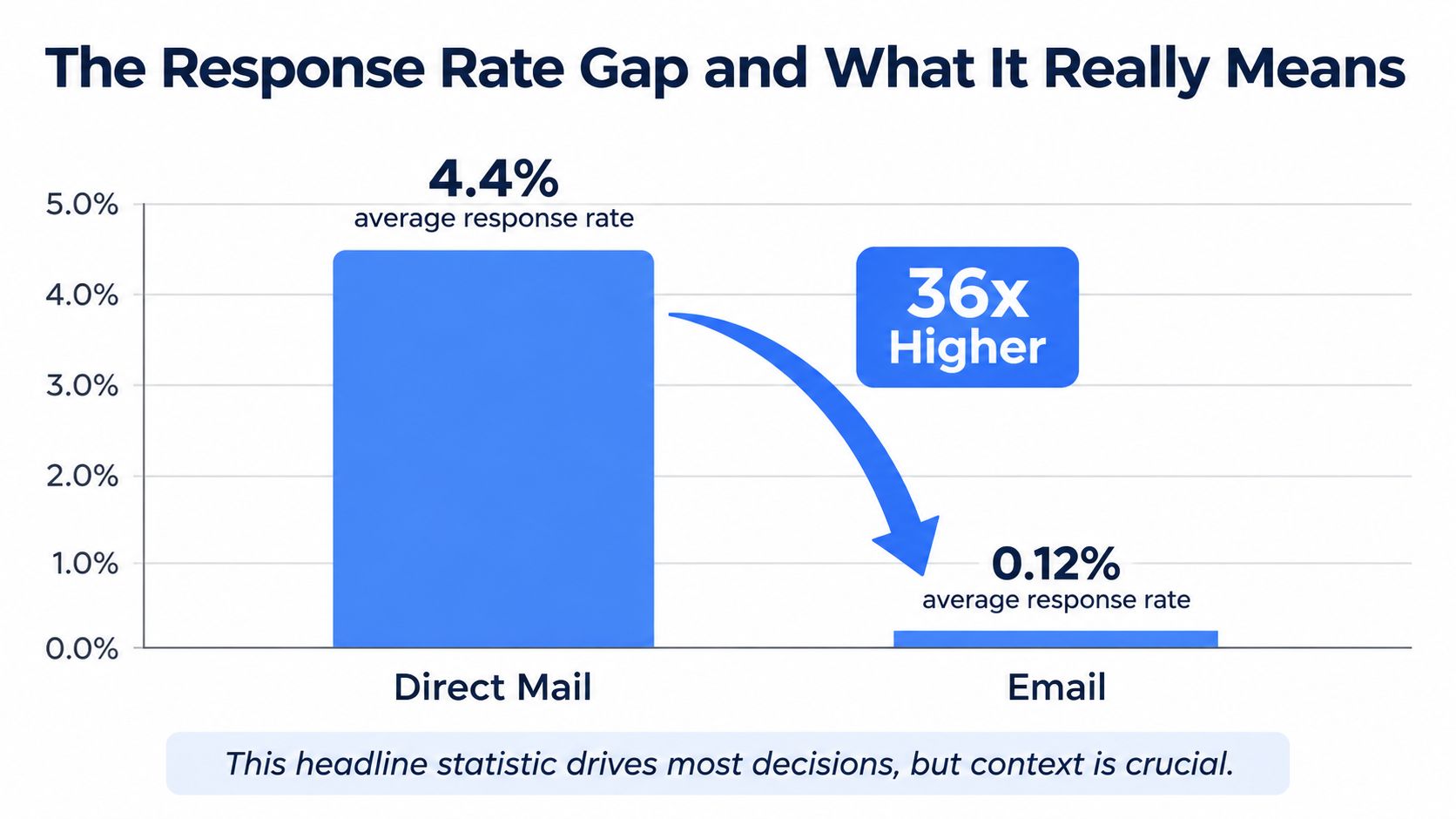
The headline gap is real within the cited benchmark, but it's easy to misuse. A 4.4% direct mail response rate means far more when the recipient is a known customer, a carefully selected account, or someone who has already shown interest than when the same piece goes to an unverified prospect. Email's 0.12% average also compresses many different campaign types into one figure, from broad acquisition to highly relevant follow-up.
The comparison becomes more useful when you separate three variables:
- Audience temperature: Has the recipient bought, engaged, requested information, or shown a relevant signal?
- List quality: Does the record identify the right person, role, company, and address?
- Response definition: Does “response” mean a reply, scan, form completion, meeting request, or purchase?
A physical piece can command attention because it arrives outside the inbox and creates a tangible interaction. Email can reach a large audience quickly, but deliverability, filtering, competing messages, and weak relevance can prevent a prospect from seeing or acting on it. Teams working on email deliverability rates need to treat inbox placement as part of channel economics, not as a technical footnote.
Practical rule: Never use a channel-level response benchmark as a forecast until you've classified the audience by intent and list source.
Response intensity is not the same as pipeline value
Direct mail may produce denser responses, but the response still needs qualification. A reply from the wrong company is not a sales opportunity. An email response from a tightly matched decision-maker may be more valuable than several low-intent physical responses.
Email's strength is operational flexibility. You can test subject lines, offers, roles, industries, and geographic segments without redesigning and reproducing a physical asset. Direct mail's strength is attention intensity, especially when the recipient is important enough to justify the investment.
The historical context supports a complementary view. U.S. households received an average of 361 pieces of marketing direct mail and 94 pieces of nonprofit direct mail in a single year, according to benchmark reporting from Postalytics (direct mail usage and benchmark statistics). Physical mail remains a mass-market channel, but B2B marketers generally get better economics when they use it selectively.
The response gap should therefore change your planning, not end the discussion. Use email to discover which segments and messages deserve attention. Use direct mail when you've identified accounts where a stronger physical interruption can influence the next action.
Cost Structures and Unit Economics Compared
Email looks almost free beside direct mail because sending another message usually carries little marginal distribution cost. That view misses the infrastructure required to send responsibly. Domains, inboxes, authentication, warm-up, deliverability monitoring, data enrichment, copy, list verification, sequencing software, and reply management all affect the cost of a qualified opportunity.
Direct mail makes the cost visible. You pay for creative production, printing, postage, addressing, fulfillment, and sometimes manual handling. The financial risk is concentrated before launch, which makes list selection and offer clarity especially important. A poorly targeted mailing wastes the full production cost for every undeliverable or irrelevant recipient.
Email vs Direct Mail Cost Comparison
| Cost Factor | Email Marketing | Direct Mail |
|---|---|---|
| Distribution | Low marginal distribution cost after infrastructure is established | Printing, postage, packaging, and fulfillment apply per piece |
| Technical setup | Requires sender infrastructure, authentication, warm-up, monitoring, and suppression processes | Requires production specifications, address quality, and mailing logistics |
| Testing speed | Fast testing of copy, segments, offers, and sequences | Slower testing because changes require revised creative and production |
| Personalization | Dynamic fields, enrichment, role signals, and message variations can operate at scale | Physical customization can be powerful, but each variation adds production complexity |
| Measurement | Replies, clicks, visits, and booked meetings can be captured digitally | Requires tracked URLs, QR codes, phone numbers, codes, or CRM matchback |
| Best economic fit | Broad prospecting, market validation, sequencing, and repeated follow-up | High-value accounts, warm lists, reactivation, and carefully selected ABM programs |
| Primary waste risk | Poor deliverability, bad data, generic copy, and excessive follow-up | Weak list selection, unclear offers, production errors, and low-value targets |
The correct model is cost per qualified opportunity, not cost per send. Start with the total campaign cost, then divide it by qualified responses, sales-accepted opportunities, meetings held, and eventually closed revenue. Keep each stage separate. A campaign can generate inexpensive replies and still produce costly meetings if qualification is weak.
Budget discipline: Direct mail shouldn't be asked to solve a list-quality problem. If the account data is uncertain, validate the segment digitally before paying to print.
Direct mail can make economic sense for a smaller group of high-LTV accounts because one qualified opportunity may justify several failed pieces. Email usually wins when the market is broad, the message still needs testing, or the sales team needs a continuous flow of prospects. The break-even point depends on your conversion rates and deal value, so model both channels against the same pipeline stages rather than comparing production invoices.
How Audience Temperature Changes the Equation
The most important comparison isn't “email versus direct mail.” It's cold acquisition versus warm-list activation.
Industry benchmark summaries report direct mail response rates of roughly 2.7% to 3.2% for prospect lists, or broader prospect-list ranges of 2% to 5%, while house-list campaigns commonly reach 4.4% to 5.3%. Triggered mail can reach 8% to 14%, according to the summarized benchmark data from Direct Response Marketing Group. These ranges show that the recipient's relationship with the sender can matter as much as the medium.
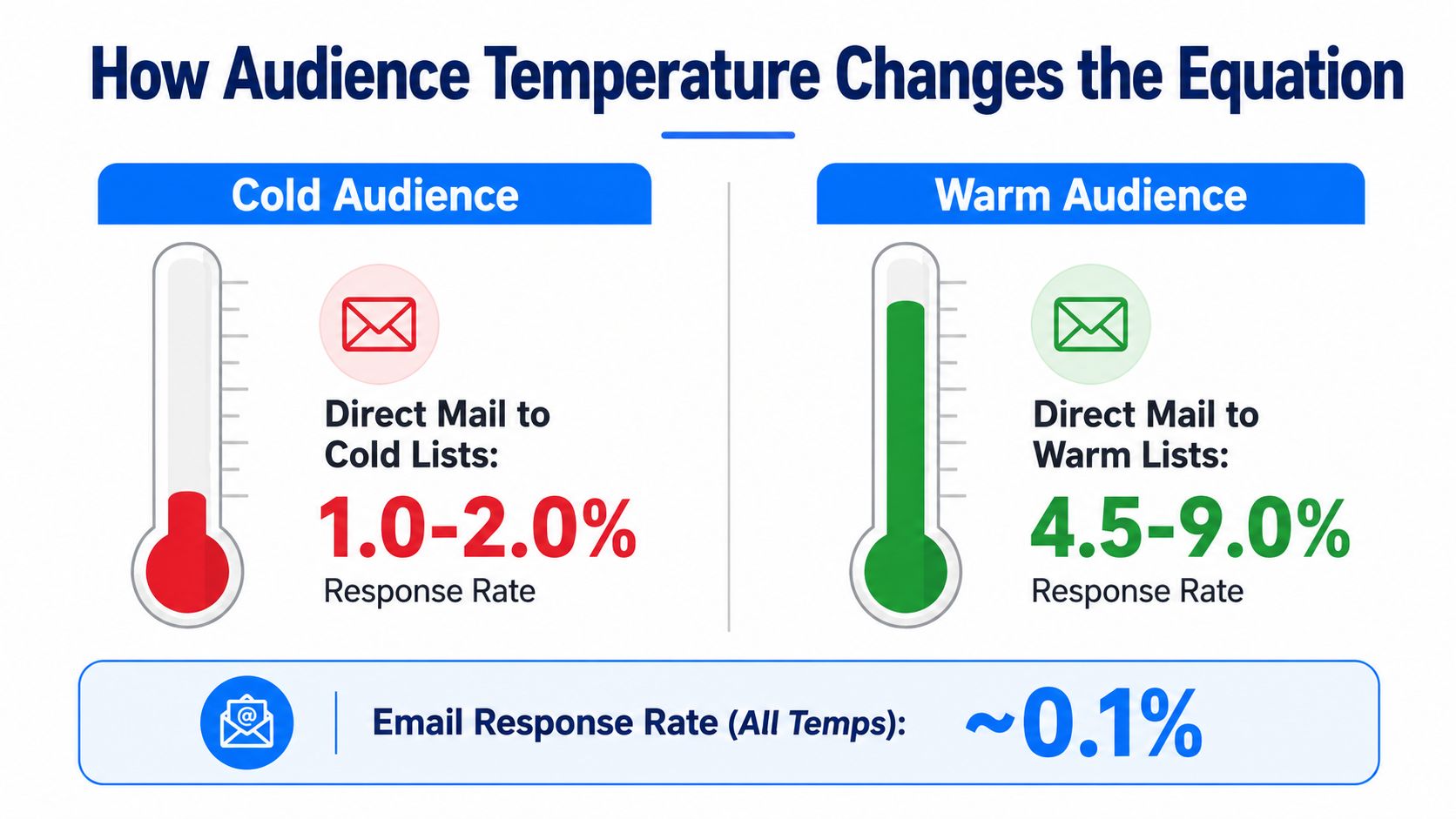
Cold direct mail still has a role, but it needs sharper selection. You're paying to reach a person who may not know the brand, may not control the problem, and may not be evaluating the category. The piece must compensate with relevance, credibility, and a low-friction response path.
Warmth changes what “good” looks like
UK campaign benchmark reporting puts direct mail response at 7.2% for warm existing-customer mail and 0.9% for cold acquisition mail. The same source reports a 0.45% cold email reply rate across 7.5 million B2B emails in 2025 (audience temperature and direct mail response data). These figures aren't interchangeable forecasts, but they expose the flaw in treating every recipient as equally reachable.
Use the following decision logic:
- Cold, broad, or unvalidated audience: Start with email because it supports rapid segmentation, message testing, and low-cost rejection of weak hypotheses.
- Known customer or engaged account: Consider direct mail because the recipient already has context and the physical touch can reinforce a relevant offer.
- Triggered event: Use direct mail when a clear event, such as renewal, expansion, reactivation, or a sales milestone, gives the piece a timely reason to exist.
- High-value account with multiple stakeholders: Combine channels so the physical piece creates recognition while digital touches make response easy.
Email benchmarks often hide the same temperature differences. A warm reply from an existing relationship shouldn't be compared with a cold first-touch response, even if both arrive by email. Segment reporting by acquisition source, prior engagement, account fit, and buying stage before declaring a winner.
The channel doesn't create intent by itself. It either captures existing intent, develops it, or pays to interrupt someone who has none.
This framework flips the ROI equation. Direct mail is expensive for broad, cold audiences, but its economics can improve when the list is warm and the account value is high. Email remains the practical baseline for cold acquisition because it lets the team learn before committing to physical production.
Targeting Precision and Personalization Depth
Email offers more flexible targeting at the execution layer. A B2B team can combine LinkedIn Sales Navigator filters with firmographic data, technology signals, role seniority, geography, and website behavior, then enrich records in Clay before writing a sequence. The message can reference a relevant product category, hiring pattern, market, or operational challenge without producing a new physical asset for every segment.
That flexibility doesn't automatically create relevance. Merge fields alone aren't personalization. A first name and company name can still introduce a generic pitch. Strong cold email connects a verifiable business context to a specific reason for contact, then gives the recipient an easy way to decline or continue.
For a practical guide to the craft, what email copywriting involves is a useful starting point because copy quality determines whether targeting data turns into a credible message.
Physical personalization has a different effect
Direct mail personalizes through the object as well as the words. A carefully designed letter, dimensional package, account-specific insert, or executive note can make a strategic account feel selected rather than placed into an automated sequence. That effect is strongest when the recipient list is small, the account value is substantial, and the creative reflects the buying environment.
Consider three B2B situations:
- SaaS: Email is usually better for testing different pain points across roles such as revenue operations, finance, and IT. Direct mail becomes more defensible for a named enterprise account after the team identifies an active initiative.
- Manufacturing: Email can qualify plants, distributors, and procurement roles across territories. A physical sample, specification sheet, or custom package may help when the product needs physical explanation, but only after the account and contact are verified.
- Professional services: Email supports thought-leadership sequences and referral outreach. Direct mail can reinforce a high-value proposal or reintroduce the firm to a dormant account where a tangible reminder feels more considered.
Email wins on data-driven variation and speed. Direct mail wins on physical distinctiveness and memorability. Neither rescues weak positioning. If the offer doesn't matter to the recipient, a better envelope or a more elaborate sequence only makes the waste more expensive.
Best B2B Use Cases for Each Channel
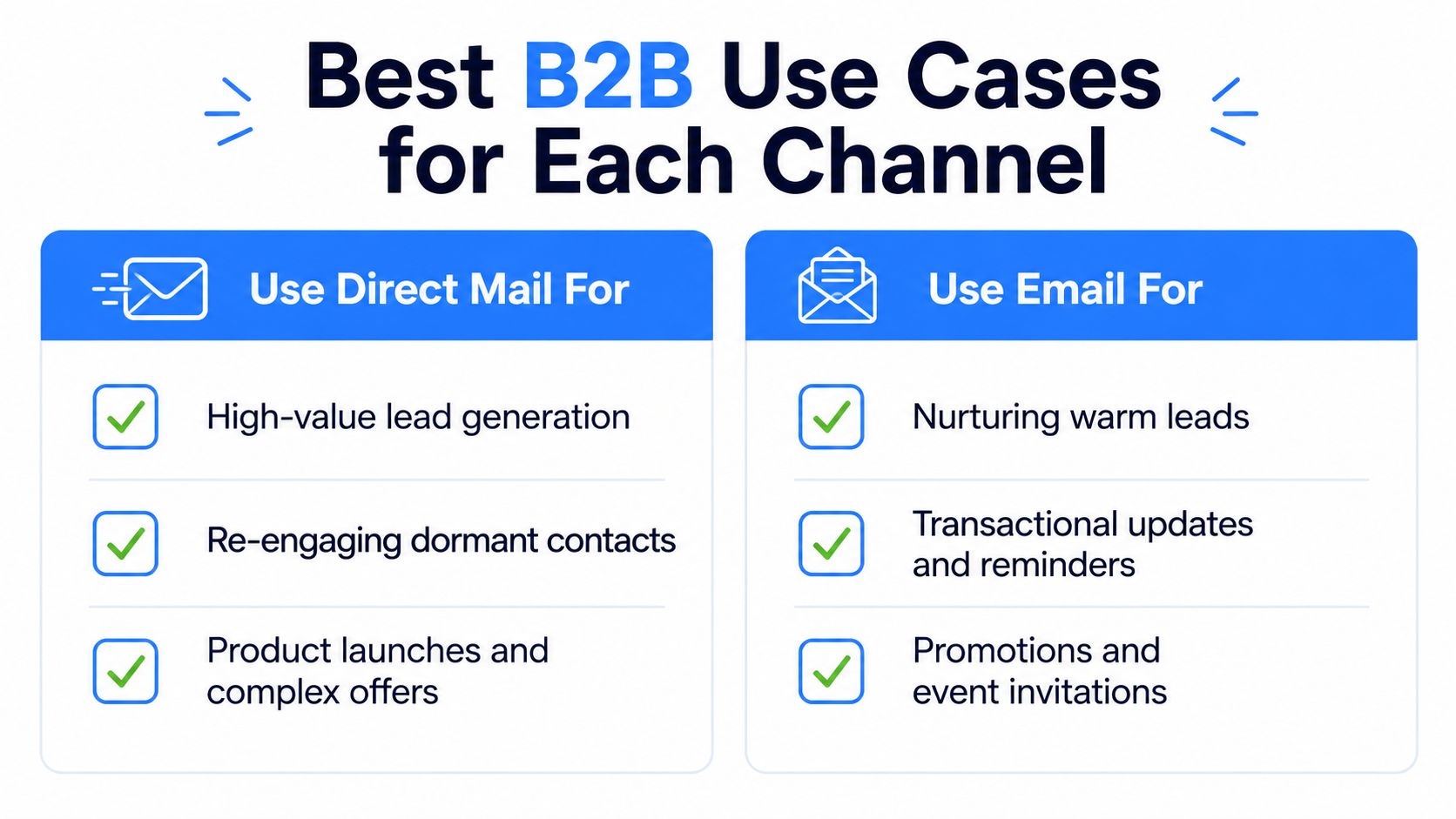
The right channel depends on the job the campaign must perform. Email is the default when the team needs to test demand, reach a broad account universe, or coordinate repeated follow-up. Direct mail deserves a defined role when the audience is valuable, the message benefits from physical presence, or digital touches alone haven't created enough recognition.
Use email for learning and coverage
Email is the stronger choice for cold outbound prospecting, especially when the team still needs to validate its ideal customer profile. Build a focused segment, test a few distinct messages, and watch for qualified replies rather than optimizing opens in isolation. The channel also works well for nurturing warm leads, event invitations, reminders, and transactional updates where speed matters.
It's particularly useful when:
- The market is new: Test industries, regions, and roles before investing in physical creative.
- The offer has multiple angles: Compare pain-point and outcome-led messages quickly.
- The sales cycle needs repeated education: Sequence useful proof, objections, and next steps.
- The team needs measurable iteration: Use replies, clicks, booked meetings, and pipeline stages to guide revisions.
Use direct mail for high-value attention
Direct mail is a better fit for named-account programs, late-stage nurture, dormant-contact reactivation, and complex offers that benefit from a physical explanation. It can also support product launches when a selected group of accounts deserves a more memorable introduction.
For teams planning account-based programs, these account based marketing use cases provide useful context for matching coordinated activity to account priorities. The key is to define the account list before designing the piece, then give sales a clear follow-up action.
- High-value lead generation: Reserve the spend for accounts where one credible conversation has meaningful commercial value.
- Re-engaging dormant contacts: Use a fresh physical reason to reopen a relationship, then make the next step digital.
- Product launches and complex offers: Give the recipient something they can review, share internally, or bring into a buying conversation.
Direct mail doesn't need to replace email. In most B2B programs, it works best as a selective layer on top of digital coverage. Choose it because the account or moment warrants physical attention, not because a benchmark headline looks impressive.
Building a Hybrid Multichannel Sequence
A hybrid sequence works when each touch has a distinct job. Sending the same pitch through email and postal mail creates repetition, not orchestration. The physical piece should establish recognition or provide something useful. Email should clarify the offer, handle objections, and reduce the effort required to respond.
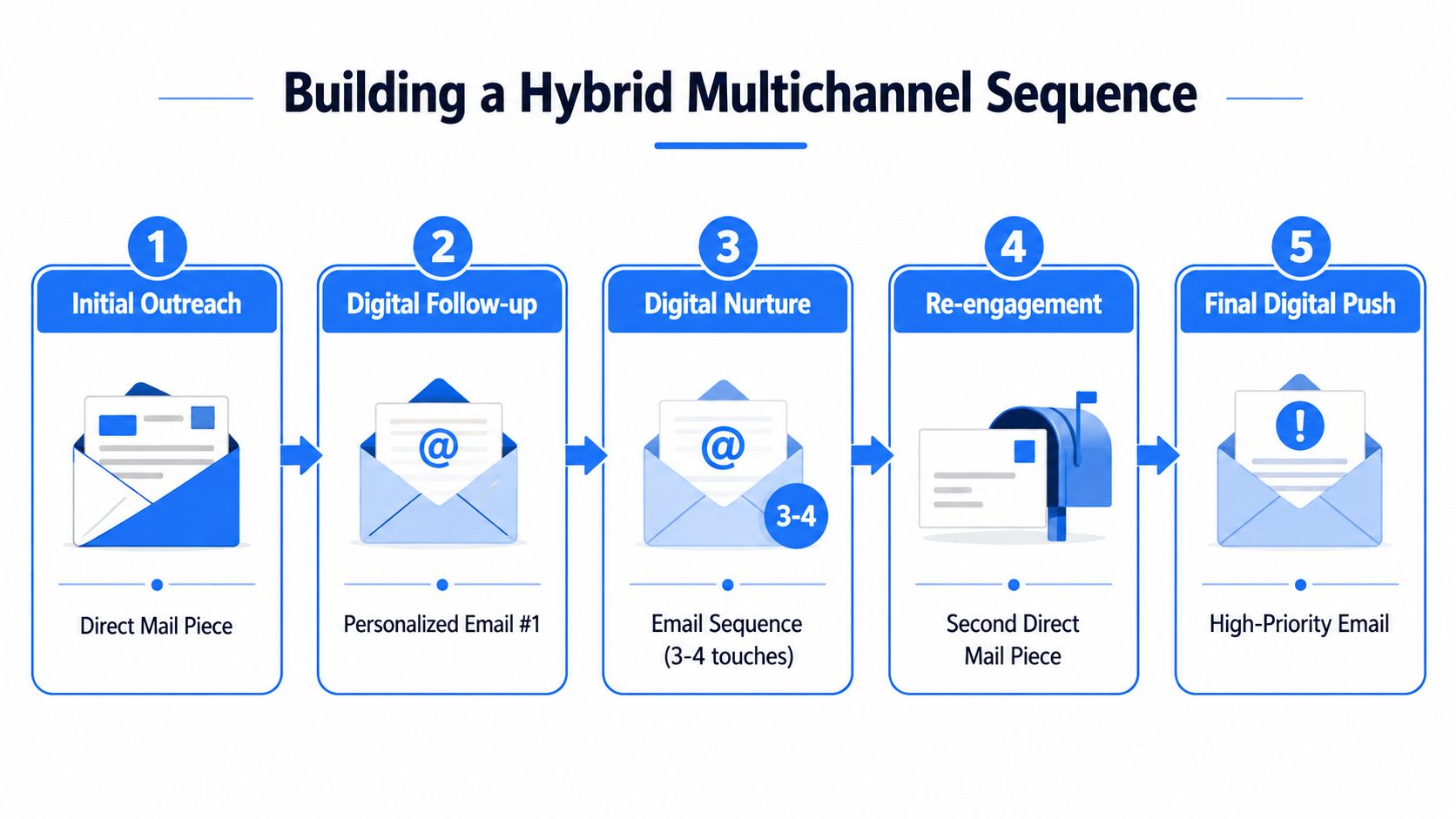
A practical five-touch design
- Initial outreach: Send a relevant direct mail piece to a carefully selected account. The message should make the recipient curious, not force a complicated response.
- Digital follow-up: Send a personalized email that explains why the piece was sent and connects it to a recognizable business problem.
- Digital nurture: Use a short email sequence to add context, answer likely objections, and offer a clear meeting or resource path.
- Re-engagement: Send a second physical piece only when the account remains strategically important or a new trigger justifies it.
- Final digital push: Close the sequence with a concise email that gives the recipient an easy yes, no, or later response.
Coordinate LinkedIn DMs carefully. A social touch can confirm identity or add context, but it shouldn't repeat the same copy. Sales ownership also matters. Someone must monitor replies, update the CRM, suppress contacts who respond, and hand qualified conversations to the right owner.
Good follow-up requires more than adding touches. Guidance on how to boost follow-up conversions can help teams tighten the handoff between initial interest and a scheduled conversation.
Sequence principle: Add a new reason to respond at each stage. Don't add another channel merely to increase activity.
Use a shared account-level view so email, LinkedIn, and direct mail aren't working against one another. The cross-channel lead generation approach is useful here because the campaign should be managed around the account and pipeline stage, not around isolated channel dashboards.
The strongest hybrid programs also set stop rules. Pause outreach after a clear reply, a request not to be contacted, a sales opportunity, or a change in account status. Multichannel doesn't mean permission to pursue indefinitely.
Measuring Performance Across Both Channels
A unified scorecard starts with the CRM, not the email platform or mail house. Track every recipient, touch, response, qualification decision, meeting outcome, opportunity, and revenue event against the same account and contact records.
Email provides direct digital signals such as replies, clicks, visits, and booked meetings. Direct mail needs response mechanisms that connect the physical piece to the same reporting system:
- Tracked landing pages: Use campaign-specific URLs that identify the audience and offer.
- QR codes: Send recipients to a mobile-friendly page with a clear conversion action.
- Unique codes or phone numbers: Give sales and operations a straightforward matchback path.
- CRM matchback: Compare mailed accounts with subsequent visits, replies, meetings, and opportunities, while recognizing that some recipients may respond without using the assigned mechanism.
Report the funnel, not isolated engagement
Use a common progression:
- Reach: Which valid accounts or contacts received the intended touch?
- Response: Which recipients replied, scanned, visited, called, or completed a form?
- Qualification: Which responses met your ICP and buying criteria?
- Sales acceptance: Which opportunities did the sales team accept?
- Pipeline: Which accounts created or influenced an opportunity?
- Revenue: Which closed outcomes can be connected to the campaign?
Avoid treating email opens or physical delivery as proof of commercial impact. They can help diagnose execution, but pipeline contribution and qualified meetings carry more decision value. Calculate cost per qualified opportunity and cost per meeting for each channel, then compare those figures with expected deal value and sales capacity.
To isolate direct mail's incremental effect, hold out a comparable group from the mailing while continuing the email program. Match the groups by account fit, audience temperature, and sales stage, then compare qualified responses and downstream pipeline. The test won't be perfect, but it gives you a more credible answer than asking recipients whether they remember the piece.
Review performance by temperature as well as channel. A cold prospect mailing, a warm customer reactivation, and a triggered account touch should never share one blended average. The useful result is a decision about where to allocate the next unit of budget.
Lead Printer builds B2B outbound programs around prospect research, email infrastructure, personalized sequences, LinkedIn outreach, qualification, and pipeline reporting, so teams can test email before adding selective physical touches. Visit Lead Printer to discuss a campaign that matches channel choice to audience temperature, account value, and sales capacity.